Best Bread Knives of 2026

Nothing takes the shine off a fresh loaf like a knife that can't cut it. A dull or badly shaped bread knife doesn't slice so much as crush, tearing the crust and compressing the crumb into a ragged, crumbly mess. The right one glides through a crackly sourdough and still handles a delicate layer cake without shredding it. Over the past four months, my team and I sliced our way through 14 bread knives to find the ones that genuinely do both.

Serration shape turns out to matter more than the label on the blade. Deep, widely spaced scallops grab a hard crust and hold on, while fine, tight teeth skate right across a sourdough, though they're gentler on cake and tomatoes. Blade length is the other quiet decider: a long knife clears a wide, domed boule in one stroke, and an offset handle keeps your knuckles off the board by the fourth slice.

The picks below run from long blades built for wide loaves to compact ones for sandwiches and everyday toast, but they share one thing: they cut clean on day one and were still cutting clean months later.

Our Top Picks

The 8 Best Bread Knives of 2026

1

Mercer Culinary Millennia 8-Inch Bread Knife Best Overall

Mercer Culinary M23208 Millennia Black Handle

Everyday bread slicing

Our Score 99/100
Edge
Wavy serrated
Handle
Textured Santoprene
Weight
6.4 oz
Blade Length
8 inches
View on Amazon

The scallops on the Millennia are wide and shallow — closer to waves than teeth — and that's the detail that decides how it cuts. The points break the crust, the gaps between them carry the crumbs clear, and the crumb underneath stays put instead of compressing under the blade. On a dark sourdough boule we got slices that held their shape, and the knife tracked straight because the steel behind the edge is stiff rather than springy.

That stiffness is why this is the knife we hand most people. It's one piece of stamped high-carbon steel with no bolster to work around, so the serrations are usable right to the heel and the tip, and the blade doesn't wander halfway down a dense loaf. The Santoprene handle carries the rest of the argument: textured, slightly soft, with finger points that keep a wet hand from sliding forward onto the edge.

Wash it by hand and dry it before it goes back in the drawer. That's the maker's instruction, and it's the habit that keeps the points from dulling early — a dishwasher cycle is the quickest way to take the bite off a serrated edge. Set against that is a limited lifetime warranty and a price that leaves room for a second, longer knife if you bake boules as well as sandwich loaves.

Eight inches is the ceiling, though. A boule wider than the blade means sawing from both sides and hoping the cuts meet, and that is the one job the 10-inch Piklohas handles better. Everything from sandwich loaves to bagels, it takes in a single clean pass.

Worth Noting

  • 8-inch blade runs short on very wide boules
Our Verdict

For most kitchens this is the bread knife to buy: a stiff wavy edge that cuts clean, a grip that stays put, and a price that leaves room for a second knife.

Check Latest Price
2

Victorinox Fibrox 8-Inch Bread Knife Best Upgrade

Victorinox Swiss Army 8" Serrated Bread Knife with Fibrox Handle

Daily long-term use

Our Score 98/100
Steel
Ice-tempered high-carbon stainless
Handle
Fibrox rubber
Weight
3.5 oz
Blade Length
8.3 inches
View on Amazon

The Fibrox costs more than twice what our top pick does, and you're paying for steel and a handle rather than a different shape of cut. What the extra money buys: an ice-tempered high-carbon blade with a conical grind, a bolsterless edge you can use all the way to the heel, an NSF-approved handle, and the reassurance of a knife that professional kitchens buy by the case. Daily slicers who are tired of replacing knives are the ones we send here.

At 8.3 inches and 3.5 ounces it's the lightest full-size knife in this group, and that lightness is most of its character. It moves through a loaf with almost no downward pressure, which is exactly what you want on soft sandwich bread and slightly less than you want on a punishing crust — lean on a well-fired boule and the blade will flex. Start at the heel with a light sawing stroke and the flex stops mattering.

Edge retention is where the money actually goes. Of the knives here, this one has the strongest claim to going months of daily bread without a touch-up, and the Fibrox handle — textured, slightly tapered, a little soft — is the most secure grip in the group, particularly for smaller hands. It's also the knife we hand to guests who don't know their way around a blade.

Worth Noting

  • Costs far more than the other stamped knives here
Our Verdict

We point daily bread bakers here when the budget stretches: better steel, a better grip, and an edge that keeps its bite through months of crusty loaves.

Check Latest Price
3

Piklohas 10-Inch Resharpenable Bread Knife Best for Large Boules

Piklohas 10-Inch Resharpenable Bread Knife – Resharpenable Bread Knife for Homemade Bread

Wide sourdough boules

Our Score 97/100
Edge
Resharpenable serrated
Handle
Offset ABS
Weight
15.8 oz
Blade Length
10 inches
View on Amazon

Every serrated knife goes dull eventually, and almost none of them can be brought back: the scallops defeat a whetstone, and a pull-through sharpener just rounds the points. This one is built around the opposite idea. The patent covers a serration profile you can touch up with an ordinary honing rod, so the knife is meant to keep cutting long after a conventional one would have been retired to the camping box.

Everything else is aimed at big loaves. Ten inches of blade, a raised offset handle that keeps your knuckles off the board when you cut all the way through a boule, and hollow grooves down both faces so a moist crumb releases instead of clinging. At 15.8 ounces it is by far the heaviest knife here, and the weight does real work: it drives through a tough crust with less push from you than any of the 8-inch knives in this group.

We like it best for the loaves the shorter knives struggle with — a wide boule cut into sandwich-thin slices in one pass, no sawing back and forth, no lifting to reposition. It takes a deliberate, straight pull to keep the slices level, and after a dozen cuts you notice the heft in your forearm. It arrives in a sturdy box, which is where ours lives between bakes.

Worth Noting

  • 15.7 inches overall won't fit a standard knife block
Our Verdict

Buy this one if you bake wide boules and plan to keep the same knife for years — the offset handle and the resharpenable edge are worth the drawer space.

Check Latest Price
4

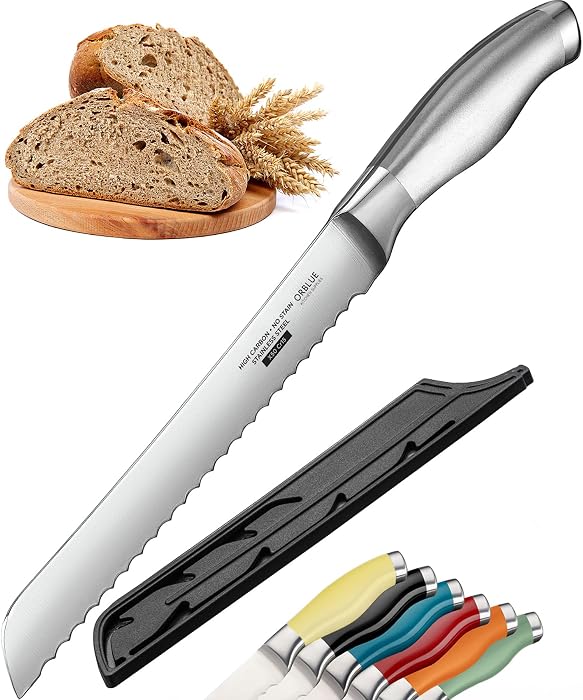
Orblue 8-Inch Serrated Bread Knife Best Budget

Orblue Serrated Bread Knife with Upgraded Stainless Steel Razor Sharp Wavy Edge

Tight kitchen budgets

Our Score 96/100
Handle
5-inch stainless steel
Warranty
Lifetime replacement
Blade Length
8 inches
Construction
One-piece stainless steel
View on Amazon

There is no seam anywhere on this knife. Blade, bolster, and handle are stamped from a single piece of stainless steel, so there are no scales to loosen, no rivets to trap flour, and no joint where water sits after a wipe-down. For a tool that gets rinsed between loaves and put away damp more often than anyone admits, that simplicity is worth more than it sounds.

The value is the other half of it. The 8-inch blade is thin — 2.2 mm — with a fine wavy edge that went through warm sourdough and bagels without tearing the crumb, and it sits nicely balanced in the hand, which suits a sawing stroke. The five-inch handle gives you room to choke back when you hit a hard crust.

Care is the thing to know going in. Thin stainless left wet can spot, so the maker's answer is hand washing and immediate drying rather than the dishwasher, which is also the fastest way to blunt the serrations. Do that and the lifetime replacement warranty is insurance you probably never use.

Worth Noting

  • Smooth steel handle is slicker than a rubberized grip
Our Verdict

The one-piece steel is what we recommend here: nothing to loosen, nothing to trap flour, and a sharp 8-inch edge for the least money in this group.

Check Latest Price
5

KUTLER 14-Inch Bread Knife Best Extra-Long Blade

KUTLER Professional 14-Inch Bread Knife and Cake Slicer with Serrated Edge

Oversized loaves and cakes

Our Score 95/100
Edge
Wavy serrated
Handle
Textured non-slip plastic
Weight
9.6 oz
Blade Length
14 inches
View on Amazon

Fourteen inches is less a bread knife than a bread saw, and the first thing to decide is whether you have a job that needs one. Laid beside an 8-inch blade it looks absurd — until you put it against a wide boule or a full sheet cake and cross the whole thing without lifting or repositioning. That single pass is the entire case for it, and it makes this the pick for anyone who bakes large or slices for a crowd.

The blade is high-carbon stainless with a wavy serrated edge, narrow behind the teeth so it follows them through the loaf instead of dragging, and stiff enough that the extra length doesn't whip. Once the cut is started it's steady rather than unwieldy, and the textured plastic handle gives you a full grip, which matters because a 14-inch knife asks for more leverage than an 8-inch one.

It's also the knife that makes a bread slicer jig worth owning: the length is what lets the blade sit in the guides and produce even slices, where a 10-inch knife fouls the frame with its handle. Cake tiers, pineapple, and party-size loaves fall into the same category — anything wider than an ordinary board.

At 9.6 ounces it balances further forward than the shorter knives here, so it doesn't feel like swinging a sword, but it is bigger than most people picture when the box arrives, and it needs a long drawer or a wall strip. The 90-day warranty is also the shortest in this group.

Worth Noting

  • No sheath or guard in the box
Our Verdict

We recommend this one for cooks who bake large or slice for a crowd: nothing else here crosses a wide boule or a sheet cake in a single stroke.

Check Latest Price
6

Cuisinart Triple Rivet 8-Inch Bread Knife

Cuisinart C77TR-8BD Triple Rivet Collection 8" Bread Knife

First bread knife

Our Score 94/100
Handle
Triple-riveted
Included
Blade guard
Blade Length
8 inches
Construction
Forged, full tang
View on Amazon

Cuisinart ships this one with a rigid blade guard in the box, and it's the only pick here that does. That sounds like a trinket until the knife lives in a drawer with everything else: the guard keeps the serrations off your other tools and keeps your fingers off the serrations.

The knife itself is the most traditional build in this group — forged high-carbon stainless, a full tang pinned with three rivets, and an extra-wide bolster between handle and edge. The bolster gives you something to choke up against and makes the blade feel planted rather than whippy, and the riveted handle has the heft and shape of a knife your parents owned.

It's at its best where the weight does the work and the slices need to come out level, and between the guard, the forged build, and a lifetime warranty, it's the sensible first bread knife for a household that goes through a loaf a week rather than a bakery's worth.

Worth Noting

  • Happier on sandwich loaves and cake than on hard-crust sourdough
Our Verdict

We suggest this for a first bread knife in a household that goes through a loaf a week — the guard and the forged build make it easy to live with.

Check Latest Price
7

Tojiro F-737 Bread Knife Best for Thin, Delicate Slices

Tojiro Japan Hand Made Bread Knife Slicer Cutter

Thin, delicate slices

Our Score 93/100
Steel
Stainless
Handle
Natural wood
Weight
3.9 oz
Blade Length
9.3 inches
View on Amazon

At 3.9 ounces this is the lightest knife in the group by a wide margin, and it changes the feel of a cut: the wood handle sits back in the palm and the blade seems to lead rather than be pushed. On a tall loaf of homemade bread it goes through in a couple of light strokes with almost no downward force from you.

The 9.3-inch serrated blade is forged from Japanese stainless with a full tang and a natural wood handle, and it cuts on a draw stroke rather than pressure — start at the heel, pull, and a crusty baguette parts in two passes. It's the most precise blade here for thin, even slices, the kind that fold over instead of breaking.

The wood is also the part to think about. It's warm, comfortable, and far better looking than the plastic on the workhorse knives here, but it is wood on a knife that gets wet several times a day. Set next to the Fibrox, this is a knife for the table rather than the prep sink, and it should be treated that way.

We think it earns its price for bakers who slice at the table and want the knife to look the part — the thin blade makes translucent slices where the heavier knives leave wedges. For a family going through a loaf a day, the Millennia's stiffness and easy care will hold up better.

Worth Noting

  • Thin blade flexes in dense, heavy loaves
Our Verdict

We keep this one for bakers who slice at the table and want the thinnest, most precise cuts here — light, handsome, and a little delicate.

Check Latest Price
8

HOSHANHO 8-Inch Bread Knife Best for Countertop Looks

HOSHANHO Bread Knife 8 inch

Countertop looks

Our Score 92/100
Steel
Japanese 10Cr15CoMoV
Handle
Pakkawood
Edge Angle
15 degrees
Blade Length
8 inches
View on Amazon

HOSHANHO sharpens this blade to 15 degrees and makes a point of it, which is a shallower edge angle than most Western kitchen knives carry. On a serrated blade that shows up as points that are genuinely sharp rather than merely pointed: the knife bites into a sourdough crust with almost no downward pressure, and it takes on a tough rye the same way.

The steel is Japanese 10Cr15CoMoV, vacuum heat-treated, and the blade is forged rather than stamped. What you notice first is the solidity — the full tang and pakkawood scales give it a planted feel the stamped knives here don't have — and at 8 ounces it is heavier than the other 8-inch picks, with enough weight forward to help on a hard crust.

Eight inches turns out to be the right length for a Dutch oven boule, which is clearly the loaf this knife was designed around: a wide slice comes off clean and the crumb stays intact. The pakkawood handle is the best-looking in this group, and it fills the hand rather than gripping it the way textured rubber does.

What you're paying for is steel, finish, and balance rather than a fundamentally better slice. We think it suits someone who wants one handsome tool on the counter and doesn't mind hand care. In a shared kitchen where the knife gets grabbed by whoever is closest, the Millennia's grip and price make more sense.

Worth Noting

  • The most expensive 8-inch knife here
Our Verdict

This is the one we hand someone who wants a single handsome knife on the counter and is willing to pay premium money for steel and finish.

Check Latest Price

How We Chose and Tested the Best Bread Knives

Our shortlist started wide: every serrated bread knife we could get our hands on, from 8-inch Japanese-style blades to long slicers with offset handles, in stamped and forged designs, with wood, plastic, and riveted handles. We filtered by steel type, how the handle was attached to the blade, blade length, and price, so the final group of 14 ran from budget to splurge.

Those 14 knives then lived in our kitchens for four months. We cut crusty sourdough with a dark, hard bake, soft sandwich bread, dense rye, bagels, tomatoes, pineapple, and layer cake. To judge cutting performance rather than guess at it, we weighed the crumbs left on the board after every loaf and looked at the cut face: a clean slice leaves a smooth crumb and almost no debris, while a dull or flexing blade compresses the bread before it parts it. We counted the strokes a loaf took and noted whether the knife bit on contact or skated across the crust first.

Functionality came down to shape. We measured the depth and spacing of the scallops, checked blade length against the width of a domed boule, and watched whether an offset handle kept our knuckles off the board at the bottom of a slice. For quality and durability, we hand-washed each knife after every use, ran the ones whose makers allow it through the dishwasher, and checked for rust spots, loose rivets, and handles that shifted under pressure. Sharpness was retested with paper and a ripe tomato at the start, middle, and end of the four months, and we set all of that against price, because a knife that needs sharpening by month two costs more than its sticker suggests.

How to Choose a Bread Knife

Match the blade to the loaf, then to the drawer

Eight inches is the all-purpose length and the easiest to control; it covers sandwich loaves, baguettes, and most round boules. Move up to 10 inches when your boules are wider than the blade, because a single pass keeps slices level and avoids the mismatched seam where two cuts meet. Fourteen inches belongs to people with a slicer jig, a sheet-cake habit, or a crowd to feed. Before you order anything longer than 10 inches, measure the drawer or the block slot — a 15-inch knife doesn't go where an 8-inch one did.

Serrations and blade stiffness

Wide, shallow scallops are the better all-round pattern: the points break the crust, the gaps carry crumbs clear, and the crumb underneath stays intact. Fine teeth do lovely work on cake and soft sandwich bread but struggle on a hard crust. Stiffness matters as much as tooth count. A thin blade glides through a baguette and flexes inside a dense whole-wheat loaf, which is how you end up with a slice that leans; a heavier spine tracks straight but asks for more push. Decide which loaf you bake most and buy for that one.

Handles: textured rubber, smooth steel, or wood

Grip is the underrated part. Textured rubberized handles stay put under a wet hand, which matters when you slice warm bread straight from the oven. Smooth stainless is easier to wipe down and looks sharper on a counter; wood is the nicest in the hand and the most demanding to keep. Then there's straight versus offset: an offset handle lifts your knuckles above the board so you can cut all the way through without hitting the surface, and it earns its place if you slice on a board every day. If you cut over a deep board or in the air, a straight handle is simpler.

Care, storage, and sharpening

Hand wash and dry a serrated knife. A dishwasher cycle dulls the points and, on thinner stainless, leaves rust in the scallops. Store it in a guard, a slot, or on a magnetic strip rather than loose in a drawer where the teeth knock against everything else. Then accept the sharpening problem: a serrated edge can't be honed like a plain one, and most home sharpeners simply round the points. A rod run along the flat side buys time, and one knife here, the Piklohas, is built to be resharpened that way.

Frequently Asked Questions

Final Verdict

We buy the Mercer Culinary Millennia 8-inch. It has the stiffest, most forgiving wavy edge in this group, a handle that stays put with wet hands, and it produces thin, even slices without a fight — the three things that still matter when the loaf is on the board.

If you want one knife to survive a decade of daily use in a shared kitchen, the Victorinox Fibrox buys you better steel and a more secure grip for a lot more money. If your boules are wider than a blade, the 10-inch Piklohas is the shape you want, and it's the only one here you can bring back to sharp.