Best Bread Makers of 2026

A bread machine only earns its counter space if you're still using it in month three. The first loaf is a thrill — the house smells like a bakery — but the tenth loaf is where a machine reveals itself: whether the crust browns evenly, whether the paddle leaves a crater in the bottom of the slice, and whether you dread scrubbing the pan at 10 p.m. That's the difference between a machine you love and one that ends up in the basement next to the quesadilla maker.

Over the past eight months, my team and I have baked through 10 machines, from compact 1-pound models to 2-pound stainless steel workhorses, running sandwich loaves, whole wheat, gluten-free cycles, dough, and jam. Two things I've learned: the delay timer is the most underrated feature on the box — load it before bed, wake up to warm bread — and loaf size matters more than program count, since a 2-pounder is a lot of bread for two people. The picks below cover both ends, plus everything in between.

Our Top Picks

The 6 Best Bread Makers of 2026

1

KITCHENARM 29-in-1 Best Overall
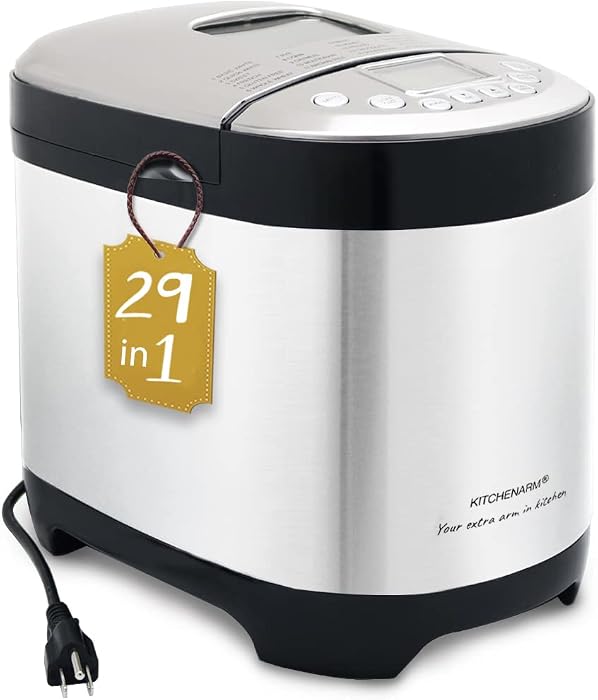
KITCHENARM 29-in-1 SMART Bread Machine with Gluten Free Setting 2LB 1.5LB 1LB

First-time bakers

Our Score 93/100
Weight
9.6 lb
Capacity
1, 1.5, or 2 lb
Programs
29
Footprint
14.2"D x 8.9"W x 12"H
View on Amazon

The booklet is why we recommend this machine. KITCHENARM ships a written manual with recipes that hold up, plus a walkthrough for building a sourdough starter from scratch, and that is what a new baker leans on during the first few Sundays. It is the difference between a machine that gets used twice and one that earns permanent counter space.

The hardware backs it up. Two pounds is the ceiling, but you can set it to one or 1.5, and the body is narrow, under nine inches across, so it tucks beside a toaster instead of taking over the run. At 9.6 pounds we lifted it out of the way with one hand, which is more than we can say for either Zojirushi here.

We ran the basic and whole-wheat cycles most, and the top of the loaf browned evenly rather than going pale in the middle, which is what a 550-watt element and a lidded stainless box are for. Cleanup is the quiet win: the nonstick pan wipes out with a sponge and nothing about it needs a second pass.

Two details earned their keep. The memory holds your last menu, loaf size, and crust color, so the second loaf takes three button presses instead of eight. And the warranty runs two years, twice the coverage on either Zojirushi, which matters in a category where the pan and the heater are usually what give out.

Worth Noting

  • More programs than most bakers will use
Our Verdict

The one we tell most first-time bakers to buy: recipes that actually work, evenly baked loaves, and a body narrow enough for a small kitchen.

Check Latest Price
2

Zojirushi Virtuoso Plus Best Splurge

Zojirushi Bb PDC20BA Virtuoso Plus 2 Lb Breadmaker

Gluten-free loaves

Our Score 92/100
Weight
24 lb
Heating
Dual heaters
Capacity
2 lb
Footprint
10.5"D x 18"W x 12.87"H
View on Amazon

This is the most expensive machine in the guide, and the money goes somewhere specific: two heaters, one under the pan and one in the lid, and two kneading blades instead of one. Even browning top and bottom is the visible payoff. The less visible one is dough that gets turned over consistently, which is what carries rye, multigrain, and other heavy flours through a full rise.

The menu is the other reason to look here. Gluten free, salt free, sugar free, vegan, and rapid whole wheat are separate courses rather than one vague specialty button, and the gluten-free results are the most convincing in this group. We take that seriously, because gluten-free dough fails loudly and a dedicated cycle paired with heat from both ends is the difference between sandwich bread and a brick.

What we minded was the footprint, not the bill. At 24 pounds and 18 inches across it needs a permanent home with clearance overhead for the lid, and you will not be lifting it into a cupboard between bakes. Give it a spot where it can stay and it behaves like a built-in.

The rapid course turns out a loaf in 2 hours 25 minutes, which covers a weeknight, and the 13-hour timer covers an early morning. The course key is printed on the lid, a low-tech touch that turns out to matter more than a touchscreen when your hands are covered in flour.

Worth Noting

  • One-year warranty at a premium price
  • Paddles can stay lodged in the loaf
Our Verdict

If gluten-free or vegan loaves are why you are shopping, this is the machine we trust with them.

Check Latest Price
3

Zojirushi Home Bakery Mini Best 1-Pound Loaf

Zojirushi Bb HAC10 Home Bakery Mini Breadmaker

Small households

Our Score 91/100
Wattage
450 watts
Capacity
1 lb
Programs
9
Footprint
11.25"D x 8.5"W x 12.25"H
View on Amazon

One pound is the whole idea here, and Zojirushi commits to it. There is no second size and no larger pan, just a small loaf that two people finish before it stales, which is the usual problem with a bread maker in a small household. At 8.5 inches wide it is the smallest machine we recommend, and the carrying handle means it can live in a cupboard and come out on baking day.

Quiet is the next thing you notice. Kneading is the loud part of any cycle, and this one keeps it to a low whir rather than a grind, steady enough that a 13-hour delay set for early morning will not carry through the house. The nine programs cover the ground that matters: basic white, whole wheat, quick, dough, jam, and cake.

There is no second size, so a bigger household needs two bakes or a different machine. That is the boundary rather than a flaw, and it is the reason the loaf turns out as well as it does. One last detail sold us: the basic white bread recipe is printed on the side of the machine, so the first loaf does not start with a hunt for a booklet.

Worth Noting

  • Pan coating can peel with heavy use
Our Verdict

For one- and two-person kitchens, this is the machine we keep coming back to: small loaves, little counter space.

Check Latest Price
4

OSIPOTO 17-in-1 Bread Maker Best Budget

OSIPOTO 17-in-1 Bread Maker – 2LB Bread Maker

Budget kitchens

Our Score 90/100
Weight
11.7 lb
Wattage
600 watts
Capacity
2 lb
Programs
17
View on Amazon

A low price on a bread maker usually costs you guidance, and that is exactly where this one cuts. The hardware is all here: 17 programs, a two-pound pan, and a 15-hour delay timer with keep-warm. The booklet reads like it was translated twice, though, and the recipes inside are the first thing to ignore.

Start with a recipe you already trust instead, weighed rather than scooped, and the machine settles down and behaves. We found the buttons plainly labeled and the nonstick pan easy to wipe out, and the stainless body looks like it cost more than it did. On the basic cycle the loaf comes out with a decent crust and a soft middle, which is the entire job.

Where it stands against the rest of this group: two pounds of capacity, three loaf sizes, and a keep-warm hour that means a loaf set for early morning is still warm at breakfast. It also weighs under 12 pounds, so it moves easily between cupboard and counter when the baking mood comes and goes.

Worth Noting

  • Parts can fail within a year of steady use
Our Verdict

Our pick for anyone spending less: solid loaves and simple cleanup, provided you bring your own recipes.

Check Latest Price
5

KBS Pro 710W Best Ceramic Pan

KBS Pro 710W 2.2LB Bread Maker

Nut breads

Our Score 89/100
Pan
Ceramic
Weight
14.7 lb
Wattage
710 watts
Programs
17
View on Amazon

The ceramic pan is the reason to pick this one over the others. KBS coats the pan and paddle in ceramic rather than PTFE, which matters if you would rather not have a nonstick coating scraping into your bread, and it releases a loaf as cleanly as any pan here. The automatic dispenser is the second draw: nuts, seeds, and raisins drop in at the right point in the cycle instead of sitting in the dough for an hour.

The rest is generous. Seventeen programs plus one you can set yourself, three loaf sizes, three crust colors, a 710-watt motor, and a 15-hour timer. The tempered glass touch panel looks like a piece of equipment rather than an appliance. At 14.7 pounds and nearly 14 inches wide it is substantial on the counter, and we noticed the footprint more than the weight.

Where it loses ground is the paperwork. The manual reads like a translation and the recipe measurements are the kind of confusing that sends you out to buy a scale. Use it for the machine's cycles and get your recipes elsewhere. We were also pleasantly surprised by the 15-minute power recovery, which picks a cycle back up after a brief outage and is more useful than it sounds in an old kitchen.

Worth Noting

  • Ceramic coating can flake with heavy use
Our Verdict

Where seeded and nut breads are the point, we choose this one: the dispenser and ceramic pan earn their keep.

Check Latest Price
6

Cuisinart Convection CBK-210NAS Best for Artisan Crusts

Cuisinart Convection 2 Lb. Programmable Bread Maker Machine

Artisan crusts

Our Score 84/100
Wattage
800 watts
Capacity
2 lb
Programs
16
Mix-in Dispenser
3/4 cup
View on Amazon

A convection fan is the one feature here that nothing else in this group has. Cuisinart circulates air through the baking chamber, which is how you get a darker, more even crust from a machine rather than the pale-sided sandwich loaf most bread makers turn out. If the corner of the loaf is the part you eat first, this is the pick.

It is also the most automated of the six. The fruit-and-nut dispenser holds three-quarters of a cup and releases on its own, the paddle comes out with the included hook before the final rise, and the glass lid runs edge to edge so you can watch the whole thing happen. Sixteen programs include sourdough starter and low carb, a broader specialty menu than most machines carry.

The recipe book is the least reliable part of the package, so plan on a source you already trust. What balances that is the three-year limited warranty, the longest here by a full year, and in a category where pans and coatings are usually what fail, that coverage is worth real money over the life of the machine.

Worth Noting

  • Bakes a smaller loaf than the rating implies
  • Pan and paddle are fiddly to remove
Our Verdict

Crust is the reason we recommend it; no other pick here moves air around the loaf the way the convection fan does.

Check Latest Price

How We Tested 10 Bread Makers Over Eight Months

We started by pulling every bread maker we could find that was actually in stock, then narrowed the list by the things that change the baking: loaf sizes from 1 to 2.2 pounds, nonstick versus ceramic pans, crust color and size settings, automatic mix-in dispensers, delay timers, and whether the machine had a real gluten-free cycle rather than a gluten-free recipe in the booklet. That left 10 machines, which we baked with for eight months.

We kept two on the counter at a time and made at least six loaves in each: a white sandwich loaf on the manufacturer's program using its own recipe, then that same loaf from our formula to see how the machine handled something it wasn't tuned for, then whole wheat, gluten-free, and a dough or jam cycle. Every loaf cooled completely before slicing, and we looked at crumb, crust color, rise, and how big a hole the paddle left, then tasted it plain, toasted, and again three days later to see how fast it staled.

Ease of use got judged with the manual closed — how many presses to start a basic loaf, whether the countdown made sense, how the pan seated and released. Cleaning meant the pan, paddle, and shaft after every bake, noting which needed soaking and which wiped clean, and whether flour packed into lid seams or the dispenser chute. We tracked knead noise from the next room, and across eight months of repeated bakes we watched for scratched coating and motors that labored on stiff whole wheat dough. Each pick also had to justify its price against cheaper machines that simply got the basics right.

How to Choose a Bread Maker

Pick the Loaf Size You'll Actually Finish

A one-pound loaf suits one or two people who eat toast at breakfast. Two pounds feeds a family and covers sandwiches for a few days. Buying a two-pound machine for a one-pound habit mostly buys counter space, so start with the loaf you will finish before it goes stale.

Machines with selectable sizes let you scale week to week. The KITCHENARM, OSIPOTO, KBS Pro, and Cuisinart all bake one, 1.5, or two pounds. The Zojirushi Virtuoso Plus bakes two pounds and nothing smaller; the Home Bakery Mini bakes one pound and nothing bigger. Those two are for households whose size is settled.

Measure the Counter and the Space Above It

Footprints here run from 8.5 inches wide to 18, and weight from under 10 pounds to 24, which is the difference between an appliance that lives on the counter and one that gets stored. Width is the easy number to check. The one people forget is clearance above, because the lid hinges up and you still need room to lift a hot pan out with mitts.

Set the machine back from the counter edge as well. A stiff dough can make a light machine walk while it kneads, and a bread pan full of hot dough is not something to catch midair.

Buy the Programs You'll Use, Not the Count

A 29-program panel and a 7-course panel do the same core job. What earns its place is a gluten-free cycle if you need one, a dough cycle for pizza and rolls, and a timer that lets bread be waiting when you get up.

The deepest specialty menu here belongs to the Zojirushi Virtuoso Plus, with separate gluten-free, salt-free, sugar-free, and vegan courses. The Cuisinart adds a sourdough starter cycle that nothing else in the group has. Beyond that, a long program list mostly means more scrolling to find Basic.

Look at the Pan Before the Panel

Nonstick and ceramic pans both release a loaf; ceramic avoids a PTFE coating and is the reason to consider the KBS Pro. Whichever you choose, the pan coating is the first thing to wear, so hand wash it with a soft sponge and keep metal utensils away from it.

Expect to hand wash, period. None of these pans are meant for a dishwasher, and the few minutes it takes while the pan is still warm is the difference between a coating that lasts and one that flakes.

Weigh the Warranty Against the Repair

Bread machines fail at the pan, the coating, and the heating element far more often than at the electronics, and coverage varies more than it should: one year on both Zojirushi machines, two on the KITCHENARM, three on the Cuisinart.

Register the machine the week it arrives and keep the receipt somewhere you can find it. A coating that flakes in month fourteen is a warranty conversation, not a cleaning problem, and if you bake weekly the coverage belongs in your price comparison.

Frequently Asked Questions

Final Verdict

If you want one machine and no second thoughts, buy the KITCHENARM 29-in-1. It bakes an even two-pound loaf, comes with a manual and recipe set a beginner can actually follow, and carries a two-year warranty that neither Zojirushi matches.

Spend more for a specific reason: the Virtuoso Plus if gluten-free or vegan loaves are why you are baking, the Cuisinart Convection if crust is the point, and the Home Bakery Mini if one pound is all your household eats in a week.