Best Carbon Steel Knives of 2026

The first carbon steel knife I owned looked like a mistake within a week: gray patina, a blue streak from an onion, a fleck of orange at the pivot because I left it wet overnight. I still reach for it before every stainless blade in the drawer. Carbon steel takes an edge that feels almost unfair, comes back sharp after a minute on a stone, and pays you back for wiping it dry.

Over the past five months, my team and I have cooked, camped, whittled, and generally mistreated 16 carbon steel knives to see which ones are worth that bargain. Format splits the field first — a folder with a solid lock disappears into a pocket, while a fixed blade with a sheath is the one you hand to someone at a campsite. After that it comes down to blade thickness, handle shape, and whether the lock ever makes you hesitate mid-cut.

Rust is the question everyone asks, and the truth is that all of these will spot if you ignore them; what differs is how forgiving the finish and the grind are. Size and weight vary more than the specs suggest, so the picks below run from a knife you forget you're carrying to one that wants a job to do.

Our Top Picks

The 3 Best Carbon Steel Knives of 2026

1

Opinel No. 08 Carbone Best Overall

Opinel No. 08 Carbone

Everyday carry

Our Score 95/100
Lock
Virobloc locking collar
Handle
Beechwood
Blade Steel
XC90 carbon steel
Blade Length
3.28 inches
View on Amazon

The blade on the No. 08 Carbone is XC90 carbon steel, and the first thing it does is start to gray. Cut an apple, wipe it on your sleeve, and within a few days the flat of the blade wears a dull pewter film. That film is the bargain: with no chromium in the steel, a couple of minutes on a stone brings back an edge as fine as anything in this group, and it gets there faster than the harder steels do.

What sells us on it as the default is a 3.28-inch blade paired with a handle you forget you are holding. It is long enough to break down a pear or a wedge of cheese on a board and small enough that the whole knife vanishes into a jacket pocket. The Virobloc collar is a rotating ring rather than a button, and we like how little there is to it: twist, and the blade is locked solid; twist back, and it folds. The beech is warm in the hand and plain enough that pulling it out at lunch does not turn heads.

Opening is where the design asks for patience. The nail nick sits nearly flush with the handle, so the first weeks take a thumbnail and a small wiggle, and one-handed opening is not happening. It eases as the pivot wears in, and a drop of oil speeds that along — after a few weeks we stopped noticing it, because the thumbnail finds the nick on its own.

Worth Noting

  • Nail nick is shallow and slow to work
Our Verdict

We recommend the No. 08 Carbone to anyone who wants one light, inexpensive knife for a picnic, a package, and a pear; its carbon blade takes the finest edge here.

Check Latest Price
2

Morakniv Companion Best for Board and Camp Work

Morakniv Companion Carbon Steel Fixed-Blade Knife with Sheath

Board and camp

Our Score 94/100
Sheath
Polymer with belt clip
Blade Steel
1095 carbon steel
Blade Length
4.1 inches
Blade Thickness
0.08 inch
View on Amazon

If the No. 08 is the one that rides in a pocket, the Companion is the one that stays where the work is — on a board, in a pack, clipped to a belt. It is a fixed blade with 4.1 inches of 1095 carbon steel, and that extra length over the Opinel is the difference between trimming mushrooms and breaking down a chicken.

The number we keep coming back to is 0.08 inch, the blade's thickness. Stock that thin slices an onion instead of wedging through it, and it is a large part of why the knife weighs under four ounces with the sheath on. It also sets the limit: this is a cutter, not a pry bar, and the tip will not thank you for being used as a screwdriver.

The sheath is where we expected least and got most. The plastic is plain and there is nothing refined about it, but it snaps the knife in positively, and the belt clip is wide enough to sit on a pack strap rather than slide around it. That clip is the reason this one travels in a bag instead of a drawer.

It arrives biting into a tomato skin without pressure, and the steel is forgiving when it dulls — a few passes on a crock stick and it is back to shaving paper.

Worth Noting

  • Bare 1095 spots if put away damp
Our Verdict

The Companion is our pick when the knife stays by the cutting board: 4.1 inches of 1095 that slices cleanly, sharpens in minutes, and clips to a pack.

Check Latest Price
3

CIVIVI Mini Praxis

CIVIVI Mini Praxis Folding Pocket Knife

Pocket carry

Our Score 93/100
Lock
Liner lock
Handle
G10
Blade Steel
D2 tool steel
Blade Length
2.98 inches
View on Amazon

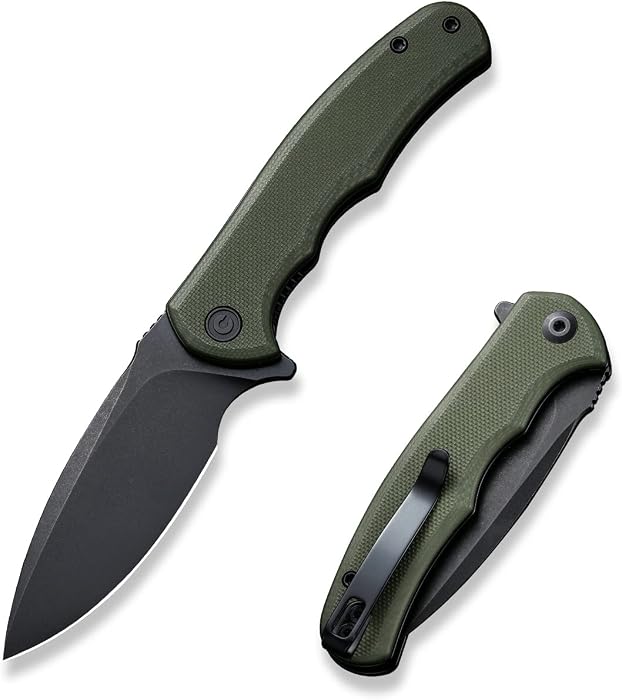
D2 is the odd steel in this group. It is a high-carbon tool steel with enough chromium in it to resist the spotting the other two pick up, so the Mini Praxis is the knife for someone who wants a carbon-steel edge without a nightly oil ritual. It is a different animal from the Moras and the Opinel, not a purer version of them.

What we appreciate most is how small the whole package is: a 2.98-inch blade in a 6.79-inch knife that sits at the bottom of a front pocket without a lump. The ball-bearing pivot flips it open with a thumb and it closes on a liner lock, which means one hand does all of it while the other is holding a bag of groceries. The G10 handle has a light texture that grips without chewing at a pocket seam.

One thing to check before you order: the knife is listed as right-handed, with the liner lock and clip set up for that grip, so a left-handed user fights the design on every opening. That is an easy call to make in advance and an annoying one to discover after the fact.

Where it earns its keep over the carbon blades is cardboard, which is what a pocket knife actually meets most days — the D2 keeps biting long after a plain carbon edge has gone smooth, and it does it without needing to be wiped down.

Worth Noting

  • Handle runs small for large hands
  • Short blade limits board work
Our Verdict

We think the Mini Praxis is the pick for a pocket knife you will not fuss over: D2 holds an edge through cardboard and shrugs off damp better than the plain carbon blades.

Check Latest Price

How We Tested Carbon Steel Knives

We began with a few dozen candidates pulled from retailer listings, outdoor forums, and the knives our own staff already owned, then cut the field down before buying anything. Two filters did most of the work: whether the blade was genuinely carbon steel rather than a stainless alloy with a misleading name, and whether the knife came in a format people actually carry — a locking folder or a fixed blade with a sheath. From there we compared handle material, blade thickness, and weight, and bought 16 knives spanning budget and mid-range.

Testing ran five months and happened wherever knives actually get used. In the kitchen we broke down onions, tomatoes, chicken, and bunches of parsley, noting how each blade bit into a ripe tomato and whether it steered or stuck. On camping trips we batoned kindling, carved feather sticks, cut rope, and prepped food on a tailgate cutting board. Folders rode in a front pocket for full days; fixed blades went on hikes and got passed around at camp. We opened and closed every folder one-handed dozens of times and checked for blade play afterward.

Rust resistance got its own routine. After each session we left half a blade wet with tap water and checked it 20 minutes later for spotting, and one knife from each group spent the night damp in its sheath or folded shut to see what a forgotten weekend looks like. Sharpness was measured in strokes, not adjectives: we dulled each edge on a ceramic rod, then counted passes on a stone to bring it back to slicing paper. Size and weight we judged with wet hands and gloved hands, and at the end we asked the simplest question — which one did we reach for when nobody was watching, and did it feel worth what it cost.

How to Choose a Carbon Steel Knife

The Upkeep Comes With the Blade

Carbon steel has no chromium shielding it, which is exactly why it sharpens so easily and exactly why it needs a routine. The routine is short: wash by hand, dry the blade before it goes back in a drawer or a sheath, and wipe a thin film of oil on it every few weeks. A dishwasher will strip the finish and start rust in the pivot.

We keep a rag by the sink for this and it costs about ten seconds. If that is a step you know you will skip, buy stainless instead — a neglected carbon blade is a worse tool than a cared-for stainless one.

Fixed Blade or Folding

Where the knife lives decides this. A fixed blade is stiffer, easier to clean because there is no pivot to trap food, and better over a cutting board or a camp stove; it also needs a sheath and takes up more room in a bag. A folder goes in a pocket, opens when you need it, and asks you to clean and oil the pivot now and then.

If most of its work happens at home, the fixed Companion makes more sense. If it leaves the house in a jacket, take the Opinel or the Mini Praxis.

Match the Blade to the Work

Lengths here run from 2.98 inches to 4.1, and those inches change the job. Under three inches is a pocket tool: boxes, tags, an apple, a bit of cheese. Three to three and a half inches is the useful middle — enough to break down a piece of fruit on a board, small enough to peel in your hand. Four inches and up is board and camp territory, better for a pile of onions and clumsy for detail work.

Pick the length for the job the knife will do most often, not the biggest job you can picture it doing.

Locks and Sheaths

A folding knife should lock open, and both mechanisms here are simple. The Opinel's rotating collar has almost nothing to fail and takes two hands; the CIVIVI's liner lock is faster and is built for right-handed use, so confirm the hand orientation before you order.

With a sheath, test retention before you trust it: hold the sheathed knife upside down over a sofa and shake it gently. One that drops out on the first shake should ride in a pack rather than on a belt.

Frequently Asked Questions

Final Verdict

For most people, the Opinel No. 08 Carbone is the one to buy. It is the lightest and least expensive of the three, its carbon blade takes the finest edge, and it moves from a picnic table to a jacket pocket without complaint — the stiff opening is the only tax.

If the knife will live on a cutting board or in a pack, the Morakniv Companion's 4.1-inch fixed blade earns its extra length. And if you want a one-hand folder you will not have to oil, the CIVIVI Mini Praxis is the modern answer.