Best Dehumidifiers for Bathrooms of 2026

A hot shower dumps a startling amount of water into the air. In a bathroom with one small window, that moisture has nowhere to go but into the grout, the towels, and eventually the ceiling paint. A dehumidifier pulls it back out before it settles in; the small ones sit on a vanity and hum along quietly, and the big ones will hold a damp basement at a set humidity.

Tank size is the spec everyone fixates on, and it's the least useful one. Ninety-five ounces sounds generous until you're dumping it twice a day in July; if there's a sink or a floor drain within reach, a continuous drain hose turns it into an appliance you forget about. My team and I have spent the past six months with 12 of them — compressor models, semiconductor models, and a cordless desiccant unit you recharge on a wall plug — and what separates the good ones is how much water they actually pull and how much noise you pay to get it. The picks below are sorted by that trade-off.

Our Top Picks

The 6 Best Dehumidifiers for Bathrooms of 2026

1

BEDRED 95-Ounce Dehumidifier Best Overall
BEDRED 95-Ounce Dehumidifier – Dehumidifier

Steamy full bathrooms

Our Score 90/100
Coverage
1,000 square feet
Dimensions
6.7 x 8.7 x 14.6 in
Power Draw
85 watts
Tank Capacity
95 fluid ounces
View on Amazon

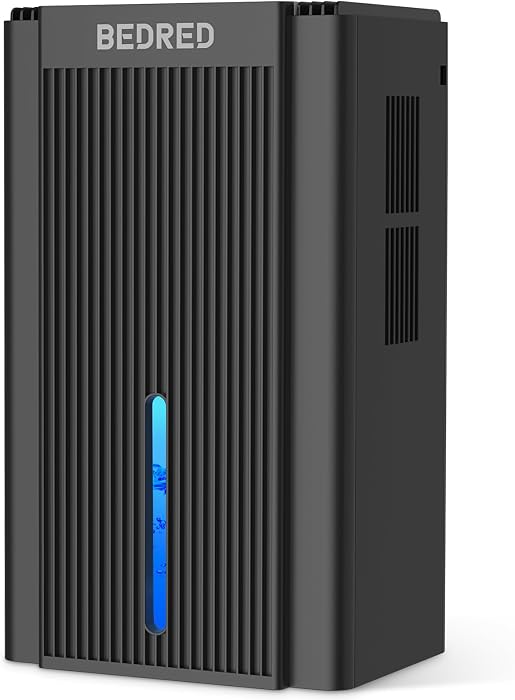
The 95-ounce tank is the first thing we look at on a bathroom unit, because it decides how often you are carrying water across the room. At 6.7 by 8.7 by 14.6 inches, this BEDRED is small enough to slide beside a vanity, but the tank is much larger than the 25- to 60-ounce bins on many compact models. We like that combination: it stays out of the way without asking for a refill every day. The sleep mode also turns off the ambient light and quiets the fan, which matters if the bathroom is next to a bedroom.

This is a thermoelectric dehumidifier, so it is the quiet, low-power type rather than a compressor. The 85-watt draw is modest, and the auto shutoff cuts power when the tank is full. We treat the 1,000-square-foot coverage claim as marketing math; in a bathroom, the useful measure is whether it keeps the mirror and grout from staying wet between showers. Run it with the exhaust fan, not instead of it.

If you want two fan speeds, the ToLife is more adjustable. For a typical bathroom, though, the BEDRED's larger tank and lights-out sleep mode are the simpler everyday choice. The tank lifts out from the top, and the unit's narrow side profile leaves room for a hamper or scale.

Worth Noting

  • No drain hose, so you empty by hand
  • Thermoelectric drying is slow in a freshly steamed room
Our Verdict

For a steamy bathroom, this is our default: the 95-ounce tank stretches time between empties, and sleep mode keeps it quiet and dark.

Check Latest Price
2

ToLife 95-Ounce Dehumidifier Best for Adjustable Airflow

ToLife 95-Ounce Dehumidifier

Adjustable airflow

Our Score 89/100
Dimensions
8.27 x 5.55 x 13.78 in
Power Draw
93 watts
Tank Capacity
95 fluid ounces
Moisture Removal
1 liter per day
View on Amazon

Two speeds sound like a small thing until you are sharing a bathroom with a shower schedule. The ToLife lets you run it on high after a steamy shower and switch to the quieter setting while you get ready. We prefer that flexibility to a single-speed unit, especially in a bathroom that is small enough for the fan noise to bounce off tile.

The 95-ounce tank is the same size as our top pick's, and the 1-liter-per-day rating is in the same class. We think this is the better pick for someone who wants to tune airflow rather than just set it and forget it. The built-in handles make it easy to move from bathroom to closet, and the 7-color light is there if you want a nightlight.

The controls are simple, and the tank lifts out without a fuss. We think the two-speed control is the reason to pick this over the BEDRED; the BEDRED's sleep mode is the reason to pick the other way. The unit is also light enough to carry to a closet when guests are coming.

Worth Noting

  • No drain hose included
  • Water collection can be modest in dry air
Our Verdict

Two fan speeds and a comfort setting make this a flexible bathroom pick, and we like the large tank and simple controls.

Check Latest Price
3

boglvr 98-Ounce Dehumidifier Best with Continuous Drain

boglvr 98-Ounce Dehumidifier – Dehumidifier for Home up to 1000 Sq.Ft

Drain-line setups

Our Score 88/100
Drainage
Drain hose included
Dimensions
7.88 x 6.25 x 13.98 in
Tank Capacity
98 fluid ounces
Moisture Removal
1 liter per day
View on Amazon

The included drain hose is the reason to consider this one. A 98-ounce tank is already generous, but the hose lets you run a gravity line to a shower drain or tub and skip the emptying routine. We like that for a bathroom where the unit can sit higher than the drain and the hose can run without a kink. If the only spot is lower than the drain, the hose does nothing and you are back to the tank.

The 8/16/24-hour timer is more useful than the light show: set it for a stretch after a shower and let it shut off. The 80-watt draw and 1-liter-per-day rating put it in the same small-bathroom class as the BEDRED and ToLife. The aroma slot is a nice extra, but it is not the reason to choose this unit.

The 98-ounce tank is the backup for the days you do not want to run a line. That is why it earns a spot for bathrooms with a drain nearby, not as the default for every bathroom. At 5.5 pounds, it is light enough to lift onto a shelf when floor space is tight.

Worth Noting

  • Some units stop working within days
Our Verdict

When you have a gravity drain, this is the one we point to: the included hose and 98-ounce tank make emptying far less frequent.

Check Latest Price
4

Waykar 34-Pint Dehumidifier Best for Serious Moisture

Waykar 34 Pints 2000 Sq. Ft. 2025 Energy Star Dehumidifier for Home

Chronic dampness

Our Score 87/100
Weight
28.7 lb
Dimensions
9 x 12.2 x 20.9 in
Tank Capacity
0.66 gallons
Moisture Removal
34 pints per day
View on Amazon

A 34-pint compressor is more machine than most bathrooms need—until the dampness is chronic. If your bathroom never fully dries, shares a wall with a basement, or has a shower that runs several times a day, the extra capacity changes the job from mopping up humidity to actually lowering it. That is a different assignment from a compact thermoelectric unit, and it is why this one earns a place here.

We like it for the bathrooms that need a real compressor: 34 pints per day, a 0.66-gallon tank, and a continuous drain hose. The hose is the setting we prefer for a bathroom with a floor drain, because the tank otherwise fills quickly in a wet room. The unit also has auto defrost and a washable filter, which are the maintenance details that keep a compressor working in a damp space.

The trade-off is size and weight. At 20.9 inches tall and 28.7 pounds, it takes up floor space that a small bathroom may not have. If you only need to take the edge off shower moisture, a 95-ounce thermoelectric unit is easier to live with. If the room stays damp all day, the Waykar's capacity is worth the footprint.

Worth Noting

  • Some units fail within the first year
Our Verdict

For chronic bathroom dampness, the 34-pint compressor and drain hose do the job a small thermoelectric unit cannot; we recommend it for that specific problem.

Check Latest Price
5

BREEZOME 60-Ounce Dehumidifier Best for Tight Spaces

BREEZOME 60-Ounce Dehumidifier – 60 OZ Dehumidifiers for Home

Tight bathrooms

Our Score 86/100
Weight
3.75 lb
Dimensions
6.26 x 8.62 x 11.34 in
Tank Capacity
1.8 liters
Moisture Removal
0.56 liters per day
View on Amazon

At 6.26 by 8.62 by 11.34 inches and 1.7 kilograms, this is the unit that disappears beside a vanity or on a shelf. That small frame is the point: in a tight bathroom, a 95-ounce model can crowd the sink, while this one leaves room for a towel bar. The 60-ounce tank is smaller, but it is still enough for a small room.

The dual semiconductor design is rated at 0.56 liters per day. In a small bathroom with a working exhaust fan, it is enough to take the edge off. We appreciate the 35dB sleep mode and the adjustable light, which make it easier to leave running near a bedroom.

The timer is the detail that makes it feel less like a bathroom appliance: 12, 24, 36, or 48 hours, so it can dry the room after a shower and then stop. We think that, plus the small footprint, is the reason to choose it over a 95-ounce unit when space is the deciding issue. The tank lifts out from the top, and the light can be locked to one color or turned off.

Worth Noting

  • Lower daily removal than the 95-ounce models
Our Verdict

A cramped bathroom is where this one earns its place: it is light, quiet, and timed, and we like that it tucks beside a vanity.

Check Latest Price
6

Eva-Dry E-333 Mini Dehumidifier Best for Tiny Enclosed Spaces

Eva-Dry Wireless Mini Dehumidifier

Tiny enclosed spaces

Our Score 85/100
Capacity
6 oz
Coverage
333 square feet
Dimensions
6.25 x 1.25 x 4.75 in
Moisture Removal
0.38 pints per day
View on Amazon

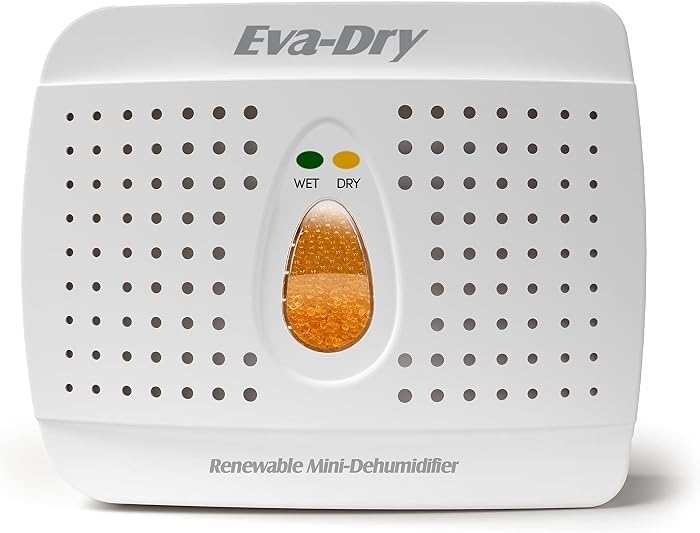
There is no cord, no tank, and no fan—just a small silica gel brick that hangs or stands in a corner. That is appealing for a tiny half-bath, a cabinet, or a closet where an outlet is not available. The catch is capacity: 6 ounces of silica gel and a 0.38-pint-per-day rating are not built for a full bathroom after a hot shower. This is spot protection, not a room dehumidifier.

The beads change from orange to green as they load up, and you renew the unit by plugging it into an outlet. That is simple, and the 5-year warranty is unusually long for a unit in this price class. The color change is the only signal you get, so check it before you trust it; there is no tank to empty or filter to replace.

For a small closed space, we think the low-effort trade-off is worth it: it is silent, cordless, and small enough to hang from a hook. The included hook is the detail that makes it useful in a cabinet, because it keeps the unit off the shelf and in the air. At 1.25 inches wide, it also hangs flat against a cabinet wall.

Worth Noting

  • Beads and recharge can stop working over time
Our Verdict

We keep this for a tiny half-bath or cabinet because it is cordless and silent, but it cannot keep up with a full bathroom after a shower.

Check Latest Price

How We Tested Bathroom Dehumidifiers

We started with every bathroom-sized unit we could get our hands on — 60-to-98-ounce tank models, drain-hose models, wall-rechargeable desiccant pucks, and one compressor unit rated for a couple thousand square feet — and dropped anything with a vague capacity claim or a tank you'd have to empty more than twice a day. That left 12 units, which ran for six months.

Each one went into rotation in a real home: a windowless half bath off a hallway, a shared bathroom where four showers land back to back, a damp corner of a laundry room, and the counter of an RV. For the bathroom runs we steamed the room with the door shut for ten minutes, then checked the mirror, the grout line at the tub, and the towel bar an hour later.

Water was the number we cared about most, so we weighed what each tank collected over a fixed two-hour window and set that against the price. Noise got two decibel readings — one at arm's length, one from the hallway with the door shut — plus notes on which fans whined or rattled. We let tanks fill until the auto-shutoff float tripped, timed a drain-hose install one-handed, and measured each footprint against a standard vanity top. Every unit also spent a night on a dark bathroom counter so we could see whether the seven-color light kept us awake and whether sleep mode truly went quiet. The cordless desiccant model got extra scrutiny: we counted the days until the beads shifted color and checked whether a wall recharge reset them.

We kept the strongest performers plugged in for the full six months to see what broke — cracked tanks, seeping hose fittings, a fan that picks up a rattle by month three — and whether the cheaper units held their value per ounce of water pulled.

How to Choose a Dehumidifier for a Bathroom

Match the Unit to the Bathroom, Not the Box

Bathrooms are small, repeatedly wet rooms, so a compact thermoelectric unit with a 60- to 98-ounce tank is usually the right shape. The 1,000-square-foot claims on some boxes are not a useful guide for a 5-by-8 bathroom; what matters is whether the unit can run long enough between showers to keep the mirror and grout from staying wet. A 34-pint compressor is the exception for chronic dampness, a bathroom that shares a wall with a basement, or a household where the shower runs constantly. If the room already has a working exhaust fan, you need less machine, not more.

Tank Size and Drainage

A 25-ounce tank can need emptying daily in a humid bathroom; 95 to 98 ounces buys you margin, but it does not make the unit self-emptying. A drain hose is the better fix if you have a floor drain, a tub, or a shower base below the unit's outlet. The hose works by gravity, so it will not help if the bathroom drain is higher than the dehumidifier. Before you buy a hose-ready model, check that the unit can sit above the drain and that the hose can run without a kink. The boglvr 98-Ounce is the clear example here.

Noise and Overnight Operation

Thermoelectric units are generally quieter than compressor models, but quiet is not the same as silent. If the bathroom is next to a bedroom, look for a sleep mode or a low fan setting, and check whether the display can be turned off. Auto shutoff is the other overnight feature that matters: it should cut power when the tank is full, not just when the float happens to rise. Test it once by filling the tank partway and listening for the click before you trust it in a room with a wood floor.

Passive Desiccant vs Powered

A passive silica gel unit like the Eva-Dry E-333 is cordless, silent, and useful for a closet, cabinet, or tiny half-bath. It absorbs a small amount of moisture and then gets renewed in an outlet. It is not a substitute for a powered unit in a bathroom with daily showers; the 6-ounce capacity is the giveaway. Choose passive for closed, small spaces and powered for a room that gets steamy. If you want one unit for both, start with the powered one and add a passive absorber for the cabinet under the sink.

Placement and Power

Put the dehumidifier on a dry, stable surface, not in the shower splash zone, and keep the cord away from the sink and tub. A bathroom outlet is the right place to plug it in; avoid extension cords and power strips in a wet room. Leave a few inches around the air intake and outlet so the fan can move air. If the only free outlet is next to the mirror, a unit with a lights-off sleep mode is easier to live with than one that glows all night.

Frequently Asked Questions

Final Verdict

For most bathrooms, we recommend the BEDRED 95-Ounce Dehumidifier. Its 95-ounce tank cuts down on emptying, sleep mode keeps the light and fan out of your morning routine, and auto shutoff covers the days you forget. If the bathroom stays damp even with the fan running, the Waykar 34-Pint is the step-up compressor; if you have a gravity drain, the boglvr 98-Ounce is the easier set-and-forget option.

For a tiny half-bath or cabinet, the cordless Eva-Dry E-333 is the right tool, not a full-bathroom dehumidifier.