Best Electric Knife Sharpeners of 2026

A dull knife doesn't just make dinner slower — it makes it more dangerous, because you end up sawing and pressing instead of slicing. An electric sharpener is supposed to fix that in under a minute. But most people who've tried one have a story about a scratched blade, a wavy edge, or a knife that came out shorter than it went in.

I've sharpened my own knives on a whetstone for years, so I came to this category skeptical. We spent nine months with 11 electric sharpeners, feeding them everything from a cheap grocery-store chef's knife to a good santoku and a serrated bread knife. The feature that matters most isn't motor power — it's whether the angle guides hold the blade steady, and how many stages you get between coarse grinding and a final polish.

Those are the things that decide whether a sharpener earns counter space or lands in a drawer. The picks below run from simple two-stage machines you can hand to a first-timer to adjustable models built for pocket knives, shears, and garden tools.

Our Top Picks

The 7 Best Electric Knife Sharpeners of 2026

1

Chef'sChoice 15XV EdgeSelect Best Overall
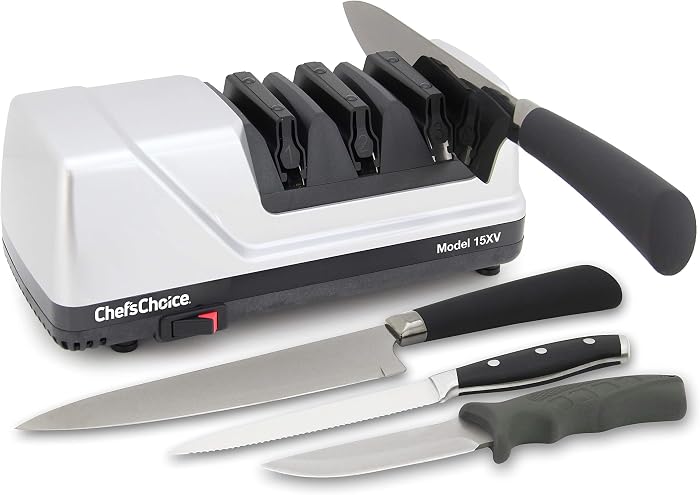
Chef’sChoice 15XV EdgeSelect Professional Electric Knife Sharpener

All-purpose kitchen sharpening

Our Score 94/100
Stages
3, diamond abrasives
Sharpens
Straight-edge and serrated knives
Footprint
10 x 4.25 x 4.25 in, 4.2 lb
Edge Angle
15 degrees (from 20-degree edges)
View on Amazon

Most machines on this page put back the edge a knife came with. The 15XV changes it. It takes the 20-degree factory bevel on a typical American or German blade and grinds it into a 15-degree Trizor edge, three facets finished on a diamond strop, and that conversion is the reason we recommend it so readily: the same chef's knife that bruised a tomato went through the skin with almost no pressure, and the rest of the block followed it. Spring guides in each slot hold the blade at the exact angle, so the only skill involved is drawing it through at an even pace.

Three stages do the work — grind, hone, strop — and on a knife that already carries its 15-degree bevel, the last two bring it back in well under a minute. Serrated blades are supported, which is not true of every machine here. At 10 inches long and 4.2 pounds it sits still while the motor pulls, and the flexible guides swallow thick German spines and thin paring blades without an adjustment.

What you pay for is the angle and the abrasives, and this is one of the pricier machines in the group. A 15-degree edge is also a thinner one, so it rewards a few light passes every month or two far more than a long session once a year. If the block is a mix of old Chicago Cutlery and one good santoku, that trade is worth making.

Worth Noting

  • Can scratch the flat of polished blades
  • One of the pricier machines in this group
Our Verdict

We recommend it as the default for a kitchen of good straight and serrated knives: it cuts a finer 15-degree edge and holds the angle for you, and that is what the extra money buys.

Check Latest Price
2

Work Sharp MK2 Best for Knives and Tools

Work Sharp MK2 Electric Knife Sharpener

Knives plus tools

Our Score 93/100
Speeds
2
Sharpens
Kitchen knives, scissors, axes, garden tools
Warranty
3 years
Sharpening Method
Flexible abrasive belts
View on Amazon

The first blade we fed it was the worst one in the drawer, a chipped chef's knife that had been demoted to opening packages, and it was slicing paper before the coffee finished brewing. This is a belt machine rather than a slot machine: a narrow abrasive belt runs over a small platen and the blade rides against it, so the belt conforms to the edge instead of grinding a fixed V. Curved blades, serrated edges, scissors, pruners, and mower blades all get the same treatment, and the two-speed motor gives you a slow pass for a thin paring knife and a fast one for a hatchet.

Range is what earns it a place here. We liked that one machine covers the kitchen drawer and the garden shed, and that the edge guide takes the guesswork out of the angle on ordinary kitchen knives instead of leaving you to hold a wrist steady. If your sharpening is strictly cutlery, that extra capability is wasted on you, and a guided three-stage machine gives a more polished kitchen edge with less attention.

Belts are the running cost, and the fine grit is the one that goes. Sharpen a dozen knives in a session and you can feel it cutting slower, so order spares with the machine rather than after. A belt also removes steel quickly — a moment of sideways pressure on a thin blade can round the tip before you notice — which is why a light hand matters more here than on any slot machine in this guide.

Worth Noting

  • Fine grit belts wear out quickly
Our Verdict

We keep this one for households where the dull pile includes pruners and mower blades as well as chef's knives; it sharpens both on the same belt, with the guide setting the angle.

Check Latest Price
3

Work Sharp Ken Onion Mk2 Best Adjustable Angle

Work Sharp Ken Onion Mk2 Electric Knife Sharpener

Mixed knife collections

Our Score 91/100
Sharpens
Knives, scissors, serrated blades, tools
Warranty
3 years
Angle Range
15 to 30 degrees
Sharpening Method
Flexible belts, variable speed
View on Amazon

Fifteen degrees for a Japanese santoku, 20 for a German chef's knife, 25 for a hunting blade, 30 for an axe: the Ken Onion Mk2 lets you dial the guide to the edge the knife in your hand actually needs, rather than the edge the machine was built around. If your block grew one knife at a time and ended up a mix of Asian and European steel, that adjustability is the whole point.

Speed is on a dial as well, which matters more than we expected. A slow belt on the final pass leaves a clean, even bevel on a thin fillet knife, while opening it up takes a chipped edge back to fresh geometry without standing there for ten minutes. Belts swap in seconds when you move from coarse to fine.

It measures about 10.6 by 7.8 inches and weighs 2 pounds, so it takes a corner of a counter or a deep shelf, and the three-year warranty covers a machine built around a motor that sees real work. Scissors, serrated blades, and garden tools go through on the same belts as the kitchen knives.

What the extra money over the MK2 buys is not a sharper edge but the one you asked for, and control costs attention. We were deliberate for the first few knives — setting the angle, checking the speed, stopping to look at the bevel between passes — and a heavy hand on a thin blade will take off steel the knife cannot spare. On a drawer of inexpensive knives it is overkill. On a collection you plan to keep for decades, it is the machine that maintains every bevel in it.

Worth Noting

  • Takes practice to avoid over-grinding thin blades
  • The priciest machine in this group
Our Verdict

This is the pick for cooks who sharpen everything on one machine and want to set the angle deliberately, from a 15-degree santoku to a 30-degree hatchet.

Check Latest Price
4

Chef'sChoice 250 Hybrid Best Compact

Chef'sChoice Hybrid Knife Sharpeners for 20-Degree Straight and Serrated Knives

Compact 20-degree sharpening

Our Score 90/100
Stages
3, electric and manual
Sharpens
Straight-edge and serrated knives
Footprint
8.8 x 3.3 x 3.7 in, 2.7 lb
Edge Angle
20 degrees
View on Amazon

At 8.8 inches long and 2.7 pounds, the 250 is the one that goes in the drawer instead of claiming permanent counter space. It is a three-stage machine for 20-degree knives: diamond abrasives in the powered stages, a manual stage for the finish, and the Trizor three-facet edge that Chef'sChoice builds into its 20-degree models. Straight-edge and serrated blades both go through.

That makes it the right machine for a block that should stay exactly where it is. European knives are ground at 20 degrees on purpose — more steel behind the edge, tougher in a heavy hand — and the 250 puts that edge back without converting anything. We also appreciated that the last stage is manual: slowing down for the finishing pass gives a lighter touch on a thin blade than a fully motorized unit manages, and you feel the burr come off under your fingers.

Two things worth knowing. The notches are narrow, and a thick-spined cleaver or a blade with a fat bolster feels tight going in. And some of these units quit early — that is the honest open question with this model, so buy it where returning is easy and run a handful of knives through it in the first week.

Worth Noting

  • Slots are narrow for thick-spined blades
Our Verdict

We point people to it when the knives are German or American and should stay at 20 degrees, and when the sharpener needs to disappear into a drawer between uses.

Check Latest Price
5

SHARPAL 198H Best Value

SHARPAL 198H Electric Knife Sharpener 3 Stage with Diamond Wheels

Quiet one-hand sharpening

Our Score 89/100
Stages
3, diamond and ceramic
Sharpens
Double-beveled straight edges, serrated
Footprint
8.66 x 4.13 x 2.8 in
Edge Angle
20 degrees, preset
View on Amazon

The 198H sharpens both bevels at once. Set the blade in the slot, draw it through, and the wheels work each side of the edge simultaneously — no counting passes, no flipping the knife, no evening out a lopsided grind afterward. That single design decision is what makes it our value pick: it removes the mistake beginners make most often, and it does it with one hand while the other holds a bowl.

Three stages cover coarse diamond, fine diamond, and a ceramic finish, all preset at 20 degrees, which suits most kitchen knives. Sharpal builds in overheat protection so a long session does not draw the temper out of a thin blade, and the motor is quiet enough that running it after the kids are down will not wake anyone. At 8.66 inches long it stows in a drawer, and the base grips well enough that one-handed use is realistic.

The limit is the blade, not the machine. It is built for double-beveled edges, so a single-beveled Japanese knife — a yanagiba or a traditional usuba — is not a candidate for it, and there is no way to ask this one for a 15-degree edge. For the ordinary chef's knife, paring knife, and serrated slicer, neither matters.

Worth Noting

  • Double-beveled edges only
  • Fixed at 20 degrees with no angle choice
Our Verdict

We suggest it for anyone who wants an electric sharpener that takes one hand and one pass per side, and who is working with ordinary double-beveled kitchen knives.

Check Latest Price
6

Presto 08800 EverSharp Best for Beginners

Presto 08800 EverSharp Electric Knife Sharpener

First-time sharpener users

Our Score 88/100
Stages
2, Sapphirite wheels
Sharpens
Kitchen and sport knives
Footprint
9.9 x 7.2 x 4.8 in, 3 lb
Blade Type
Non-serrated blades only
View on Amazon

Two stages, two wheels, one switch. The 08800 runs a coarse Sapphirite wheel with a fine one behind it, and fixed guides hold the blade at the angle so you can concentrate on drawing it through evenly. There is nothing to set, no dial to choose, no stage to skip, and no need to know what a bevel is before you start.

In use it is quick and unglamorous: a couple of passes on each wheel and a dull knife is cutting again. It weighs 3 pounds and measures 9.9 by 7.2 inches, so it stays where you set it down and takes about as much counter as a small toaster. It is built for kitchen and sport knives, and the guides mean a shaky hand is not the disaster it is on a stone.

The edge it leaves is a working edge rather than a showpiece. Beside the three-stage machines here it feels toothier and less polished — it grabs a tomato instead of gliding through it — and after a few weeks of ordinary cooking that difference stops registering. What we noticed instead is that it is the machine people actually reach for, because there is no ritual to talk yourself into.

Worth Noting

  • Straight-edge blades only
Our Verdict

It is the one we hand to anyone who wants the shortest path from a dull drawer to a usable edge, with no angle to learn and nothing to adjust.

Check Latest Price
7

Narcissus QN-M866

Narcissus QN-M866 – Knife Sharpener

Cheapest way in

Our Score 87/100
Motor
30-watt DC
Extras
Scissors slot, metal dust box
Stages
2, sharpen and polish
Footprint
8.6 x 2.6 x 2.9 in, 1.6 lb
View on Amazon

This is the least expensive machine here by a wide margin, and it is the smallest: 8.6 by 2.6 by 2.9 inches and 1.6 pounds, which is small enough to live in the drawer with the knives rather than on the counter. Two stages handle grinding and polishing, and the 30-watt DC motor is rated to run continuously for over an hour, so a whole drawer in one sitting is not a problem.

The extras are what make it feel less like a compromise than the price suggests. There is a scissors slot on the side that actually sharpens scissors, and a metal dust collection box underneath catches the filings that otherwise end up as gray grit on the counter. The flip side of the light weight is that it skates if you lean on it, so brace it with your free hand.

Results depend heavily on what you feed it. Soft, inexpensive kitchen knives come up sharp in a few passes; harder steel takes many more passes and still finishes behind what a diamond machine produces, and that is where this sharpener divides opinion. Early failure is the other open question, so buy it somewhere with an easy return and put several knives through it in the first week.

Worth Noting

  • Takes many passes on hard steel
  • Some units fail within the first few uses
Our Verdict

We like it for a first electric sharpener, a second kitchen, or a drawer of inexpensive knives where a small machine and a scissors slot matter more than a polished edge.

Check Latest Price

How We Tested 11 Electric Knife Sharpeners

We started by pulling every electric sharpener we could find from brands with a real track record in sharpening, then narrowed the field by what each machine actually lets you adjust: fixed versus selectable angles, two stages versus three, variable speed, and whether the slots can handle serrated edges and kitchen shears. Price factored in as a ratio rather than a filter — we wanted to know what a buyer gets by spending more. Eleven models made the cut.

Each one lived on my kitchen counter for the full nine months, and I sharpened on a schedule meant to mimic real use: the chef's knife before Sunday meal prep, the bread knife after it tore a loaf instead of slicing it, the paring knife whenever it started bruising herbs. I timed how long each machine took to raise a burr you could feel with a fingertip, then checked the edge on a ripe tomato and on printer paper. I also handed each sharpener to two people who had never used one and watched where they put their hands — that is where the manuals either helped or left them guessing.

After every session I held each blade up to a window and looked for scratches or a blunted tip, and I weighed the knives before and after to see how much steel a pass removed. Noise got measured the unglamorous way: running each machine in the same spot, standing a foot away, and deciding whether I would tolerate it before 7 a.m. In month six we re-checked every unit for loose housings, worn wheels or belts, and slots that had stopped holding an angle — that is where the cheaper builds separated from the rest.

How to Choose an Electric Knife Sharpener

Match the machine to the angles your knives already have

German and American knives usually leave the factory at 20 degrees; most Japanese blades are ground at 15. A machine fixed at 20 degrees restores what those knives already have, which is why the Chef'sChoice 250 is the easy answer for a Wüsthof or Zwilling block. The Chef'sChoice 15XV and the Work Sharp Ken Onion Mk2 go further, setting a finer edge or working across a range.

Converting a whole block is a commitment. The first pass grinds away the factory bevel, and a knife taken back to a 20-degree machine later gets sharpened twice for no gain. Decide before you start rather than halfway through the drawer.

Decide between guided slots and a flexible belt

Slot machines hold the blade at a preset angle and are close to foolproof: draw straight through and you are done. Belt machines wrap a narrow abrasive belt around the edge, so they can take serrated bread knives, curved blades, scissors, and pruners that slots cannot reach.

The trap is assuming the belt does the work for you. A guide sets the angle, but you still control how flat the blade sits and how long it stays in contact, and that is exactly where a fast belt can round a tip.

Count the stages and look at the abrasives

Two stages — grind, then hone — keep a decent knife cutting. A third adds a strop or polish, which is the difference between an edge that grabs and one that glides through a tomato, and it is worth having if your knives are genuinely dull rather than merely tired.

Abrasive type matters less than the labels suggest, but diamond cuts faster and removes more steel than ceramic or alumina. A three-stage machine run only on its fine stages will outlast a two-stage machine worked hard on the coarse wheel.

Budget for the parts that wear

Every machine here has a consumable: belts on the Work Sharps, abrasive wheels on everything else, and the fine grit always goes first. Confirm that replacements are sold and what they cost before you buy, because a sharpener you cannot re-supply becomes a one-year appliance.

Steel is the other running cost. Powered sharpening takes off more metal than a whetstone does, so several light passes on the fine stage beat one long session on the coarse one.

Measure the space and think about noise

Sizes here run from 1.6 to 4.2 pounds and 8.6 to 10.8 inches long, so a drawer that swallows the Narcissus will not close on the Chef'sChoice 15XV. Weight matters during use too: a light unit skates across the counter when you press, while a four-pound one stays where you put it.

If you sharpen after the household is asleep, the SHARPAL 198H is the one here built for low noise.

Frequently Asked Questions

Final Verdict

For most kitchens the Chef'sChoice 15XV is the one to buy. It cuts a 15-degree edge, holds the angle through three stages, and takes the serrated knives other machines ignore — and the pricier models here mostly buy control rather than sharpness.

Two changed requirements change the pick. If garden tools and scissors are part of the pile, the Work Sharp MK2 covers them on the same belt for less money. If you want one quiet pass per side with no angle to hold, the SHARPAL 198H does that for a fraction of the price and disappears into a drawer.