Best Electric Pasta Makers of 2026

There are two kinds of electric pasta maker, and which type you buy matters far more than how many shaping discs come in the box. An extruder kneads the dough for you and pushes it out through a die. A motorized roller is a hand-crank machine with a motor attached: you make the dough, it rolls and cuts.

Either way, what you're buying is fresh pasta on a Tuesday night without a flour-dusted counter. My team and I spent seven months running 11 machines through weeknight dinners and Sunday batch cooking, and the gap between good and frustrating had little to do with wattage. It came down to how each one handled dough that was a touch too wet or too dry.

One thing I'd tell a first-time buyer: don't shop by shape count. Most machines turn out passable spaghetti; what separates them is whether the adjustable thickness holds its setting and whether the dies come clean before the dough sets like cement. Both types are represented below.

Our Top Picks

The 8 Best Electric Pasta Makers of 2026

1

Philips 7000 Series Pasta Maker Best Overall

Philips 7000 Series Pasta Maker

Weeknight family pasta

Our Score 86/100
Weight
20 lb
Capacity
8 portions
Batch Time
Under 10 minutes
Pasta Discs
8
View on Amazon

The 7000 Series makes its case on a weeknight: load flour and liquid, choose a disc, and let the machine mix, knead, and extrude while the water comes to a boil. Philips rates the batch at under 10 minutes, and the eight-portion capacity means one cycle can cover dinner plus leftovers. The 8 discs cover spaghetti, penne, fettuccine, and more, and the mixing function can also start cookie, pizza, or bread dough.

What earns it the top spot is how much of the job it takes off your hands. We recommend it first for families and pasta lovers who want fresh pasta to be a routine, not a weekend project. The 20-pound body is the trade-off: this is a leave-it-on-the-counter appliance, not something you pull out of a cupboard. We also like that the parts are dishwasher-safe, because cleaning extruder dies is the chore that makes people stop using a pasta maker.

The HomeID app is more useful than most appliance apps. It supplies recipes, including vegan and gluten-free options, and the step-by-step guidance gives you a ratio to start from. We paid attention to the 8 discs, but most households settle on three or four shapes. The rest are there when you want them.

The mixing bowl is the detail that separates this from every other automatic here: it can start a pizza dough before it makes the pasta. That versatility is why it stays out, and why the counter space feels earned rather than lost.

Worth Noting

  • Premium price for a family machine
Our Verdict

The 7000 Series is the one we recommend first for families: it mixes, kneads, and extrudes eight portions, then sends its parts to the dishwasher.

Check Latest Price
2

Philips Compact Pasta Maker Best for Small Households

Philips Kitchen Appliances Compact Pasta and Noodle Maker

Small households

Our Score 85/100
Weight
13 lb
Capacity
2 to 3 servings
Batch Time
18 minutes
Pasta Discs
3
View on Amazon

The Compact is the machine for a household that eats pasta by the bowl, not by the pot. It makes two to three servings in about 18 minutes, and its narrow body earns a permanent spot on a small counter. We recommend it for couples and small families because it turns a weeknight portion into a realistic habit, not a project.

Three discs—spaghetti, penne, and fettuccine—cover the shapes most of us cook, and the discs store inside the machine instead of rattling around a drawer. The 13-pound body is stable enough to leave out, and the 40-inch cord gives you some placement flexibility. The 18-minute cycle is longer than the 7000 Series, but the batch is smaller, so it fits a different rhythm. It is also the one automatic here that does not dominate a counter.

Accuracy matters more than speed here. We keep a small kitchen scale nearby because the machine is unforgiving when the flour and liquid are off. The cleaning brush also lacks a narrow pick for the shaping dies, so a wooden skewer earns its place in the drawer. The dies pop out for cleaning, and the brush does the rest; the skewer is only for the tight corners. Neither issue is a dealbreaker; they are the small habits that make the machine pleasant to own.

Our Verdict

For couples and small families, this is the automatic we choose when counter space matters more than batch size.

Check Latest Price
3

Marcato Atlasmotor Best Roller-Style

MARCATO Made in Italy Atlasmotor 110V Electric Pasta Machine

Rolled pasta sheets

Our Score 84/100
Motor
Included
Weight
9.5 lb
Sheet Width
6 inches
Thickness Settings
10
View on Amazon

The box includes a hand crank, and that is the detail that makes the Atlasmotor more than a motorized roller. The Atlas 150 is a chrome-steel machine with 6-inch rollers and 10 thickness positions; the Pastadrive motor attaches to do the cranking, and the clamp holds the base steady. You can also take the motor off and roll by hand.

This is a roller, not an automatic extruder. You mix and knead the dough, then feed sheets through the rollers and cut them with the included cutter. That extra step is the point for anyone who wants control over gluten development, sheet thickness, and filled pasta. The 6-inch width handles lasagna and ravioli without folding the sheets.

We recommend it for cooks who want to roll and cut their own sheets. The 10 settings move from delicate to thick, and the steel build feels like a tool you keep. We prefer it for ravioli and long sheets, where an extruder is the wrong shape for the job. It is a premium machine for a specific cook, not the default for someone who wants one-button pasta.

The hand crank stays in the box, which is real insurance if the motor stops. That is the trade-off of buying a motorized version of a manual machine, and it is worth knowing before you clear the counter space.

Worth Noting

  • Motor is the shorter-lived component
Our Verdict

We prefer the Atlasmotor for rolled sheets and ravioli; its steel build, 10 settings, and hand-crank backup justify the premium.

Check Latest Price
4

Newhai Electric Pasta Maker Best for Big Batches

Newhai Electric Pasta Maker

Big pasta batches

Our Score 83/100
Output
11 pounds per hour
Weight
16 lb
Noodle Sizes
2
Thickness Range
0.5 to 3 mm
View on Amazon

At 16 pounds, the Newhai is not a machine you tuck into a cupboard. It is a stainless-steel roller with a 135W motor, an 11-pound-per-hour output, and two cutters: 1.5 mm round noodles and 4 mm flat noodles. The body, roller, and blade are 430 stainless steel, and the thickness knob runs from 0.5 to 3 mm.

We like it for big batches. The 11-pound-per-hour figure is the reason to choose it over a compact automatic: a family that makes pasta to freeze can work through a lot of dough without waiting on a small hopper. The two cutters cover spaghetti and fettuccine, and the adjustable roller gives you lasagna sheets. If you want penne or rigatoni, this is not the machine.

The 16-pound body is the trade-off, and it is a fair one for a machine that stays put. The stainless surfaces wipe down easily, and the two cutters are simple to brush. The 11-pound-per-hour output is the part that changes the math for a freezer batch. The stainless body is plain and purposeful, not a showpiece.

Our Verdict

We like the Newhai for big families and freezer batches: its stainless roller turns out up to 11 pounds an hour and takes thickness down to 0.5 mm.

Check Latest Price
5

Shule Electric Pasta Maker Best Budget Roller

Shule Electric Pasta Maker with Motorized Roller

Budget roller pasta

Our Score 82/100
Speeds
2
Housing
Stainless steel
Cutter Widths
1.5 and 6.6 mm
Thickness Range
0.5 to 3 mm
View on Amazon

The Shule is the budget roller we trust more than the GVODE, and the stainless housing is a big reason. It rolls sheets from 0.5 to 3 mm, cuts 1.5 mm and 6.6 mm noodles, and gives you two motor speeds plus a hand crank. The anodized aluminum rollers and cutters feel more substantial than the price suggests.

It does not mix or knead dough, so you make the dough first and feed it through. The hand crank is not a gimmick; it keeps the machine useful if the motor stalls or you want more control. The roller guards are plastic, so store it without stacking anything on top. The motor is the part to watch on a budget machine, and the hand crank is the backup. The two cutter widths give you a fine noodle and a wider ribbon, which covers most weeknight sauces.

Cleaning is dry-only: wipe the body and brush the rollers, but never rinse the machine or put it in the dishwasher. That sounds fussy, but it is quick once it becomes the routine. The dry brush lives in the drawer with the machine, and that is the whole cleaning kit.

Our Verdict

The Shule is our budget roller to beat, with a stainless housing, two cutter widths, and a hand crank that keeps dinner moving if the motor stops.

Check Latest Price
6

VEVOR Electric Pasta Maker Best Budget Automatic

VEVOR Electric Pasta Maker

Budget automatic pasta

Our Score 81/100
Power
150W
Batch Time
14 minutes
Pasta Shapes
8
Flour Capacity
1.1 lb
View on Amazon

The VEVOR is the least expensive automatic extruder here, and it makes the category accessible. It has a 150W motor, a 500-gram flour capacity, eight shaping discs, and four automatic modes. The listed batch time is about 14 minutes, and the box includes a flour cup, liquid cup, spatula, and cleaning brush.

The measuring cups are not filler. Automatic extruders are fussy about the flour-to-liquid ratio, and the included cups give you a repeatable starting point. The four modes are mostly presets for mixing and extruding, not four different kinds of pasta; the eight discs do the real shape work. We like the brush for the dies, though a narrow pick still helps.

We recommend it as a starter automatic for someone who wants to try fresh pasta without a premium outlay. The 11-pound body is stable on the counter, and the 500-gram capacity is enough for about four people. It is not the machine for daily family batches; the lower price buys a starter machine. For occasional pasta nights, that trade-off is easier to accept.

Worth Noting

  • Basic plastic build
Our Verdict

We see the VEVOR as a low-cost entry into automatic pasta making, with eight discs and measured cups that make the first batches easier.

Check Latest Price
7

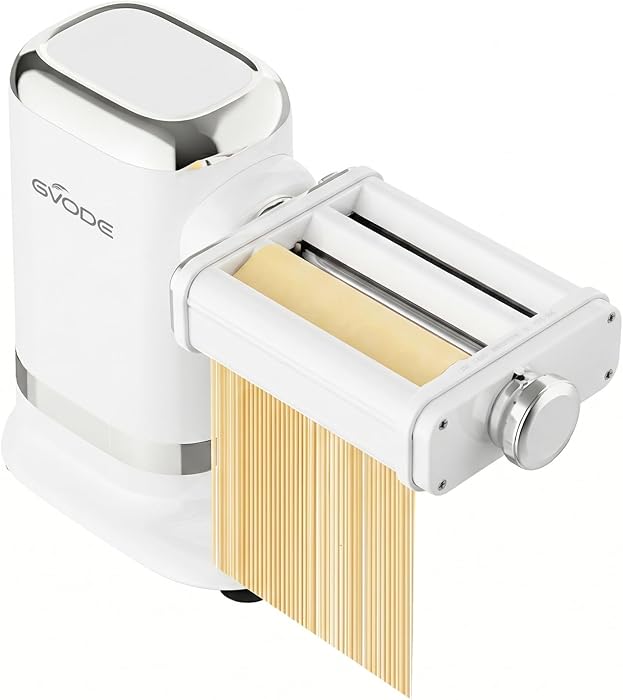
GVODE Electric Pasta Maker

GVODE Electric Pasta Maker Machine

Lightweight roller

Our Score 80/100
Speeds
2
Weight
5.2 lb
Thickness Range
0.4 to 2 mm
Thickness Settings
8
View on Amazon

At 5.2 pounds, the GVODE is the roller that can live in a cupboard. It has a 700W motor, eight thickness settings from 0.4 to 2 mm, two speeds, and stainless-steel blades in a plastic housing. Suction cups hold it to the counter while the rollers turn.

It rolls and cuts; it does not mix or knead. You make the dough, then pass it through the rollers on progressively thinner settings before cutting. The 15-minute run limit with a 5-minute cool-down is the rhythm to plan around. Big batches go in stages, and the vents on the motor base need to stay clear.

The 8 settings go thin enough for delicate angel hair and wide enough for lasagna. We like the slow, progressive passes because they relax the gluten and give the cutters a cleaner edge. The suction cups are a small thing that makes a big difference when the machine is working through a stiff dough.

We recommend it for someone who already makes dough and wants the rolling done, especially in a small kitchen. It is not a replacement for an automatic extruder; it is a different tool. For a single dinner's worth of pasta, the compact body and quick setup are the reasons it earns a spot.

Our Verdict

For cooks who already make dough, the GVODE is the light, eight-setting roller we choose when storage is tight.

Check Latest Price
8

Zuguachi Handheld Noodle Machine Best for Handheld Noodle Pressing

Zuguachi Handheld Noodle Machine – Handheld Electric Noodle Machine

Handheld noodle pressing

Our Score 77/100
Weight
2.3 lb
Operation
Semi-automatic
Dimensions
11 x 8 x 3 inches
Pasta Molds
5
View on Amazon

The Zuguachi is a compact electric press for noodles, not a countertop pasta station. It weighs 2.3 pounds, measures 11 by 8 by 3 inches, and runs semi-automatically: load mixed dough, press the button, and the machine pushes it through one of five shaping plates.

The five plates cover wide noodles, thin noodles, flat noodles, hollow noodles, and a standard noodle shape. The cordless design means no outlet hunt, and the small body fits in a drawer. That is the appeal: it is a niche tool for someone who already has a dough recipe and wants a faster way to shape it.

It does not mix or knead, and the single blade and five plates limit you to the shapes in the box. For a tiny kitchen or a second home, that may be enough; for a family that wants one machine to do the whole job, it is not.

We recommend it only as a small electric press for dough you have already made. It makes the most sense for someone who already owns a mixer or a roller. The cordless body is the detail that earns it a place in a tiny kitchen.

Worth Noting

  • Plastic build
Our Verdict

We recommend the Zuguachi only as a compact electric press for dough you have already made; it is a drawer-sized helper, not a full pasta maker.

Check Latest Price

How We Put These Pasta Makers to Work

We started by pulling every electric pasta maker a home cook could reasonably buy, then cut the list by price, counter footprint, and whether replacement dies and parts were actually available. Reviews kept flagging the same complaints — dies that clogged, motors that bogged down in stiff dough, machines that walked across the counter — so the shortlist included both extruders and motorized rollers, plus a few designs built to answer those problems.

Eleven machines came into our kitchens for seven months. Each got the same first run: a basic batch on a Sunday afternoon, timed from the moment we pressed start to the last strand, with a decibel app running while the motor worked. We used one dough recipe throughout and noted whether it needed extra water, whether it extruded evenly, whether sheets came out uniform or tapered at the edges, and whether the one-touch modes saved a step or just added buttons. We counted what came in the box too — extra discs, measuring cups, a cleaning brush — since that's where value hides.

Then we ate. Every batch went into boiling water, and we judged cooking performance by whether strands stuck together, whether they held sauce, and whether the texture was springy or chalky. Cleanup got timed as well: we rinsed each die and brush immediately, then again after a night of dried dough, to see what a lazy evening actually costs.

Durability was mostly repetition. We ran back-to-back batches until the motor housing got warm, checked whether the thickness dial drifted mid-sheet, and kept every machine in rotation for months so a slow failure had time to surface. Ease of use came down to whether we could hand one to someone who'd never made pasta and walk away — and whether they had to come find us.

How to Choose an Electric Pasta Maker

Automatic Extruder or Motorized Roller?

An automatic extruder takes flour and liquid, mixes and kneads the dough, then pushes it through a die. The Philips 7000 and VEVOR work this way, and they are the choice if you want one-button pasta. A motorized roller pasta machine does not mix or knead; it rolls and cuts dough you make yourself. The Marcato Atlasmotor and Shule are in this camp. Neither type is better, but the roller asks for more of your time and gives you more control over sheets, ravioli, and thickness.

Match Capacity to Your Table

Capacity is where most buyers overshoot. An automatic that makes two to three servings suits a couple; an eight-portion machine is for a family or for leftovers. Roller machines measure output differently, often in pounds per hour, so compare that figure with how much dough you actually make in a session. Weight matters just as much: a 20-pound machine is a leave-it-out appliance, while a 5.2-pound roller can live in a cupboard. Measure the counter and the storage shelf before you choose.

Cleaning Is Part of the Recipe

Extruder dies are the cleaning bottleneck. Dishwasher-safe parts make a real difference, especially if you use the machine weekly; the Philips 7000 is the easiest in this group on that front. Roller machines are usually dry-clean only. The Shule explicitly warns against rinsing the body or putting it in the dishwasher. If you will not brush a die or wipe rollers, choose a machine with removable, dishwasher-safe parts and skip the rest.

Shapes, Thickness, and the Pasta You Cook

Disc count is easy to compare and easy to overvalue. Three discs cover spaghetti, penne, and fettuccine; eight discs only help if you actually cook the extra shapes. On a roller, thickness settings matter more than the number of cutters, because sheets become lasagna, ravioli, or noodles. List the three pasta shapes you cook most, then check the discs or cutters against that list. A machine that does your favorites well beats one with a drawer full of shapes you never use.

Motor Power and Rest Cycles

Wattage is not a performance score. A 150W automatic can do more useful work than a 700W roller because the gearbox and auger do different jobs. What matters is the duty cycle: the GVODE asks for 15 minutes of running and a 5-minute cool-down, and that rhythm is normal for a compact motor. Plan big batches in stages, keep the vents clear, and do not treat a rest interval as a defect. It is how the machine lasts.

Frequently Asked Questions

Final Verdict

The Philips 7000 Series is our top pick because it does the whole job—mixes, kneads, extrudes, and cleans up in the dishwasher—and it makes enough for a family. If you want rolled sheets rather than extruded shapes, the Marcato Atlasmotor is the better tool, and its hand crank is real insurance. For a small household, the Philips Compact is easier to live with; for a tight budget, the VEVOR gets you into automatic pasta making.