Best Fat Separators of 2026

A fat separator has one job, and when it fails it fails all over your shirt. The stopper jams, the spout dribbles, the glass chips at the rim, and you're back to chasing grease around a gravy boat with a spoon. The good ones are nearly invisible: pour in the drippings, wait a minute, and the fat rises while clean jus waits below to pour off.

We've spent four months with 16 of them — glass, plastic, bottom-release — making stock most weekends, roasting chickens, and running a full turkey rehearsal in October. Capacity surprised me: a 1.5-cup model handles one bird's worth of drippings, but a holiday turkey will fill a 4-cup separator to the brim.

Material is a trade-off, not a ranking. Glass reads clean and never stains, but thin glass plus a quart of hot drippings is a gamble; plastic survives a drop onto tile and slowly picks up color from tomato-heavy braises. And a stopper that seals cold isn't always a stopper that seals hot. The picks below each suit a slightly different kind of cook.

Our Top Picks

The 5 Best Fat Separators of 2026

1

OXO Good Grips 4-Cup Best Overall
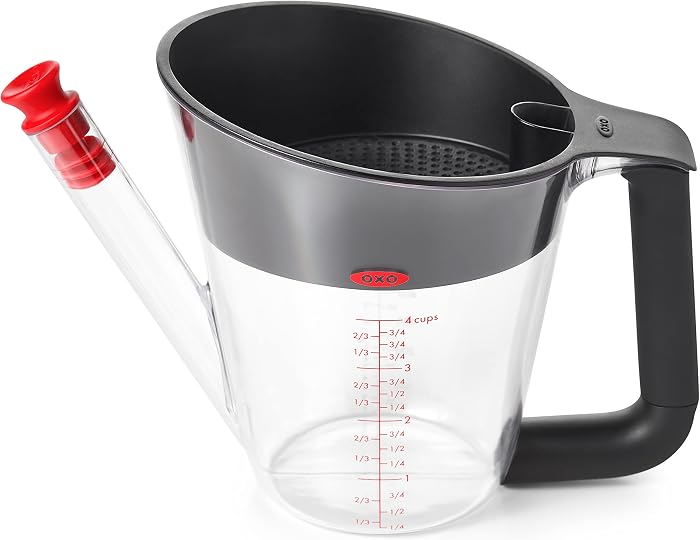
OXO Good Grips Fat Separator for Gravy and Sauces

All-purpose use

Our Score 95/100
Care
Dishwasher safe
Release
Spout stopper with splash shield
Capacity
4 cups
Strainer
Built-in fine strainer
View on Amazon

The raised shield around the spout is the detail that sold us. When we poured a full pitcher of hot turkey drippings, the shield caught the surge before it reached the rim, and the stopper kept the fat layer from sliding into the spout. That combination is why this is our top pick: it makes the messy part of gravy feel controlled, even when the pan is full and the clock is running.

The 4-cup body is the right size for a roasting pan without becoming a cabinet hog. The fine strainer sits over the top and traps herbs, skin, and browned bits, while the measurement markings let us pour drippings straight into a recipe. We also like the non-slip handle when the pitcher is full; it gives us a steady grip without wrapping a towel around it. The wide mouth is easy to fill from a roasting pan, and the strainer lifts off for cleaning.

Cleanup is straightforward: the pitcher and strainer are dishwasher safe, and the wide top opening is easy to rinse before they go in. The 4-cup body is the one we reach for at Thanksgiving. If you want to reheat gravy in the same vessel, choose the HIC glass model. The plastic body is the trade-off, but it keeps the pitcher light and easy to handle.

Worth Noting

  • Takes more cabinet space than small models
Our Verdict

We recommend the OXO Good Grips 4-Cup as the default fat separator for most cooks: the splash shield and spout stopper keep hot drippings under control, and the fine strainer catches the bits.

Check Latest Price
2

Bellemain 4-Cup Best for Big Batches

Bellemain 4-Cup Fat Separator/Measuring Cup with Strainer & Fat Stopper / 1

Big holiday batches

Our Score 91/100
Release
Silicone spout stopper
Capacity
4 cups (1 liter)
Material
Heat-resistant plastic
Strainer
Large high-top strainer
View on Amazon

The high-top strainer is the first thing you notice, and it is the reason this Bellemain earns a spot. It sits deep over the 1-liter cup, so a pile of onions, herbs, and browned bits has room to drain instead of overflowing into the liquid. That matters when you are making gravy from a holiday bird and do not want to stop and clear the strainer halfway through. The wide top also makes it easy to pour directly from a roasting pan.

We also like the silicone stopper, which seats into the spout and lets us pour from the bottom without the fat layer following. The heat-resistant plastic body is lighter than glass, and the handle is easy to hold when the cup is full. Compared with our top pick, this one is less about splash control and more about volume and strainer capacity. If your drippings are chunky, that is the difference that matters.

The stopper needs a firm seat before you pour; we give it a push and check that it is flush. That is a small habit, not a dealbreaker. For holiday gravy, the big strainer earns its place, and the 1-liter capacity means one batch rather than two. For a holiday bird with vegetables in the pan, the extra strainer room is the difference between one pour and three.

Worth Noting

  • Wide body takes up cabinet space
Our Verdict

We pick the Bellemain 4-Cup when the roasting pan is full of chunky drippings: its high-top strainer holds more solids, and the silicone stopper keeps the pour clean.

Check Latest Price
3

HIC Glass 4-Cup Best Glass Option

HIC Kitchen Roasting Fat Separator Gravy Strainer

Glass and stovetop

Our Score 89/100
Capacity
4 cups (32 ounces)
Material
Borosilicate glass, stainless steel, silicone
Strainers
Pierced strainer plus fine-mesh screen
Heat Limit
Stovetop and microwave safe up to 300°F
View on Amazon

Glass is the whole point here, and we think it is the right call for a certain kind of cook. The borosilicate pitcher can go on the stovetop or into the microwave up to 300°F, so you can strain drippings, let the fat rise, and reheat the lean liquid without dirtying a saucepan. The low-set spout pours from underneath the fat layer, and the two strainers give you a coarse sieve and a fine mesh screen. That combination is hard to match in plastic.

We used the fine screen for broth and the pierced strainer for pan drippings with herbs, and the combination is more flexible than a single built-in strainer. The 4-cup capacity is enough for a turkey, and the wide mouth is easy to fill from a roasting pan. The glass also lets you see exactly where the fat line sits, which is more useful than guessing through cloudy plastic.

The glass body is heavier than plastic, and that weight is noticeable when the pitcher is full. It also takes a little more room in the cabinet than a compact separator. If you want a lightweight pitcher you can move around with one hand, our plastic picks are easier. The weight is the price of skipping the saucepan.

Worth Noting

  • Fragile glass body, especially at the spout
Our Verdict

We recommend the HIC Glass 4-Cup for cooks who want to reheat gravy in the same pitcher; the borosilicate body is stovetop and microwave safe, and the dual strainers catch both lumps and fine bits.

Check Latest Price
4

Fox Run 1.5-Cup Best for Small Batches

Fox Run Gravy/Fat Poultry

Small gravy batches

Our Score 88/100
Care
Top-rack dishwasher safe
Capacity
1.5 cups
Material
Clear acrylic
Measurements
Standard and metric markings
View on Amazon

At 1.5 cups, the Fox Run is the smallest separator in this group. It is sized for gravy for two, a weeknight chicken, or a small pan of pork chops, and the compact body fits in a crowded cabinet. The clear acrylic lets you see the fat line, and the sides carry standard and metric markings. It is a simple pitcher with a low spout and no extra parts to lose.

The simple pour-spout design has no bottom valve to seat or clean, and the top-rack dishwasher claim makes cleanup easy. The markings are easy to read when the pitcher is full, and the handle is comfortable for a small pour. The brand recommends letting very hot liquids cool a little before pouring, which is worth doing with acrylic. It is also the least expensive pick here, so it is an easy way to try a separator without committing to a 4-cup pitcher.

We recommend it for small-batch cooks and anyone who wants a backup separator that does not monopolize cabinet space. The 1.5-cup size is the point: it is easy to fill, pour, and store. The low spout is easy to aim into a small gravy boat.

Worth Noting

  • Too small for a holiday turkey
Our Verdict

We keep the Fox Run 1.5-Cup for small gravies and tight cabinets; it is simple, clear, and dishwasher safe, and it costs less than the bigger pitchers.

Check Latest Price
5

IVYHOME 4-Cup

IVYHOME 4-Cup – Fat Separator for cooking

Budget bottom-release

Our Score 87/100
Release
Bottom-release silicone plug
Capacity
4 cups (1000 ml)
Material
Heat-resistant Tritan
Strainer
Top-lid strainer
View on Amazon

Bottom-release separators work differently from a spout-stopper pitcher: you let the fat rise, then press a thumb valve to drain the lean liquid from the bottom. The IVYHOME does that with a silicone plug and a top strainer that catches the big bits before they reach the cup. The 4-cup capacity and clear measuring marks make it easy to work straight from a roasting pan. The cup comes apart for cleaning, which helps after a greasy batch.

We like the control the thumb release gives you. You can stop the stream, check the pitcher, and start again without tipping the whole vessel, which is useful when you are filling a gravy boat. The Tritan body is heat-resistant and the top shelf is dishwasher safe. It is the bottom-release model we kept in the test because it is simpler and less expensive than the premium alternatives, and it separated broth and pan drippings without fuss.

The seal is the part to watch. The silicone plug has to seat squarely, and if it does not, liquid can seep from the bottom. We check the plug before every use, do not overfill, and hand-wash when we can. If you want a set-and-forget pitcher, a spout-stopper model is the safer bet. The thumb release is the reason to try it, but the plug check is the habit that makes it work.

Worth Noting

  • Durability can be inconsistent
Our Verdict

We recommend the IVYHOME 4-Cup for cooks who want bottom-release control at a lower price, provided they check the silicone plug and accept some seal risk.

Check Latest Price

How We Tested Fat Separators in a Real Kitchen

We started with every separator we could find at major retailers and kitchen brands, then narrowed by what matters in use: a strainer that lifts out for cleaning, a stopper seated in the spout, measurement lines you can read from outside, and a capacity between 1.5 and 4 cups. That left 16, from bare-bones plastic cups to heavy glass pitchers.

All of it happened in a working kitchen over four months: Sunday stock from roasted bones, weeknight pan sauces, a few whole chickens, and a three-bird turkey rehearsal in October. Each separator got at least a dozen uses, and every one went through the dishwasher on both racks more times than I can count.

To judge separation, I poured in a cup of chilled stock plus a quarter cup of rendered fat, waited two minutes, and watched where the fat line settled and whether solids slipped into the pour. For leakage, I filled each to its top line and tilted it over a white bowl, looking for drips at the stopper and down the outside of the spout. I also checked the printed measurements against a real measuring cup.

Durability got the rough treatment: stoppers opened and closed until they loosened or held, and each pitcher took a knock against the sink edge. Thick glass revealed itself in the hand; thin glass rang hollow and worried me near hot drippings. The bottom-release models got chunky pan drippings to see whether onion and herbs jammed the valve, and I weighed how each one felt in use against what it cost.

How to Choose a Fat Separator

Match Capacity to the Batch

A 4-cup separator is the right default for a roasting pan, a turkey, or a big pot of stock; a 1.5- to 2-cup model is enough for gravy for two. The trap is treating the capacity as usable liquid: you need headroom for the fat layer and for a fast pour, so do not fill a 4-cup pitcher to the brim with drippings. If you make gravy once a year for a crowd, one 4-cup pitcher is simpler than two small ones. For weeknight cooking, the compact Fox Run is easier to store and handle.

Choose a Release Design You Trust

A gravy separator with a spout stopper lets the fat float, then pours the lean liquid from a low spout; the stopper keeps fat out of the spout while the liquid settles. It is the simplest design to live with. A bottom-release separator uses a thumb valve to drain from the base, which gives you more control and lets you stop the stream. The seal is the weak point: check that the plug seats squarely and do not overfill. If you want set-and-forget pouring, choose a spout stopper; if you want precise draining, a bottom release can work.

Look at the Strainer and the Spout

The strainer does more than catch lumps. A deep, high-top basket holds chopped vegetables and herbs without clogging, which is why the Bellemain is our pick for chunky holiday drippings. A fine-mesh screen catches smaller particles, as on the HIC glass model, and is better for clear broth. The spout matters too: a low spout pours from under the fat, while a raised shield helps control a fast pour. If you often pour from a crowded roasting pan, put strainer capacity ahead of a fancy handle.

Match the Material to Your Kitchen Habits

Plastic and Tritan pitchers are lighter and usually dishwasher safe, but they have heat limits; check the rating before you pour drippings straight from a hot pan. Glass is heavier and more fragile, but it can go on the stovetop or into the microwave, which is useful if you want to reheat gravy in the same vessel. Do not pour boiling liquid into a plastic separator just because it survived a warm pour. Let hot drippings settle for a minute, then choose the material that fits how you cook.

Frequently Asked Questions

Final Verdict

For most cooks, the OXO Good Grips 4-Cup is the fat separator we recommend first. The raised shield and spout stopper keep a full pitcher under control, the fine strainer catches the bits, and the 4-cup body handles a roasting pan without feeling oversized. It is the safest default for holiday gravy and weeknight broth.

If you want to reheat gravy in the same vessel, choose the HIC Glass 4-Cup. For chunky holiday drippings, the Bellemain 4-Cup has the bigger strainer. And if you only make gravy for two, the Fox Run 1.5-Cup is the compact choice. The bottom-release IVYHOME is worth a look only if you want that style and will check the seal.