Best Food Processors for Grinding Meat of 2026

Grinding your own meat quietly changes dinner: fresher burgers, better texture, control over the fat ratio. The catch is that not every food processor can handle a cold chunk of chuck — a weak motor stalls, a dull blade smears instead of cuts, and you get a warm paste where you wanted crumbly ground beef. I've ruined a batch or two learning that.

Over six months my team ran 13 food processors through Sunday meatballs, weeknight pesto, and a lot of pork shoulder. The ones that held up shared a few traits: a motor that keeps its speed under load, blades that stay sharp through a whole batch, and bowls that come apart easily enough to actually wash.

Capacity is the decision nobody warns you about. A 3-cup mini handles a pound of meat and fits a small kitchen, while a 9- to 14-cup machine is what batch cooking wants. The second bowl that several of these ship with is worth having, too — grind in one, chop onions in the other. Both ends of that range are represented below.

Our Top Picks

The 8 Best Food Processors for Grinding Meat of 2026

1

LINKChef 10-Cup Food Processor Best Overall

LINKChef 10-Cup Food Processor

Everyday meat grinding

Our Score 94/100
Weight
2.5 lb
Wattage
600 watts
Bowl Capacity
10 cups
Bowl Material
Stainless steel
View on Amazon

Stainless steel is the reason this one is our top pick. A 10-cup steel bowl doesn't hold on to the smell of raw pork the way plastic does, and you can take a scouring pad to it after a batch of chicken without worrying that every scratch is collecting something. The 600-watt motor drives a single S-blade, and the two speeds give you enough control to stop at a coarse grind instead of sailing past it into paste.

Grinding here is a pulsing job, not a dump-and-walk-away one. The 10-cup figure is a ceiling for thin things like soup; load cubed meat past the halfway mark and the bottom turns to paste while whole pieces ride up the sides. Two or three smaller loads, scraping down once between pulses, is what we found produces an even grind, and the motor runs for seconds rather than minutes while you do it. Everything but the base is dishwasher safe, and a scraper comes in the box.

It weighs 2.5 pounds and measures about 7 by 9 inches at the base, so it lives in a cabinet and comes out for one job without feeling like an event. That is the honest case for it over a full-size machine: if you grind in small batches, a machine you can lift with one hand is the one you actually use.

Worth Noting

  • No slicing or shredding discs included
Our Verdict

For anyone grinding meat once a week or more, we recommend the LINKChef: the stainless bowl doesn't stain or hold odor, and 600 watts chews through cubed pork and chicken in short pulses.

Check Latest Price
2

Ganiza Dual-Bowl Food Processor Best Two-Bowl Design

Ganiza Food Processors with 2 Bowls

Meat and vegetables

Our Score 93/100
Wattage
450 watts
Blade Sets
Two
Bowl Material
Glass and stainless steel
Bowls Included
Two 8-cup bowls
View on Amazon

Where the LINKChef gives you one steel bowl, the Ganiza gives you two 8-cup bowls, one glass and one stainless, each with its own blade set. For raw meat that is the entire argument: the steel bowl becomes the meat bowl, the glass one stays for onions, fruit, and baby food, and you stop scrubbing pork fat out of the bowl you use for everything else.

We rank it second rather than first because 450 watts is not the muscle the full-size machines bring, though you would not know it from the grind. Cubed beef and chicken break down to a coarse mince in seconds, and the two-speed control gives you a low gear for a rough chop and a high one for a fine grind. What impressed us most is evenness: the blade sits low and the bowl is not oversized, so a half-full load gets worked through instead of thrown against the walls.

Storage is the quiet win. The bowls stack, so the second one costs a few inches of cabinet instead of a second appliance, and the bowl, lid, and blades go in the dishwasher. A safety lock keeps the motor off until the lid is seated. For the money, the extra bowl is worth more than a few extra watts on a single-bowl model.

Worth Noting

  • Blade assembly can work loose with heavy use
Our Verdict

We point anyone who grinds meat and chops vegetables in the same week to the Ganiza: two 8-cup bowls, two blade sets, and 450 watts that handle pork and chicken evenly.

Check Latest Price
3

KOIOS 8-Cup Food Processor Best Value

KOIOS 8-Cup Food Processor

Budget two-bowl setup

Our Score 92/100
Weight
4.5 lb
Wattage
500 watts
Bowl Material
Glass and stainless steel
Bowls Included
Two 8-cup bowls
View on Amazon

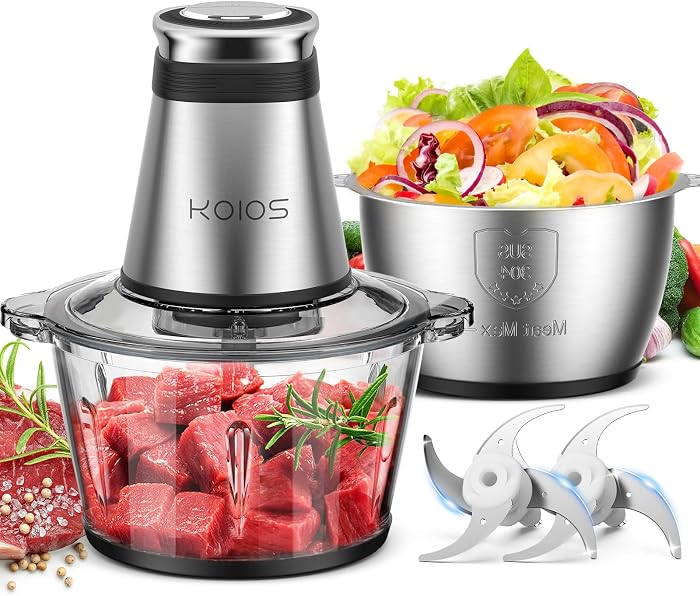
Two 8-cup bowls, a 500-watt motor, and a place at the bottom of the price range is a combination that is hard to argue with, and the KOIOS is what we point people to when they want to grind meat without spending much. One bowl is glass, one is stainless, each gets its own bi-level blade set, and the two stack when they are not in use.

Grinding is where it earns the recommendation. Pork loin and chicken thighs break down quickly and evenly, and the bi-level blades pull the top of the load down into the cutting zone instead of letting it spin above the blade. There is a hidden safety switch that keeps the motor from running unless the power pod is seated properly, which is the kind of detail we notice on a machine at this price.

The compromises are in the feel rather than the results. At 4.5 pounds the base is light enough to shift with one hand, which is convenient and also why it does not sit as planted as the Cuisinarts when the blade hits something cold. It is small enough to leave out between jobs, and for the money that is a fair trade.

Worth Noting

  • Motor needs 30-second bursts with rest between
Our Verdict

Our value pick: 500 watts, two 8-cup bowls with their own blades, and grinding performance on pork and chicken we're glad to stand behind.

Check Latest Price
4

Ninja Professional Plus BN601 Best for Big Batches

Ninja Professional Plus Food Processor

Large batches

Our Score 91/100
Wattage
1000 peak watts
Bowl Capacity
9 cups
Bowl Material
Plastic
Included Blades
Chopping, dough, slice/shred
View on Amazon

At 16 inches tall and almost 8 pounds, this one does not go back in a cabinet. It takes a counter corner and stays there. That is the trade for a 9-cup bowl and a 1000-peak-watt motor that turn a family-size batch of ground meat into one job instead of three.

The Auto-iQ presets are the feature we did not expect to lean on. One button runs a programmed sequence of pulses and pauses and then stops on its own, which is exactly the rhythm that keeps meat from going pasty. The 9-cup bowl takes a big load without a second pass, and the dough blade plus the slicing and shredding discs make it a full processor rather than a chopper.

So the ranking comes down to size. Against the compact choppers here, the Ninja does more, faster, and in bigger batches, and nothing else in this group makes dough. It is simply more appliance than a pound of meat needs, and setting it up for a small job is more work than the job.

If you grind once a week for a family, the capacity and the motor are worth the counter space. If you are mincing a chicken breast for dinner, the LINKChef does the same work for less money and lives in a cabinet.

Worth Noting

  • Plastic lid parts can crack with use
  • Narrow feed tube slows big vegetables
Our Verdict

For big batches, we reach for the Ninja: 1000 peak watts, a 9-cup bowl, and presets that run the pulse sequence for you.

Check Latest Price
5

Cuisinart 14-Cup Food Processor Best Heavy-Duty

Cuisinart 14-Cup Food Processor

Heavy daily use

Our Score 90/100
Weight
18 lb
Wattage
720 watts
Bowl Capacity
14 cups
Included Discs
Slicing and shredding
View on Amazon

Cold pork shoulder is where a weak machine gives itself away: the blade stalls, the bowl hops, and you end up with smashed meat instead of ground. The 720-watt motor in this Cuisinart does not flinch at it, and the 18-pound base stays planted on the counter while the blade works through the chunk.

Fourteen cups is a serious bowl, and it is the reason this one is for people who grind in quantity: a big batch of sausage meat or a week of dog food fits in a single run. It is also quiet for a motor this size, quiet enough to keep a conversation going next to it, and the slicing and shredding discs make it the machine you leave out for everything else.

Where it sits in this group is straightforward: it is the most capable machine here, and the one we trust with a cold, heavy load. It also asks the most of your kitchen, at 15 inches of height, 18 pounds to move, and the top of the price range, so it earns its place if grinding is a regular, sizable job rather than an occasional one.

Worth Noting

  • Plastic bowl and lid can crack
Our Verdict

When grinding is a big, regular job, the 14-cup Cuisinart is the machine we want on the counter: 720 watts, a base that doesn't walk, and room for a family-size batch.

Check Latest Price
6

Cuisinart Mini-Prep Plus Best for Small Batches

Cuisinart Mini Food Processor

Small batches

Our Score 89/100
Blade
Reversible chop and grind
Weight
2.2 lb
Wattage
250 watts
Bowl Capacity
3 cups
View on Amazon

Three cups is the whole story with this one. It has one speed plus pulse, and a chicken breast needs cutting down before it fits. What it does well is mince a single breast or a handful of trim in seconds, in a machine that weighs a little over two pounds and sits on the counter without being in the way.

The blade is the interesting part. Cuisinart's SmartPower blade reverses, so one direction chops and the other grinds, and the grind side is the one for meat. The 250-watt motor is modest, which is why the pulse button does most of the work: hold it too long and you are making paste rather than grind.

Cleanup is three pieces, the bowl, lid, and blade, and the bowl and lid are dishwasher safe, which matters more than it sounds when there is raw meat residue to deal with. The 18-month warranty is the shortest in this group. For small jobs, nothing else here is this easy to leave out.

Worth Noting

  • Plastic work bowl feels flimsy
Our Verdict

Buy the Mini-Prep if your grinding happens in handfuls: a 3-cup bowl and a reversible chop-and-grind blade in a machine that earns its counter space.

Check Latest Price
7

Bear 2-Bowl Food Processor Best for Tiny Kitchens

Bear 2-Bowl Food Processor

Tiny kitchens

Our Score 84/100
Speeds
2
Wattage
400 watts
Bowl Material
Glass
Bowls Included
8 cup and 2.5 cup
View on Amazon

The 2.5-cup bowl is the reason to pick the Bear over the other two-bowl machines here. It nests inside the 8-cup bowl for storage, and it is the right size for one chicken breast, a handful of nuts, or a batch of baby food, jobs where an 8-cup bowl just smears everything across the walls.

Both bowls are glass, which is the material we trust most with raw meat: it does not stain, it does not hold odor, and you can see how far the grind has gone without lifting the lid. The 400-watt motor has two speeds and a hidden safety lock that only engages when the blade is seated, and the warranty runs three years.

For meat, the 8-cup bowl does the work. Use the high speed for pork and chicken and pulse rather than hold, because the low gear is meant for soft or small ingredients and holding it on a full bowl is how you get paste instead of grind.

Where it lands in this group: it is the most compact way to get two glass bowls, and the small bowl is a genuine second tool rather than a spare. Four hundred watts is the lightest of the two-bowl machines here, so plan on smaller loads and let the motor rest between them. It is the pick for a small kitchen, not for a freezer-filling session.

Worth Noting

  • Motor can burn out within months
Our Verdict

We pick the Bear for small kitchens: an 8-cup glass bowl for meat, a 2.5-cup bowl that nests inside it, and a 3-year warranty.

Check Latest Price
8

Savorfuze FP500 Food Processor

Savorfuze FP500 Food Processor – Food Processor with 2 Bowls (8 Cup+8 Cup)

Complete starter kit

Our Score 83/100
Extras
Brush and two mats
Wattage
500 watts
Bowl Material
Glass and stainless steel
Bowls Included
Two 8-cup bowls
View on Amazon

Two bowls, two blade sets, two non-slip mats, and a cleaning brush: the Savorfuze arrives as a complete kit, which is unusual at the bottom of the price range and the main reason it made this list.

The spec sheet reads better than the money suggests: a 500-watt full-copper motor with over-temperature protection, two press-and-hold speeds, and matching 8-cup bowls in glass and stainless steel. Each bowl gets its own blade set, so you are not swapping a blade between raw meat and fruit.

The four blades sit at two levels, which is what lets a fuller bowl get worked top and bottom instead of only at the base, and the non-slip mat under the bowl does real work on a smooth counter. Press-and-hold control means the motor only runs while your hand is on the button, which we think is the right design for meat: you stop exactly where you want the grind.

What holds it back is history. This is a newer model with far less of a track record than the KOIOS or the LINKChef, and at this stage the design is easier to vouch for than the long-term motor. If you want the most complete kit for the least money and you are comfortable being early, it is a sensible buy; if you want a machine with years of grinding behind it, spend a little more.

Worth Noting

  • Newer model with a short track record
Our Verdict

We keep the Savorfuze on this list for the kit, two bowls, two blade sets, mats, and a brush, from a newer design we're watching.

Check Latest Price

How We Tested Food Processors for Grinding Meat

We started by pulling every chopper and full-size processor we could find that was sold for grinding meat, then filtered by motor power, bowl material, capacity — from 3 cups up to 14 — and whether the bowl and blades were dishwasher-safe. That left 13 machines, from compact minis to full-size models that lived on the counter for six months.

The main event was meat. I cubed chuck and pork shoulder, chilled them for 20 minutes, and pulsed a pound at a time, scraping down the bowl as I went. I counted how many pulses a pound took, noted whether the meat fell into loose, distinct crumbles or smeared into paste against the wall, and felt the bowl afterward to see how much heat the motor was pushing into the food. Chicken thighs, nuts, and a pile of onions got the same treatment.

Along the way we used the extras the way a cook would: grinding in one bowl and chopping in the second, swapping blade sets, and comparing glass against stainless when it came time to wash up. Cleaning was hands-on — I dug ground meat out of the blade hub and the center column before anything went into the dishwasher. Lids got latched and unlatched dozens of times, and back-to-back batches totaling five pounds showed which motors slowed down or started to smell hot.

How to Choose a Food Processor for Grinding Meat

Batch Size Matters More Than Bowl Size

Meat needs room to move. Fill a bowl to the top with cubed shoulder and the bottom layer turns to paste while whole chunks ride up the sides, so plan on loading meat about half full and working in two or three rounds. That makes a 3-cup mini a tool for a single chicken breast and an 8- to 10-cup machine the practical size for a family's worth of ground meat.

Two-bowl models stretch that further: one bowl for meat, one for everything else, with no scrubbing in between. If you grind more than once a month, that second bowl does more for you than another hundred watts.

Watts, and the Duty Cycle Nobody Mentions

Power matters less as a number than as a behavior. Around 250 watts is enough for a chicken breast in a small bowl; 450 and up handles pork shoulder and venison without stalling. More important is how long the motor runs before it needs a rest, because most compact choppers are rated for roughly 30 seconds on and 20 off to protect the motor.

That suits pulsing anyway, which is how you keep a grind coarse. But if you picture yourself running a continuous batch through a big cut of meat, that is a full-size machine's job, and the 720- and 1000-watt models here are built for it.

Bowl Material and Keeping Raw Meat Separate

Glass and stainless steel are both non-porous, which is why they are the right materials for raw meat: neither holds odor, neither stains, and both scrub clean. Plastic bowls on full-size machines are the ones that eventually keep a smell. Stainless is the most forgiving if you are rough with it; glass lets you watch the grind, which genuinely helps when you are trying not to over-process.

If a machine only comes with one bowl, choose one with two. A second bowl costs less than a second appliance and saves you the raw-meat scrub before you chop an onion.

Lids, Cleanup, and What You'll Actually Do With It

The chopping blade that sits low in the bowl is the only part that grinds meat; slicing and shredding discs will not do it. Look for a bowl and lid that are dishwasher safe and a blade you can lift out by its stem, because raw meat means washing up right away, and a lid with a fussy lock is the difference between using the machine and avoiding it.

Full-size processors earn their keep when they are easy to assemble. If the lid takes three tries to seat, you will reach for a knife instead.

Where It Lives: Counter Space and Weight

Compact electric food choppers run 2 to 5 pounds and fit in a cabinet; full-size processors run 8 to 18 pounds and generally do not. Measure the height under your upper cabinets before you commit to leaving one out, and be honest about whether you will lift 18 pounds out of a low cabinet for a pound of ground meat.

For most people grinding a few times a month, a light machine that stays within reach beats a powerful one that lives in the basement.

Frequently Asked Questions

Final Verdict

The LINKChef is the one we recommend to most people who want to grind meat at home. Its stainless bowl is the right material for the job, 600 watts handles pork and chicken without strain, and it stores in a cabinet, which is where a machine this size belongs when it is not in use.

Change the requirement and the pick changes. If you grind meat and chop vegetables in the same week, the Ganiza's two bowls save you a scrub every time. If you are feeding a freezer, the Ninja's 9-cup bowl and 1000 peak watts do a family-size batch in one pass.