Best German Chef Knives of 2026

German steel isn't the sharpest steel in the drawer — it's the toughest. Blades made from it are a touch softer, so they give instead of chipping when they hit a chicken joint or a butternut squash, and they hone back into shape in seconds. That forgiveness is why a German chef's knife is the one I'd hand most people first.

I learned to cook beside someone who broke down chickens with a knife older than she was, and the lesson stuck: weight and handle matter as much as the edge. Over the past six months my team and I have cooked with a dozen German-style 8-inch knives, from featherweight stamped blades to fully forged full-tang models, and the differences showed up within ten minutes of chopping.

First-time buyers overrate two things: the factory edge and a dishwasher-safe label. What matters is whether a knife still bites into a tomato after a month of dinner prep, and whether the handle feels secure when your hands are slick with chicken fat. The picks below earned their place on the magnetic strip.

Our Top Picks

The 9 Best German Chef Knives of 2026

1

Victorinox Fibrox Pro 8-Inch Best Overall

Victorinox Fibrox Pro 8 Inch Chef’s Knife

Most home cooks

Our Score 99/100
Blade Length
8 inches
Construction
Stamped
Dishwasher Safe
Yes
Handle Material
Thermoplastic elastomer (TPE)
View on Amazon

The best knife in this guide isn't German and isn't forged. The Victorinox Fibrox Pro is Swiss, stamped from a sheet of stainless, and cheaper than the German-made knives here — and it's the one we recommend to almost everyone. What earns it the top spot is how the pieces work together: a thin blade that tapers to a laser-tested edge, a handle molded to hold a wet hand, and a weight that disappears during a long prep session.

The edge is the reason it cuts the way it does. It's thin behind the bevel, so tomato skin splits instead of crushing and onion halves come apart without a fight; a stamped blade can manage that because there's no thick forged spine holding it back. The TPE handle is the detail we appreciate most, though. It's molded with a texture that's rough without being abrasive, and it stays put in a wet hand — which is more than you can say for a lot of polished wood.

What you give up is heft. There's no bolster and no mass behind the edge, so a butternut squash takes a firm push where the WÜSTHOF falls through it. We didn't mind, because the same lightness keeps your wrist fresh after forty minutes of onions. This is the knife we reach for when the pile is big and the clock is short.

Victorinox lists the Fibrox as dishwasher safe and backs it with a lifetime warranty, which tells you the maker expects it to survive a normal kitchen. We wash ours by hand anyway. If you want forged heft and a bolster under your fingers, the Mercer Renaissance and the WÜSTHOF are where to look; this one is for cooks who want the lighter tool.

Worth Noting

  • Light stamped blade lacks forged heft
Our Verdict

We recommend the Fibrox Pro to anyone who wants one Western chef's knife for everything — it grips when wet, arrives sharp, and never needs to be babied.

Check Latest Price
2

WÜSTHOF Classic 8-Inch Best German-Made

WÜSTHOF Classic 8 Inch Chef’s Knife

Serious home cooks

Our Score 98/100
Blade Length
8 inches
Construction
Forged
Blade Hardness
58 HRC
Handle Material
Composite
View on Amazon

The Classic is the most expensive knife here, and it answers the search most literally: forged from a single billet, tempered to 58 HRC, honed on Wüsthof's precision edge line, and made under the Solingen name by a company that has been at it for seven generations. None of that guarantees a better dinner. What it does guarantee is a knife with no shortcuts in it.

Hold it and the difference from a stamped blade is obvious — the forged construction puts mass forward of the handle, and the full bolster and finger guard give your pinch something to sit against instead of a bare spine. We found it steadies long cuts through cabbage and pineapple where a light knife starts to wander, and the 58 HRC edge comes back quickly off a honing rod. This is the knife in the group that feels like an heirloom rather than a purchase.

The bolster is also the catch. It runs the full length of the blade to the heel, so a whetstone can't reach the last inch of edge without chewing into steel you want to keep. Sharpening becomes a rod between sessions and, occasionally, someone with the right equipment. We accept the trade for the finger protection and the balance, but if you sharpen your own knives you should know it's there before you order.

Whether it's worth the money depends on how long you plan to keep it. The HENCKELS Classic delivers the same forged architecture and finger guard for a lot less; the Mercer Renaissance sharpens more easily for less again. The WÜSTHOF is what you buy when you want the reference version and intend to hand it down.

Worth Noting

  • Full bolster makes the heel hard to sharpen
  • The most expensive knife in this guide
Our Verdict

We recommend the WÜSTHOF Classic to cooks who want the real German article once and expect to keep it — the heft and edge are the point, and the price is the toll.

Check Latest Price
3

HENCKELS Classic 8-Inch Best Traditional Forged Feel

HENCKELS Classic 8-Inch Chef Knife

Traditional forged feel

Our Score 97/100
Blade Length
8 inches
Construction
Forged
Blade Material
Stainless steel
Handle Material
Composite, triple-riveted
View on Amazon

Forged, triple-riveted, and built around a heavy bolster, the HENCKELS Classic is the shape most people picture when they hear German chef's knife. It's a substantial traditional tool with a composite handle and a satin-finished blade that arrives ready to cut, and it does the job without any of the ceremony of the WÜSTHOF.

We like where the weight sits. The bolster and full tang put mass right behind your pinch grip, so the knife does more of the work in a rocking chop than a light stamped blade does, and the edge comes out of the box sharp enough to split tomato skin cleanly. The handle is plain but shaped well — no hotspot where your middle finger sits, and no ridge to fight during a long session.

The bolster is where the limits are. That collar sits right where the edge meets the handle, so sharpening the back inch means working around it, and the factory edge benefits from a few strokes on a rod now and then to stay at its best. Neither is a dealbreaker on a knife built to be maintained rather than replaced, but it is exactly why the Renaissance is in this guide for people who sharpen at home.

If you want the traditional German feel without paying for the most famous name on the page, this is the sensible version. The distance between it and the WÜSTHOF in the hand is smaller than the distance between them in price, and that's the whole argument for buying it.

Worth Noting

  • Bolster makes the heel awkward to sharpen
Our Verdict

We recommend the HENCKELS Classic to anyone who wants a forged German knife with a finger guard and doesn't want to pay the most expensive name here for it.

Check Latest Price
4

MOSFiATA 8-Inch Chef Knife Best German Steel Value

MOSFiATA 8 Inch Chef Knife

First forged knife

Our Score 96/100
Edge Angle
12.5° per side
Blade Steel
EN1.4116 German high carbon
Construction
Forged
Handle Material
Micarta
View on Amazon

Open the box and there's more than a knife: a blade guard, a finger guard, a pull-through sharpener, and a presentation case. That's an odd thing to lead with, but for a first chef's knife it's the difference between buying a tool and buying a tool plus the accessories most first knives leave you to buy separately.

The knife underneath is worth the packaging. The blade is EN1.4116, the German stainless family, with 15 percent chromium for stain resistance, forged and full-tang into a Micarta handle that stays grippy when your hands are covered in onion. It's hand-sharpened to 12.5 degrees per side — the most acute listed edge angle in this guide — and that shows up in soft herbs and ripe tomatoes, where it needs almost no pressure to start a cut.

The trade for that keenness is upkeep. A 12.5-degree edge is thinner than the 16-to-18-degree edge on the Dalstrong, and thin edges roll and dull faster, especially when they meet chicken joints or frozen stock. The included pull-through will keep it usable, though a rod and a light hand treat the blade better. Budget on honing it more often than you would the WÜSTHOF.

One thing worth knowing before you buy: the swirling pattern on the blade is decorative rather than a Damascus forging. It looks better than knives at twice the money, and it doesn't affect the cut either way. Buy this one because the steel, the tang, and the handle are right — the looks are a bonus.

Worth Noting

  • Blade pattern is decorative, not Damascus
Our Verdict

We recommend the MOSFiATA to anyone buying a first forged knife who wants genuine German steel, a full tang, and the sharpening kit in the same box.

Check Latest Price
5

Mercer Culinary Renaissance 8-Inch Best for Easy Sharpening

Mercer Culinary M23510 Renaissance

Home sharpening

Our Score 95/100
Bolster
Shortened
Blade Length
8 inches
Construction
Forged
Handle Material
Delrin
View on Amazon

The Renaissance's bolster stops short of the heel, leaving the entire edge exposed from tip to corner. It's a small thing to look at and a large thing to live with: the whole blade can be laid flat on a stone, so the heel gets as sharp as the belly instead of slowly turning into a blunt inch you learn to work around.

That single choice is why it's here. Everything else is solid mid-range forged work — high-carbon steel, a taper-ground edge, a triple-riveted Delrin handle — but the short bolster is the detail that changes ownership. It's also why we point home sharpeners at this knife ahead of the HENCKELS or the WÜSTHOF, both of which guard the heel with a full collar.

At 8.8 ounces it's the heaviest blade in this set, and the mass carries a chop through sweet potato while the tip stays planted when you rock. Two design touches earn their keep alongside it: the spine is rounded, so a pinch grip doesn't dig into the side of your index finger, and the heel is tall enough that larger hands get knuckle clearance over the board.

Neither of those shows up in a listing the way blade steel does, and both show up every time you cook. For a culinary student or a home cook who intends to keep one forged knife sharp for years, this is the one that makes the upkeep easiest.

Worth Noting

  • Heaviest blade here at 8.8 ounces
Our Verdict

We recommend the Renaissance to cooks who sharpen their own knives and want forged heft that still lays flat on a stone from tip to heel.

Check Latest Price
6

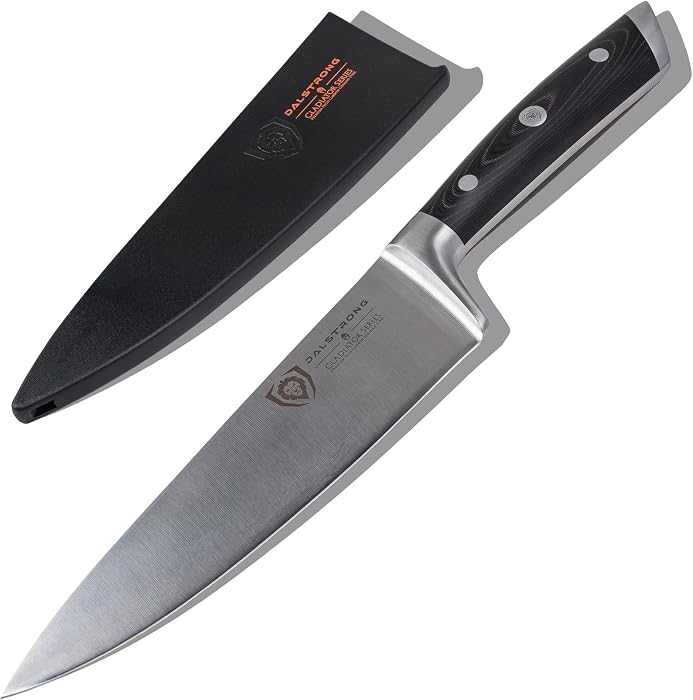
Dalstrong Gladiator Elite 8-Inch Best for Heavy-Duty Prep

Dalstrong Gladiator Elite 8-Inch

BBQ and proteins

Our Score 94/100
Edge Angle
16–18° per side
Blade Length
8 inches
Construction
Forged
Handle Material
G-10
View on Amazon

If the WÜSTHOF reads as too much money for a knife that's going to meet a barbecue, the Gladiator Elite is the same Western idea in a working finish: forged German stainless at 56+ HRC, a 16-to-18-degree edge, a full tang, and a hybrid bolster that leaves more blade exposed than a traditional German collar does.

The G-10 handle is what we appreciate most. It's a resin composite, so grease, marinade, and a wet towel don't change how it feels in your hand, and the taper toward the tip gives knuckle clearance over a board that a thicker German blade can take away. It's NSF certified as well, which matters if the knife lives in a commercial kitchen rather than a home drawer.

It's a heavy knife with a pronounced belly, tuned for rocking through herbs, peppers, and proteins — buy it for that. It is not the knife for delicate butterflying or for a small hand that prefers a light blade, and it isn't the one to reach for when the work is precision rather than volume. The fitted sheath in the box is a genuinely useful addition for a knife that travels out to a grill.

Where it gives ground to the top picks is refinement. The edge is good rather than remarkable, and the whole package is built around toughness rather than finesse. Heavy contact with bones and frozen food is where any thick knife takes wear, so keep it for the prep it was designed for and it will keep earning its place.

Worth Noting

  • Heavy Western profile is not for light-knife cooks
Our Verdict

We recommend the Gladiator Elite to pitmasters and protein-heavy cooks who want a thick Western blade that shrugs off grease and board work.

Check Latest Price
7

Mercer Culinary Millennia 8-Inch Best Budget

Mercer Culinary M22608 Millennia Black Handle

Commercial kitchens

Our Score 93/100
Blade Length
8 inches
Construction
Stamped
Blade Material
High-carbon steel
Handle Material
Santoprene
View on Amazon

Restaurant supply catalogs sell the Millennia by the dozen, and that tells you most of what matters: it's the knife a line cook buys because it cuts, costs little, and can be replaced without a wake. For a home kitchen, the same logic is why it's the budget pick in this guide.

The blade is stamped from one piece of high-carbon steel and ground thin, so it moves through a pile of onions faster than any forged knife here. The Santoprene handle has textured finger points molded into it, and that texture is the part we keep coming back to — wet hands, oily hands, floury hands, the grip doesn't change. At 6.7 ounces it's light enough that a big prep session doesn't turn into wrist work.

You give up heft and a bolster, which means less finger protection and less help through something dense like a rutabaga. What you get in return is speed, a blade that steers easily, and a price that makes a second one painless. The edge takes a rod well and holds a working sharpness through months of daily use.

One caveat worth knowing: Mercer's warranty excludes dishwasher damage, so despite the price, treat it like the tool it is and wash and dry it by hand. Do that and it will keep cutting long after the money suggests it should.

Worth Noting

  • Stamped blade, so no bolster or heft
Our Verdict

We recommend the Millennia to anyone who wants a fast, cheap, genuinely sharp knife for volume prep and doesn't need it to be the last one they buy.

Check Latest Price
8

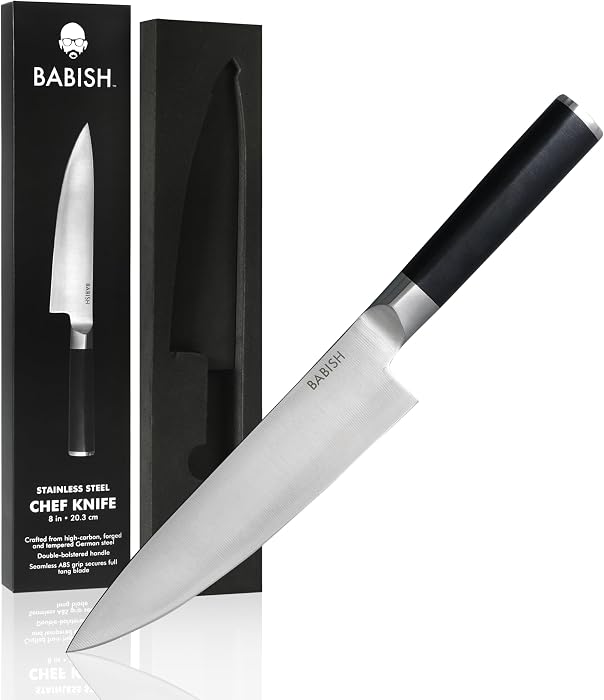
Babish 8-Inch Chef Knife

Babish 8-Inch Chef Knife

Budget forged buy

Our Score 92/100
Blade Steel
1.4116 German steel
Blade Length
8 inches
Construction
Forged
Handle Material
ABS
View on Amazon

Forged from a single piece of 1.4116 German steel, full tang, taper-ground, and priced with the budget knives — the Babish is the least expensive way here to get a forged blade in German steel, and it doesn't cut the corners that usually come with that position.

Set beside the MOSFiATA, which uses the same steel family, the difference is in the finish rather than the cut: a plainer grind, a plainer look, and an edge that arrives just as ready. The full tang runs through an ABS handle that's shaped comfortably and won't win any beauty contests. What matters is that the balance sits where your hand does, so the knife doesn't fight you through a long chop.

The reason to choose it over the other budget picks is construction. The Millennia is stamped, the PAUDIN isn't German steel at all, and the Babish gives you forged and full-tang in 1.4116 for less than either the MOSFiATA or the Renaissance. The reasons to look past it are cosmetic — a plain handle and an unremarkable spine — and none of them change how it cuts.

For a first forged knife, a housewarming gift, or a second knife for a rental kitchen, that's enough. Our reservation is long-term: the ABS handle and the simple finish are the parts that will show age first, and the Renaissance is the better buy if you plan to keep one knife for twenty years.

Worth Noting

  • Plain ABS handle and finish feel entry-level
Our Verdict

We recommend the Babish to anyone who wants a forged German-steel blade on the smallest budget here and cares more about the cut than the finish.

Check Latest Price
9

PAUDIN N1 8-Inch Chef Knife

PAUDIN N1 8-Inch Chef Knife

Looks on a budget

Our Score 91/100
Blade Steel
5Cr15MoV
Blade Length
8 inches
Construction
Stamped
Handle Material
Wood
View on Amazon

The first thing anyone notices about the PAUDIN is the blade: a waved pattern etched across the flat, matched to a wood handle. It's the best-looking knife in this guide, and it's the one that most needs a correction before you buy it.

The listing calls the steel German high carbon, but PAUDIN's own bullet points name 5Cr15MoV, which is a Chinese stainless rather than the 1.4116 the German knives here use. That's not a reason to avoid it — 5Cr15MoV is a legitimate kitchen steel, and at this price the knife is a lot of tool for the money. It is a reason to buy it for what it is: a light, good-looking 8-inch chef's knife, not a German one.

In the hand it's the friendliest of the budget knives. At 6.88 ounces it steers with your fingertips, the wood handle fills a palm without hard edges, and the balance sits right at the bolster. A wide range of hand sizes gets along with it, which isn't a given at this price.

The wood is the upkeep. It wants drying after washing and an occasional wipe of mineral oil, where the synthetic handles on the Millennia and the Fibrox ask for nothing. If you like the look and don't mind the minute of care, this is a lot of character for the money.

Worth Noting

  • Not German steel despite the listing title
  • Wood handle needs drying and occasional oiling
Our Verdict

We recommend the PAUDIN to shoppers who want a light, striking 8-inch knife on a tight budget and don't need the steel to actually be German.

Check Latest Price

How We Tested a Dozen German Chef Knives

We built the shortlist from the German-style 8-inch chef's knives that keep turning up in restaurant kitchens and in reviews from home cooks — stamped blades and fully forged ones, traditional triple-rivet handles and modern composites — then narrowed it to 12 that actually differed in steel, construction, and blade geometry. Each knife went into a home kitchen and stayed there for six months, so nothing was judged on a first impression.

They were used the way knives are actually used: dicing onions and mincing garlic on weeknights, breaking down whole chickens, carving roasts, slicing tomatoes and butternut squash, shaving herbs, and prepping brisket for the smoker. We logged whether the blade glided or wedged in tall vegetables, whether it steered off course through a hard squash, and whether the cut stayed clean at the bottom of the stroke.

Every tester handled each knife with dry, wet, and greasy hands and noted where the balance point sat — blade-forward, neutral, or handle-heavy — along with how the handle felt after 20 minutes of continuous chopping. Sharpness was tracked over time rather than out of the box: we honed when a knife started sliding on tomato skin and recorded how many dinners passed before that happened.

Quality and value got checked the unglamorous way. We looked for gaps where the handle meets the bolster, rivets that loosened, and staining or pitting along the edge, and we ran the dishwasher-safe claims through real cycles to see what came out the other side. Then we asked the only question that settles value: what does this knife do that a cheaper one in the same drawer doesn't?

How to Choose a German Chef's Knife

Forged or Stamped

Forging starts with a single heated billet shaped under pressure, which is why forged knives carry a bolster, a thick spine, and real mass behind the edge. Stamping cuts the blade from a sheet of steel and grinds the edge, so the result is lighter, thinner, and cheaper. Neither method is sharper by nature — the grind and the steel decide that.

We reach for forged when we're breaking down squash and poultry and for stamped when the board is piled with vegetables and speed matters. If you cook standing up for an hour at a time, a stamped knife like the Fibrox or the Millennia tires your wrist less. If you want one knife to lean on for decades, buy forged.

The Steel Behind the Edge

Most German knives use a steel in the 1.4116 family — roughly 0.5 percent carbon, 15 percent chromium, plus molybdenum and vanadium — hardened into the mid-to-high fifties on the Rockwell scale. That's deliberately softer than a hard Japanese blade, and the softness is the point: it survives chicken joints, squash stems, and the occasional slip onto a board, and it answers to a honing rod in seconds.

The cost is edge retention, so expect to touch up more often. MOSFiATA and Babish both specify 1.4116; WÜSTHOF tempers its Classic to 58 HRC, near the top of the German range. Check the number rather than the badge — a title that says German steel is not the same as a spec sheet that names it.

The Bolster Decides How You Sharpen

A full bolster is the thick collar between blade and handle. It guards your fingers, puts weight forward of your pinch, and gives a knife the classic German silhouette. It also covers the back inch of the edge, so a stone can't reach the heel without gouging steel you'd rather keep.

A shortened bolster, like the one on the Mercer Renaissance, leaves the full edge exposed and makes home sharpening genuinely simple. If you plan to maintain the knife yourself, choose the short bolster or none at all. If you'll hand it to a professional once a year, take the full one and enjoy the protection.

Handles and Wet Hands

Handle material matters most at the moment your hands are wet, which in a home kitchen is most of the time. Molded TPE and Santoprene, on the Fibrox and the Millennia, are textured and grip hard. Micarta and G-10 are resin composites that shrug off grease and water. Delrin and ABS are the plain synthetics — perfectly durable, less interesting to look at. Wood looks best and asks the most, needing a dry towel and an occasional wipe of mineral oil.

If anyone in the house has grip issues, prioritize texture over appearance. A beautiful handle you have to think about is a worse handle than a plain one you don't.

Edge Angle and What It Asks of You

Out of the box, the German-style knives here land between 12.5 degrees per side on the MOSFiATA and 16 to 18 degrees on the Dalstrong, and that number is really a maintenance contract. A thinner edge opens ripe tomatoes and soft herbs with almost no pressure and needs honing sooner. A fatter edge is steadier through dense root vegetables but feels blunter on delicate work.

For a first good knife, the middle of that range is the safer buy. Whatever you choose, buy a honing rod along with the knife — week to week it does more for a German blade than a whetstone does.

Frequently Asked Questions

Final Verdict

Most cooks should buy the Victorinox Fibrox Pro. It isn't German and it isn't forged, but it comes sharp, holds a wet grip, takes more neglect than anything else on this page, and cuts as cleanly as knives that cost a good deal more.

Buy the WÜSTHOF Classic if the point is to own a forged German knife once and keep it for decades — the bolster, the 58 HRC steel, and the Solingen name are what the extra money buys. If you want German steel and a full tang without that outlay, the MOSFiATA is the value answer.