Best Hunting Knife Sharpeners of 2026

Halfway through field dressing a deer a few seasons back, my knife quit cutting hide and started skating across it. A dull blade turns a 10-minute job into a long, ugly one, and the fix has to happen where you're standing, one hand on the knife and one on the tool. Over six months, my team and I put 16 hunting knife sharpeners through that exact moment.

The lesson I learned slowly: speed and steel removal are the same dial. Pull-through carbide slots bring an edge back in four strokes but shave metal fast, and a blade that lives on carbide won't last like one that gets diamond stones. Angle matters too — a few degrees off and you're rounding the edge instead of setting it.

We judged them with cold, wet hands, on tailgates and at a bench, watching whether each stayed put and held a blade steady at a consistent angle. Value counted as well, since the sharpener that matters is the one in your pack. A ferro rod or whistle is a fine bonus, but it's not why you'll carry the thing.

Our Top Picks

The 8 Best Hunting Knife Sharpeners of 2026

1

Work Sharp Guided Field Sharpener Best Overall

Work Sharp Guided Field Sharpener

All-around field sharpening

Our Score 96/100
Weight
4.6 oz
Abrasives
Coarse 220 and fine 600 grit diamond, ceramic rods, leather strop
Angle Guides
20° and 25°
Field Extras
Hook groove, broadhead wrench, lanyard hole
View on Amazon

The knife goes dull somewhere around the second or third animal, and that is the moment this sharpener was built for. Two diamond plates — 220 grit for a rolled or nicked edge, 600 for the work after it — a pair of ceramic rods, and a leather strop all fold into one body, so a blade can go from butter-knife dull to shaving without a bench, a clamp or a cord. Plenty of sharpeners do one of those jobs well. This is the one that runs the whole sequence in order.

What sells it is the pair of angle guides molded in at 20 and 25 degrees. Hold the blade against the guide and the bevel stays where it belongs, which is the part most of us get wrong freehand. The ceramic rod carries a groove for fish hooks, there is a broadhead wrench in the body, and the lanyard hole means it can be tied to a pack so it does not disappear into the leaves. The base is wide enough that the whole thing sits still on a tailgate while you work.

Set against the rest of this list, it is the only tool that covers repair, honing and stropping in one piece of gear. The Blademedic is smaller and cheaper but stops at the ceramic slot, and the SHARPAL stone will out-cut it on a badly damaged blade without ever holding an angle for you. One thing to know before you buy: the limited lifetime warranty covers workmanship, not the abrasives, so worn diamond is on you rather than on Work Sharp.

Worth Noting

  • Needs a flat surface and a free hand
  • Pack-sized at 9.5 inches, not pocket-sized
Our Verdict

The one we recommend to almost every hunter: coarse and fine diamond, ceramic rods and a leather strop in a 4.6-ounce tool, with 20- and 25-degree guides holding the bevel.

Check Latest Price
2

Lansky Blademedic Best for the Hunting Pack

Lansky Blademedic – Lanksy Blademedic 4-in-1 Knife Sharpener

Pocket or pack

Our Score 95/100
Body
Metal with magnetic rod closure
Weight
3.53 oz
Abrasives
Tungsten carbide, ceramic, tapered diamond rod
Dimensions
3.25"L x 1.77"W x 1.48"H
View on Amazon

Where our top pick is a small bench you carry, this is a tool you forget is in your pocket until a blade needs help. The Blademedic puts a tungsten carbide slot, a ceramic slot and a tapered diamond rod into a metal body about the size of a small folding knife, and there is nothing to assemble, adjust or plug in.

The diamond rod is what earns it a place on a hunting list. Run it along a serrated edge or through a gut hook and it refreshes the teeth instead of flattening them, which no slot can do. The carbide slot sets a new edge in a couple of pulls, the ceramic slot finishes it, and the whole thing feels more solid in the hand than the plastic pull-throughs here — the rod even snaps itself shut magnetically, so it does not rattle open in a bag.

It is also the pick for someone who does not want to learn sharpening. There is no angle to hold, because the slots and the rod set it for you. What you give up is refinement: the edge off the ceramic slot is a good working edge rather than a polished one, and a hard, wear-resistant steel will want more passes than it would take on a diamond bench stone.

Worth Noting

  • Ceramic slots load up and need cleaning
  • No strop or guided-angle option
Our Verdict

A metal-bodied pocket sharpener that handles carbide, ceramic and a diamond rod with no setup at all — the one we drop in a hunting pack and stop worrying about.

Check Latest Price
3

SHARPAL 181N Diamond Stone File Best for a Damaged Edge

SHARPAL 181N Dual-Grit Diamond Sharpening Stone File

Rebuilding damaged edges

Our Score 94/100
Carry
Leather sheath doubles as a strop, 6.6 ft paracord
Grits
Coarse 325 and extra fine 1200
Weight
5.64 oz
Dimensions
8.66"L x 1.65"W x 0.59"H
View on Amazon

There are no slots, no guides and no preset angles on this one, and that is the whole idea. The 181N is a diamond stone electroplated onto a stainless blank: 325 grit on one face for setting a new edge or grinding out a nick, 1200 on the other for refining it, with a handle and a guard at the base so your knuckles stay away from the blade.

Diamond is the abrasive we trust on a hard stainless hunting blade. It cuts without dishing the way a water stone does, and it does not need soaking before you start. The coarse side resets a bevel or works out a chip; the extra-fine side refines it; and the cowhide sheath is a genuine strop once you load it with compound. It will also take an axe, a hatchet or a pair of loppers, which is more than most knife sharpeners here will do.

At 8.66 inches and 160 grams it is a pack tool rather than a pocket one — it rides in a daypack or a truck box and comes out when a blade needs real work. Compared with our top pick, the abrasive surface is bigger and flatter, which makes quicker work of a long blade and a badly neglected edge. It is the pick for the hunter who already knows how a stone feels and wants that in diamond.

Worth Noting

  • No guide, so you hold the angle yourself
  • 325-to-1200 jump leaves polishing work
Our Verdict

A 325/1200-grit diamond stone with a leather sheath that doubles as a strop — our pick when a hunting knife needs a new edge rather than a touch-up.

Check Latest Price
4

AccuSharp Knife Sharpener Best for Quick Touch-Ups

AccuSharp Knife Sharpener

Fast touch-ups

Our Score 93/100
Grit
Coarse
Handle
Ergonomic, fits either hand
Weight
1.28 oz
Abrasive
Diamond-honed tungsten carbide
View on Amazon

Blaze orange is not a style decision here — it is the reason this sharpener comes back from the field. The AccuSharp is a pull-through with crossed tungsten carbide blades, an ergonomic handle that works in either hand, and a body that weighs 1.28 ounces, so it disappears into a lid pocket. Two or three strokes and a dull skinner is cutting again.

The trade is straightforward. Carbide scrapes rather than hones, so it takes steel off quickly and leaves a toothy edge that is ideal on a working knife and wrong on a thin, hard custom blade we would rather keep for years. It is also a single coarse stage, with no fine ceramic slot behind it, so what you get is a worker's edge rather than a polished one.

Where it wins is availability. It lives in a glovebox, a kitchen drawer or the lid of a pack, and it is the sharpener you actually reach for mid-season because there is nothing to set up and nothing to lose. The sharpening blades are replaceable when they finally go, which is the difference between a disposable tool and one you keep.

Worth Noting

  • Carbide only, so the edge stays toothy
  • Not the tool for chips or reprofiling
Our Verdict

Our budget pick for a knife that has to cut right now: a few pulls through diamond-honed carbide, a handle that fits either hand, and blaze orange that turns up in a dark pack.

Check Latest Price
5

Smith's CCKS 2-Step Sharpener Best Ultralight Backup

Smith's CCKS 2-Step Knife Sharpener

Ultralight backup

Our Score 92/100
Extras
Floats, lanyard hole, non-slip rubber feet
Stages
Coarse carbide and fine ceramic slots
Weight
Under 2 ounces
Dimensions
2.71"L x 0.88"W x 2.33"H
View on Amazon

Small, light and buoyant: 2.33 inches tall, under two ounces, and it floats if it goes over the side. Those three facts explain why the CCKS ends up in tackle boxes and duck bags where a nicer sharpener would have stayed home. Crossed tungsten carbide blades in one slot set the edge, crossed ceramic rods in the other finish it, and non-slip rubber feet keep the block from skating across a tailgate.

Three or four strokes through the carbide and a few through the ceramic bring a working edge back on a fillet knife or a folding hunter, and the preset angles mean you can hardly get it wrong. The lanyard hole lets it hang from a pack strap or a belt loop, and the whole thing rinses clean after a day around fish.

What you are buying is redundancy. This is the sharpener to buy three of and stash in the boat, the truck and the hunting pack, so there is always one within reach when a blade starts dragging. That is a different job from the tools on this list that rebuild an edge, and at this size and weight it is a job worth covering twice.

Worth Noting

  • Won't remove a chip or reset a bevel
  • Plastic body with fixed slots
Our Verdict

Tiny, cheap and it floats — this is the sharpener we leave in the bottom of a boat bag or a daypack and forget about until a blade needs a few strokes.

Check Latest Price
6

SHARPAL 101N 6-in-1 Sharpener Best for a Survival Kit

SHARPAL 101N 6-in-1 Pocket Knife Sharpener & Survival Tool

Survival kits

Our Score 91/100
Carry
Lanyard hole
Weight
2.4 oz
Functions
Carbide slot, ceramic slot, 400-grit diamond rod, fire starter, whistle
Dimensions
3.54"L x 1.46"W x 0.51"H
View on Amazon

The 101N is about the size of a large car key and claims six functions, which is normally a warning sign. There is a carbide V-notch for setting a new edge, a fine ceramic slot for honing, and a tapered 400-grit diamond rod for serrations and fish hooks, plus a ferro rod, a whistle and a lanyard hole. That is a lot to fit into 3.54 inches.

On the sharpening side it behaves like a well-made pocket sharpener rather than a novelty. The angles are preset, the body is wide enough at 2.4 ounces to grip safely, and the diamond rod reaches gut hooks and hook points that no slot can touch. A folding hunter that has gone soft comes back to a working edge in a couple of minutes.

The extras are where it gets interesting. The ferro rod ships with a coating that has to be scraped off before it throws a spark worth having — the sort of thing you want to discover at the kitchen table rather than in the dark — and the whistle is loud enough to be useful without being remarkable. Test both before a trip and you will know what you own.

So the sharpener is the reason to buy this and the fire starter is the reason to test it. If you want a pocket sharpener for a hunting pack and nothing else, the Lansky Blademedic is the more solid tool for the same money. If you want one lump of gear that covers a knife and a fire in an emergency kit, this is the one that does both without weighing you down.

Worth Noting

  • Fire starter and whistle are inconsistent
  • Carbide notch is aggressive for touch-ups
Our Verdict

A 2.4-ounce pocket tool that sharpens, sparks a fire and blows a whistle — we rate it on the sharpener and treat the survival extras as a bonus worth testing first.

Check Latest Price
7

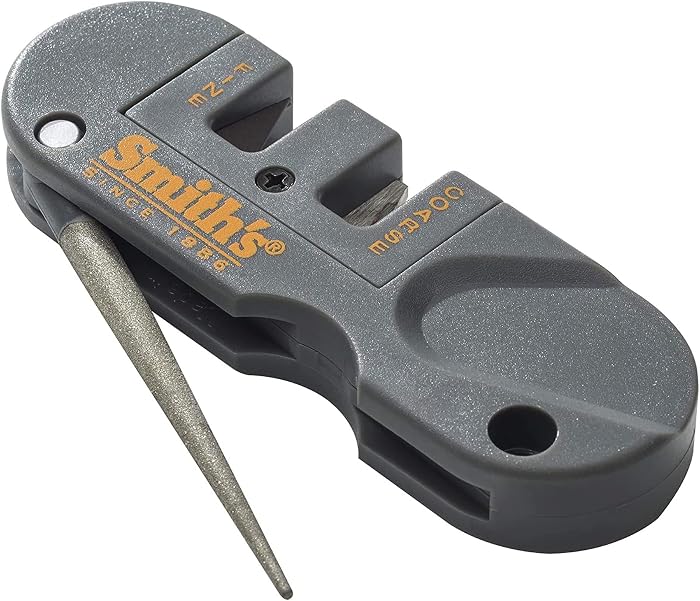
Smith's Pocket Pal

Smith's PP1 Pocket Pal Knife Sharpener Preset Carbide & Ceramic Stone

Everyday carry

Our Score 90/100
Extras
Lanyard hole, reversible replaceable stones
Stages
Carbide, ceramic, fold-out diamond rod
Weight
1 oz
Dimensions
3.24"L x 0.46"W x 1.11"H
View on Amazon

An ounce is light enough that there is no reason to leave it behind, and 3.24 inches means it vanishes into a chest pocket or hangs from a lanyard without swinging into the way of a rifle sling. The Pocket Pal pairs preset carbide and ceramic slots with a fold-out tapered diamond rod, so one small body covers a straight edge, a serrated edge and a gut hook.

The rod is the part that matters on a hunting knife. Tapered diamond gets into the curve of a gut hook and down into the valleys of serrations, where a slot just skates across the tops of the teeth. The carbide and ceramic stones are reversible and replaceable as well, which is more than most pocket sharpeners this size offer.

Where it lands in this group is the tool you keep on you and use often, in short bursts, rather than the one you pull out for a full session. A few passes keeps a working edge working, the lanyard hole keeps it attached to your gear, and the short stroke that comes with a one-ounce body is the price of it being there at all.

Worth Noting

  • Plastic body feels light-duty
  • Short rod for long or heavy blades
Our Verdict

At an ounce and three inches, this is the pocket sharpener we carry when we do not want to think about it — a fold-out diamond rod for gut hooks and serrations included.

Check Latest Price
8

Work Sharp Precision Adjust Best for Benchtop Guided Sharpening

Work Sharp Precision Adjust Knife Sharpener Kit

Benchtop guided sharpening

Our Score 89/100
Setup
Clamped fixed-angle chassis with benchtop base
Angles
15 to 30 degrees
Weight
7.58 oz
Abrasives
320 and 600 grit diamond, fine ceramic
View on Amazon

If your sharpening happens on a kitchen counter once a season rather than on a tailgate, this is the other way to do it. A clamp holds the knife, a rod holds the stone, and the chassis sets the angle anywhere from 15 to 30 degrees. The blade stays still while the abrasive moves, which is the opposite of everything else here and the reason the bevel comes out the same on both sides.

The tri-brasive stone gives you 320 and 600 diamond plus a fine ceramic in one setup, and the guide in the instructions points you to a starting angle for each kind of blade, which saves a lot of guessing. It folds down, needs no power, and stores in a drawer next to the knives it sharpens.

The clamp is where our enthusiasm cools. Folding knives and short fixed blades sit fine; past about six inches the blade can shift under pressure unless you seat it carefully, and the pivoting parts feel less precise than the rest of the kit. On a full-size hunting blade that is the difference between a repeatable bevel and one you keep checking with your thumbnail.

Buy it if your hunting knives are folders or short fixed blades and you want a factory-looking edge without freehand skill. If the knife you carry is a seven-inch skinner, spend the money on a field tool instead — you trade a little precision for a lot less fuss, and you get an edge you can maintain where the work actually happens.

Worth Noting

  • No strop or extra-fine finishing stage
  • Slower setup than any pull-through
Our Verdict

A clamped guided system that takes the guesswork out of folding hunters and shorter fixed blades — our pick for sharpening a whole collection on a counter, not for a long blade.

Check Latest Price

How We Tested Hunting Knife Sharpeners in the Field

We started with a wall of options — keychain pull-throughs, folding pocket models with diamond rods, bench kits with guided angle systems, flat diamond stones — and cut it to 16 units a hunter could reasonably carry or set up at camp. Testing ran six months, from spring turkey season through the fall deer season, and it happened wherever a blade actually goes dull: tailgates, a duck blind, a kitchen counter with a chicken to break down, and a shed full of loppers and hedge shears that hadn't been touched in years.

To get a consistent read on sharpening performance, we dulled the same set of blades on manila rope and corrugated cardboard, then counted strokes until each knife would push-cut printer paper cleanly and shave hair off a forearm. We ran the angle-adjustable models from their widest setting down to their narrowest on one blade to watch the bevel change, and checked whether each one held the knife in the same position through 40 passes without needing to be re-seated. Stability got tested on a slick tailgate and a tilted stump, where a tool that walked or tipped got marked down.

Ease of use was mostly about hands: we sharpened with wet gloves on, in 30-degree weather, and noted which tools needed two hands or a brace against the knee. On the models with a ferro rod and whistle, we struck the rod over dry grass and blew the whistle — both worked, though neither changed how we packed the thing. Quality showed up late, as it always does: we checked handles and housings for cracks after a season riding loose in a pack, and kept count of how many touch-ups each one delivered before the ceramic rods loaded up or the carbide slots stopped biting.

How to Choose a Hunting Knife Sharpener

Start With the Abrasive, Not the Gadget

Every sharpener here does one of three jobs: repairs a damaged edge, hones a working one, or polishes a finished one. Coarse diamond or carbide repairs, ceramic hones, leather or a fine stone polishes. A pull-through that promises a sharp knife in ten seconds is a maintenance tool — it keeps a good edge going, but it will not bring back a blade that has been through hide and bone.

Look for at least one coarse stage and one fine stage, and treat a single-slot sharpener as a touch-up tool. Our top pick covers all three jobs; the budget pull-throughs cover one or two and are priced accordingly.

Decide How Much of the Angle It Should Hold

Sharpening is mostly about holding one consistent angle, and sharpeners split on how much of that they do for you. Preset slots and molded guides handle it: keep the blade upright and pull. Freehand stones and files give you a better edge on a damaged blade but ask you to hold the angle yourself. Clamped guided systems are the most repeatable of all, and the fussiest.

Match the tool to your patience. If you sharpen twice a season on a tailgate, a guided field sharpener is the right call. If you enjoy the process and want a knife that outlasts the gadgets, buy the stone.

Weight and Where It Lives

A one-ounce sharpener in your pocket beats a four-ounce one in the truck. The lightest options here, the Smith's Pocket Pal at an ounce and the SHARPAL 101N at 2.4 ounces, are the ones you will actually carry all season, but their short strokes make a full rebevel slow work.

The four-to-five-ounce tools with real abrasive surface, like the Work Sharp Guided Field Sharpener, need a pack and reward you with a complete edge. Decide where the sharpener will live, then buy the largest one that still fits there.

Field Features Worth Paying For

On a hunting knife, the features that matter reach the parts a slot cannot: a tapered diamond rod for serrations and gut hooks, a groove for fish hooks, a lanyard hole so the tool does not walk off a tailgate, and a body bright enough to find at the bottom of a dark pack. A broadhead wrench is a genuine bonus if you bowhunt.

None of these sharpen better than the abrasive does, but they are the reason a tool comes with you and gets used rather than staying in the truck.

Keeping the Abrasive Cutting

Diamond and ceramic cut by exposing fresh abrasive, and both clog with steel dust long before they wear out. A few strokes with a stiff brush or a wipe with a damp cloth after each session keeps them working; a loaded ceramic slot burnishes the edge instead of sharpening it.

Check the warranty before you buy, too. Work Sharp's limited lifetime coverage excludes the abrasives, which is the part that eventually fails. Replaceable stones, like the ones on the Smith's Pocket Pal, are worth paying a little more for if you sharpen often.

Frequently Asked Questions

Final Verdict

The Work Sharp Guided Field Sharpener is the one we tell hunters to buy. It is the only sharpener here that repairs, hones and strops in a single 4.6-ounce tool, and the 20- and 25-degree guides mean someone who has never sharpened a knife can hold a real bevel on the first try.

If you want something that vanishes into a pocket, the Lansky Blademedic is the better carry. If your blade has a nick in it, the SHARPAL 181N diamond stone will take it out faster than any slot sharpener on this list.