Best Induction Heating Rice Cookers of 2026

An induction rice cooker doesn't heat the way the old appliance on your counter did. The inner pan itself becomes the heating element, so heat spreads across the whole pot instead of rising from a single coil underneath. What that doesn't tell you is why one machine hands back glossy, separate grains and another produces a cake of rice fused to the bottom.

I cooked rice on a stovetop for years before I understood how much of the result comes down to the boring parts. Rice held on keep-warm for six hours should still taste like rice, not like the inside of a paper bag. The pan coating needs to survive a spatula and a sink, the fan shouldn't whine through dinner, and the lid ought to come apart so you can actually wash the starch out of the corners.

Size also deserves more thought than the box gives it, since a 10-cup pot cooking two cups is exactly where texture goes wrong. We cooked through 10 machines over seven months, and the ones below are what I'd spend my own money on for weeknight rice, weekend porridge, and a Sunday batch of grains.

Our Top Picks

The 5 Best Induction Heating Rice Cookers of 2026

1

Zojirushi NW-QAC18 10-Cup Best Overall

Zojirushi Nw QAC18 10 Cup Induction Rice Cooker and Warmer (Black)

Most households

Our Score 91/100
Heating
Induction, 1310 watts
Capacity
10 cups
Inner Pot
Double nonstick coating
Dimensions
13.38 x 10.38 x 9 in
View on Amazon

Look inside the pot and you'll find water lines for half a cup of white rice, all the way at the bottom of the scale. That detail is why this ended up as our top pick. A 10-cup cooker usually forces a choice between a family batch and nothing, and this one will cook one bowl on a Tuesday and twenty cups for a dinner party on Saturday. At 1310 watts it is the most powerful non-pressure machine in this group, and the induction element heats the pot itself rather than a hotplate underneath it.

The menu covers what we actually cook: white and quick white, jasmine and quick jasmine, sushi/sweet, mixed, congee, and a steam function with a BPA-free tray that earns its keep on vegetables. Consistency is what we are paying for here. Because the whole pan comes up to temperature at once, a batch cooks the same at the edges as it does in the middle, which is the difference between rice you serve and rice you stir and hope.

The fan is the part to know about. This cooker pulls air in at the back and pushes it out the front for the entire cycle, so it hums while the rice cooks and goes silent the moment it drops into keep warm. In a closed kitchen you stop hearing it. In an open-plan room with the TV on, you won't.

Zojirushi covers this one for three years, the longest stated warranty here, and the double nonstick coating releases rice to a soft sponge rather than a soak. Nothing about it is fussy, which is the highest compliment we can pay a machine that is going to sit on your counter for a decade: this is the one to hand to someone who wants to stop thinking about rice.

Worth Noting

  • Cooling fan hums through the whole cook cycle
Our Verdict

We recommend this to nearly everyone: the most capable non-pressure induction cooker here, and one that treats a single bowl with the same care as a family batch.

Check Latest Price
2

Zojirushi NP-GBC05XT 3-Cup Best for One or Two People

Zojirushi NP-GBC05XT Induction Heating System Rice Cooker and Warmer

Small kitchens

Our Score 90/100
Heating
Induction, 700 watts
Capacity
Up to 3 cups / 0.54 L
Inner Lid
Detachable, hand wash
Dimensions
9.12 x 11.87 x 7.5 in
View on Amazon

Nine inches wide and seven and a half tall, this is the induction cooker that goes where a bigger one can't: under the upper cabinets, on a narrow run of counter beside the sink, on a shelf in a small kitchen. There's a carrying handle and a detachable cord, which tells you Zojirushi expects it to move.

The rice is why we kept coming back to it. Brown rice is the test, and the GABA setting gives the grain a long warm soak before the cook, so what comes out has the husk's edge softened off it instead of a bowl of chewy hulls. Sushi, porridge, mixed, rinse-free, and a quick cycle round out a menu that covers more than most three-cup machines bother to, and the thick spherical pan heats evenly enough that small batches don't scorch at the center.

Three cups is the real constraint: about six cups cooked, which is dinner for two with a lunch left over and not a grain more. Guests mean cooking twice or dragging out a bigger pot. What it does, it does in less space than anything else here, and if your household is one or two people who eat rice most nights, that is the entire calculation.

Worth Noting

  • Costs about the same as the 10-cup Zojirushi
  • Inner pot coating can flake over time
Our Verdict

For one or two people who eat rice most nights, this is the pick: the best brown rice here, in a body small enough to stay on the counter.

Check Latest Price
3

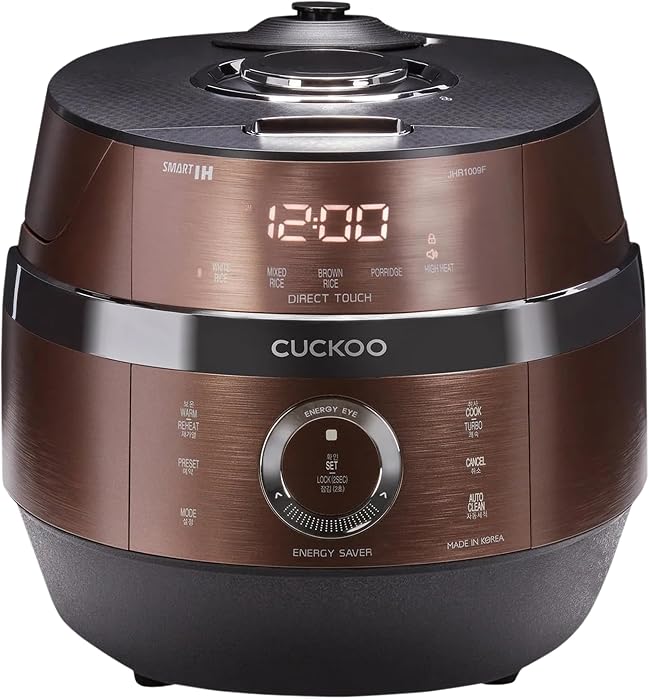
Cuckoo CRP-JHR1009F 10-Cup Best Pressure Induction

Cuckoo CRP-JHR1009F 10-Cup

Sticky rice fans

Our Score 86/100
Heating
Induction, 1000 watts
Capacity
10 cups uncooked, 20 cooked
Pressure
29 PSI (200 KPa)
Dimensions
16.3 x 12 x 12 in
View on Amazon

Twenty-nine PSI is the number that separates this Cuckoo from everything else here. Pressure raises the temperature inside the sealed pot, which drives the starch conversion behind short-grain rice's gloss and stick, and the result is the plump, faintly tacky grain you get in a good Korean restaurant, a texture the plain induction machines here can't quite reach.

The rest of the machine is generous in the way Korean appliances tend to be. The menu runs from GABA brown and glutinous/white through porridge and pressure cook to nu rung ji, the scorched-rice setting that gives you the crisp bottom layer worth scraping out of the pot. There is an auto-clean cycle, a stainless steam plate, and a voice guide that announces what it is doing, which sounds like a gimmick until you are across the kitchen with wet hands. We like that voice more than we expected to.

Whether it is the right buy comes down to the grain you eat. Short-grain, sushi rice, sticky rice, and porridge are where pressure pays for itself; if you mostly cook jasmine to go with a stir-fry, you want the separate, firmer grains a plain IH cooker gives you and you'll spend less getting them. It is also the heaviest thing here at about 22 pounds and 12 inches tall, so plan a permanent spot with headroom for the lid rather than a shelf in the pantry.

Worth Noting

  • Priciest cooker in this group
Our Verdict

Buy this if texture is the reason you're shopping: 29 PSI produces the plumpest, glossiest short-grain rice here, and it scales to a houseful.

Check Latest Price
4

Tiger JKT-D18U 10-Cup Best for Weeknights

TIGER JKT-D18U 10-Cup Induction Heating Rice Cooker

Fast weeknight rice

Our Score 85/100
Capacity
Up to 10 cups dry, 20 cooked
Inner Pot
3-layer ceramic, 1.5 mm
Keep Warm
Up to 24 hours
Express Setting
As fast as 20 minutes
View on Amazon

Tiger's express menu promises white rice in as fast as 20 minutes, and the qualifier is the whole story: it is for a limited amount of rice, not a full pot. As a bowl-right-now button for one or two people it is the fastest thing in this group. As dinner for six at quarter to seven, you are back to a normal cycle like everybody else.

Where this one earns its place is the pot. The inner pan is 1.5 mm thick with three layers of ceramic coating rather than the usual nonstick, and rice lifts off it cleanly instead of sticking and tearing, so the grains separate when you stir rather than clumping. Twelve settings, two preset timers, 24-hour keep warm, a detachable steam cap and inner lid, and a cake-bake mode we did not expect to find on a rice cooker round it out.

It is a weeknight machine rather than a banquet machine. The express cycle and the clean release are what you will actually use, and both reward small, frequent batches. If you regularly cook a full 10-cup pot for a crowd, the Zojirushi's extra power and broader menu suit that job better; for the nightly two-cup habit, this one is quicker and easier to live with.

Worth Noting

  • Widest body here at 15 inches
  • Warranty covers only one year
Our Verdict

The weeknight pick: rice in as little as 20 minutes and a ceramic-coated pot that lets go of every grain, for cooks who decide about dinner at 6:40.

Check Latest Price
5

Toshiba TRSH01 5.5-Cup Best for Low-Carb Cooking

TOSHIBA Rice Cooker Induction Heating

Low-carb cooking

Our Score 84/100
Heating
Induction, 1130 watts
Capacity
5.5 cups uncooked
Functions
8 cooking settings
Dimensions
11.89 x 10.43 x 8.66 in
View on Amazon

The gap between this Toshiba and the rest of the group is the first thing we noticed. It is the cheapest induction machine here by a comfortable margin, and it still gives you 1130 watts, a locking lid, a detachable cord, an automatic shutoff, and a five-and-a-half-cup pot sized for three or four people.

The feature list is where it gets interesting. Eight functions include a low-carb cycle, a quinoa setting, an oatmeal setting, and a steam basket that sits down in the pot. Toshiba designs the low-carb mode to leave more resistant starch behind, and what you taste is firmer, less clingy rice than the standard white cycle produces. Whether that is an improvement depends on the grain you like, but it is a real change rather than a renamed button.

For a household that wants induction, a low-carb cycle, and a steam basket without paying premium money, this is a sensible buy. The pot is the part that ages, so treat it accordingly: plastic paddle, soft sponge, no dishwasher, and don't count on handing the machine to your kids. If longevity is the priority, the Zojirushi models are built for it. If you want the everyday pot and the diet-specific jobs covered for the least money, this is your cooker.

Worth Noting

  • No dedicated jasmine or GABA brown setting
Our Verdict

The value route into induction: a 5.5-cup pot with a low-carb cycle that genuinely changes the rice, provided you look after the coating.

Check Latest Price

How We Chose and Tested Induction Rice Cookers

We started with every induction model we could find from the major appliance and cookware makers, then filtered by capacity (roughly 5.5 to 10 cups uncooked), menu range, delay timer and keep-warm options, and whether replacement inner pans were sold separately. That last filter cut more than you'd expect, because a cooker you can't buy a new pan for is a two-year appliance. Ten machines made the cut, and we bought each one at retail and ran it for seven months.

They lived on kitchen counters, not on a lab bench. We cooked medium-grain white rice twice a week for households of two to six people, made a big Sunday batch for weekday lunches, and pushed each machine through brown rice, congee, and mixed grains. Every batch went in with the maker's own measuring cup so the water ratios stayed constant, and after each one we checked whether the rice at the rim matched the rice at the center.

Keep-warm got its own test: we held a batch for 6 hours and then 12, tasting at each mark for dried edges and that faint scorched smell. We timed the quick cycles against the standard ones, dragged a spatula through the finished rice to see how much stuck, hand-washed the pans and watched for coating scuffs, and stood in a quiet kitchen listening to each cooling fan. For every machine we kept a running log of error codes, cycles that quit early, and hinges or gaskets that started to hold odor. The clearest pattern: small pots handle two-cup batches noticeably better than the 10-cup ones, which is worth knowing before you buy big for company.

How to Choose an Induction Heating Rice Cooker

Capacity Is Measured in Rice-Cooker Cups

That cup in the listing is the 6-ounce (180 mL) measure that comes in the box, filled with raw rice, not the cup you eat with. A cup of raw rice yields roughly two cups cooked, so a 3-cup machine makes about six cups: dinner for two with a lunch left over. The 10-cup machines make around twenty, enough for a family plus a few containers for the freezer.

Don't undersize out of fear of waste. The Zojirushi NW-QAC18 prints water lines for half a cup of white rice, so a big pot still cooks a single bowl. And price barely tracks capacity here: the 10-cup models cost about what the 3-cup one does, which makes the larger machine the better value if you have the counter for it.

Induction, Then Pressure

An IH rice cooker heats the pot itself with a magnetic field, so the whole pan comes up to temperature instead of a hotplate scorching one ring in the middle. Pressure goes a step further: the Cuckoo CRP-JHR1009F seals to 29 PSI, which raises the cooking temperature and drives the starch conversion behind short-grain rice's gloss and chew.

Choose plain induction for jasmine, basmati, and any grain you want separate and firm. Choose pressure for sushi rice, sticky rice, and porridge, and expect to give up counter space, because pressure bodies are larger and heavier than a plain IH machine of the same capacity.

The Settings Worth Paying For

Brown rice is the honest test of these machines. A GABA brown cycle holds the grain at a warm soak before cooking, which softens the bran and gets you brown rice that tastes nutty rather than husky. The Zojirushi NP-GBC05XT has it, and if brown rice is a weekly habit, that one setting justifies the upgrade.

Past that, look for a jasmine setting, a quick cycle for the nights you forgot to plan, and a rinse-free mode if you buy pre-rinsed rice. Length of menu is not the point. You will use three settings, and the rest are there to make the control panel look busy.

Cleaning: Removable Lids, Hand-Washed Pots

None of these inner pots go in the dishwasher, and the parts that decide how pleasant cleanup is are the inner lid and the steam cap. The Tiger and the small Zojirushi both have lids that lift out and rinse clean, and the Cuckoo's inner parts come apart for a thorough wash.

The nonstick coating is the real maintenance item. Use the plastic paddle that comes in the box, skip the scouring pad, and don't stack anything inside the pot between uses. Replacement pots are sold separately at real money, which is why the coating rather than the electronics is usually what ends a rice cooker's life.

Where It Will Live

Measure before you order. Ten-cup bodies run 13 to 16 inches deep and up to 12 inches tall, and a hinged lid needs headroom to swing, so check counter depth and the clearance under the upper cabinets together rather than one at a time.

Induction models also run a cooling fan. The Zojirushi NW-QAC18 pulls air in the back and pushes it out the front for the whole cook, then goes quiet once it drops to keep warm, which is irrelevant in a closed kitchen and noticeable in an open-plan room. Pick the spot before you pick the machine.

Frequently Asked Questions

Final Verdict

For most kitchens, the Zojirushi NW-QAC18 is the one to buy. It is the most capable non-pressure induction cooker in this group: highest wattage, widest menu, and water lines that let a 10-cup pot cook a single bowl. It also costs roughly what the 3-cup Zojirushi does, which makes the capacity almost free.

Two people with a narrow strip of counter should take the NP-GBC05XT instead: same brand, same quality in the bowl, much less space. And if plump, sticky short-grain rice is the reason you are shopping, the Cuckoo's 29 PSI is the upgrade worth paying for.