Best Nakiri Knives of 2026

The nakiri took over my cutting board somewhere around the third head of cabbage. A chef's knife rocks; a nakiri drops — straight through the onion, straight through the carrot — and the slices land clean instead of bruised. It's the one blade shape I've watched convert skeptical cooks, and over the past eight months my team and I have put 11 of them to work on weeknight stir-fries, Sunday meal prep, and a very large batch of coleslaw.

The mistake most shoppers make is falling for the swirls of a Damascus pattern, which say nothing about how a blade cuts. What matters is the steel underneath, a blade tall enough to clear your knuckles, and a handle that feels secure in a pinch grip. Sharpness out of the box is easy; sharpness in month six is the harder trick, and that's where price gaps start to show. Every knife below earned its place at the board, and one of them earned it in the first five minutes.

Our Top Picks

The 8 Best Nakiri Knives of 2026

1

PAUDIN Nakiri 7-Inch Best Overall

PAUDIN Nakiri 7-Inch

Everyday vegetable prep

Our Score 97/100
Weight
7.94 oz
Hardness
56+ HRC
Blade Steel
5Cr15Mov stainless
Blade Length
7 inches
View on Amazon

The PAUDIN costs a fraction of what the Shun does, and on a board full of onions it gives up less than that gap suggests. Seven inches of blade, 225 grams, and a balance that sits close to where you pinch it — those were the first three things we noticed, and the three we kept coming back to dinner after dinner. For most home cooks this is the nakiri to buy.

The blade is 5Cr15Mov stainless with a stated 56+ hardness, which is softer than the Japanese steels further up this list. That's less a flaw than a personality: it won't hold a polished edge as long as VG-MAX, but a dozen passes on a honing rod bring it back, and it sharpens on a stone without a fight. Out of the box it went through tomato skin without a sawing motion and left clean slices instead of crush marks.

Don't expect the flat blade face to shed wet potato slices, because it won't — a nudge with your fingers is part of the routine, and the hammered and scalloped blades here do better on that front. The pakkawood handle, by contrast, is genuinely comfortable: smooth, slightly swollen at the middle, and neutral enough for a pinch grip or a fist. The blade is tall enough that your knuckles clear the board, and tall enough to scoop what you've cut straight into the pan.

Where it stops being enough is edge longevity. If you chop daily and touch up a knife twice a year, the softer steel will send you to the rod more often than the harder blades here — and that, not the finish, is the real reason to spend more.

Worth Noting

  • Cosmetic wave pattern, not layered Damascus
Our Verdict

We recommend it as the default nakiri for home cooks: a sharp, balanced 7-inch blade, a comfortable handle, and a price that leaves room for a whetstone.

Check Latest Price
2

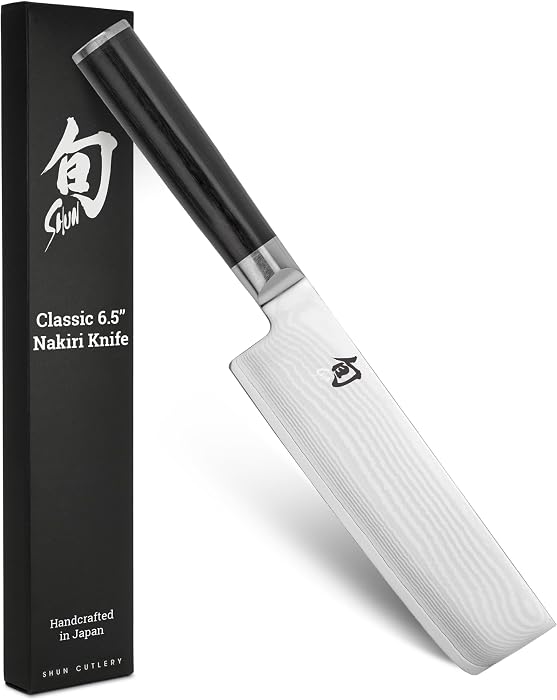
Shun Classic Nakiri 6.5-Inch Best Splurge

Shun Classic 6.5" Nakiri Knife

Serious home cooks

Our Score 96/100
Weight
7.41 oz
Edge Angle
16 degrees
Blade Steel
VG-MAX core, 68-layer Damascus
Blade Length
6.5 inches
View on Amazon

Six and a half inches is the shortest blade here, and it changes how the knife moves on a crowded board: there's less steel to steer, so the cut stays under your knuckles and the blade turns quickly from a pile of carrots to a head of cabbage. We expected to want the extra half inch. We stopped noticing it by the second onion.

What you're paying for is steel and grind. A VG-MAX core wrapped in 68 layers of Damascus cladding, taken to a 16-degree edge and finished in Japan, and it is the keenest blade in this group out of the box — it goes through tomato skin under its own weight and holds that bite far longer than the German steels here. The thin geometry is also why it feels lighter than its 210 grams.

The D-shaped pakkawood handle fills the palm and puts your hand close to the edge, which suits the pinch grip this knife rewards. It also carries a limited lifetime warranty, the sort of thing that matters when you're putting this much into one blade. What it is not is a knife for frozen spinach or chicken bones; a 16-degree edge on hard steel wants a light hand and a wood board.

Worth Noting

  • Hard, thin edge chips if you hit bone or frozen food
Our Verdict

Buy this one if you want the sharpest factory edge here and will treat the blade with respect; it's the nakiri to keep for a decade.

Check Latest Price
3

Mercer Genesis Nakiri 7-Inch Best Workhorse

Mercer Culinary M20907 Genesis 7-Inch Nakiri Vegetable Knife

Busy, wet kitchens

Our Score 95/100
Handle
Santoprene
Warranty
Lifetime
Blade Steel
High-carbon German steel
Blade Length
7 inches
View on Amazon

The handle is the reason to buy this one. Mercer molds it from Santoprene, a soft black rubber that stays grippy when your hands are wet and slick with onion juice — something none of the pakkawood handles here manage. Pair that with forged German steel and a lifetime warranty, and you have the knife we reach for when the cooking gets messy.

The blade is high-carbon German steel, forged and taper-ground, with enough bulk behind the edge to drop through a sweet potato or a wedge of winter squash without a fight. It's a workhorse rather than a laser: thin tomato slices take more attention than they do with the Global, and the taper means the edge responds well to a rod rather than demanding a stone.

Care is simple. Hand wash it, dry it, and give it a few passes on a ceramic rod once a week to keep the taper-ground edge biting, and it will keep going for years. That low-maintenance routine is the whole pitch — nothing here needs babying, and the lifetime warranty backs the blade.

Worth Noting

  • Utilitarian looks next to the Damascus picks
Our Verdict

Our pick for anyone whose hands are wet and busy: the rubber grip and forged German blade take abuse that would make a wooden-handled knife nervous.

Check Latest Price
4

Global G-5 Vegetable Knife Best Lightweight

Global G-5 Vegetable Knife

Light, precise slicing

Our Score 94/100
Handle
Stainless steel
Weight
6.77 oz
Blade Steel
Molybdenum/vanadium stainless
Construction
Stamped
View on Amazon

At 192 grams the Global is the lightest knife in this group by a wide margin, and your wrist finds out before your brain does. A nakiri has almost no tip, so all of your force travels straight down through the edge; less mass means less to lift and more control at the end of a long prep.

Stamped construction is usually shorthand for cheap. Here it's a different set of priorities: thin molybdenum-vanadium steel, hard and fine-grained, that takes an exceptionally keen edge and makes the thinnest tomato slice of anything we tested. The all-steel handle is dimpled, and the dimples aren't decoration — polished stainless is treacherous when wet, and the pattern gives your fingers somewhere to sit.

It's also the pick for anyone who wants a knife they can sanitize without thinking about wood: the one-piece steel handle wipes clean, never needs oiling, and shrugs off a hot soapy cloth. What it doesn't give you is warmth — this is a tool, and it feels like one, which is either the appeal or the dealbreaker.

Worth Noting

  • Thin stamped blade has little heft for dense squash
Our Verdict

Choose it if you want the lightest, most precise slicer here and don't need forged heft to get through dinner.

Check Latest Price
5

SYOKAMI Nakiri 7.2-Inch Best for Long Prep Sessions

SYOKAMI Nakiri 7.2-Inch – Nakiri Knife

Big-batch meal prep

Our Score 93/100
Handle
Wood
Blade Steel
High-carbon German steel
Blade Length
7.2 inches
Construction
Forged, full tang
View on Amazon

Give it a sheet pan of carrots, peppers, and onions and the SYOKAMI's 7.2 inches start to make sense: the blade covers a whole row at once, so you're not chasing the last piece of pepper around the board. It's the longest blade in this group, and on volume prep that length is the difference between one pass and three.

The build is the other half of the story. Full-tang construction with three rivets means the handle and blade are one solid piece, which you feel when you press down on a hard carrot; the raised finger guard keeps your hand behind the edge, and the textured spine gives your thumb something to press against for fine julienne. The German steel runs at a stated 56+ hardness, so expect to hone on roughly the same rhythm as the PAUDIN rather than chase a forever edge.

We like it best for cooks who prep in batches — the length and solidity suit a Sunday of meal prep more than a quick salad, and the gift box makes it an easy present for someone setting up a first kitchen. What it isn't is delicate: the extra reach and the wide blade make tight, controlled work feel clumsier than the Shun's shorter profile.

Worth Noting

  • Hand wash only; wood handle rules out the dishwasher
Our Verdict

The pick for big-batch cooks: a long, solid full-tang blade that covers a sheet pan in fewer passes, at a budget price.

Check Latest Price
6

Sunnecko Nakiri Best Budget

Sunnecko Nakiri – Nakiri Knife

First-time nakiri buyers

Our Score 92/100
Handle
Pakkawood
Edge Angle
12 degrees
Blade Steel
High-carbon stainless
Construction
Forged
View on Amazon

Twelve degrees is the most acute edge angle in this group, and you feel it the moment the blade touches an onion: it bites, then glides, with no sawing and no crush marks left on the tomato.

What else the least expensive knife here gets you is a short list — a hand-polished high-carbon stainless blade, a pakkawood handle, and a plastic sheath. The sheath sounds like nothing and isn't: it's the difference between a knife that rides in a drawer without damage and one that picks up chips.

Sunnecko doesn't quote a hardness figure, so judge the steel by the grind. A 12-degree bevel is quick to restore on a stone — a dozen light passes and it's back — which suits a knife at this price and makes it a friendly thing to learn sharpening on.

For a first nakiri, or a second one for a small kitchen, we think it's the smartest buy on the page: the edge is genuinely impressive, the sheath means it can live in a drawer, and if you decide the shape isn't for you, you've risked almost nothing. This is a knife that rewards a light hand, not a careless one.

Worth Noting

  • Acute edge chips more readily than harder grinds
Our Verdict

A smart first nakiri: an impressively acute edge, a sheath for drawer storage, and very little money at risk if you don't take to the shape.

Check Latest Price
7

HOSHANHO Nakiri 7-Inch

HOSHANHO 7 Inch Nakiri Knife

Cooks who like heft

Our Score 91/100
Handle
Pakkawood
Edge Angle
15 degrees
Blade Steel
10Cr15CoMoV
Blade Length
7 inches
View on Amazon

The HOSHANHO is the heaviest knife in this group, and it announces itself the moment you pick it up: the mass sits forward in the blade and the whole thing wants to fall through whatever is under it.

That weight earns its keep on carrots and sweet potato, where you can let the knife do the work instead of pressing. The blade face is scalloped with shallow oval hollows that break the suction between wet slices and steel, so cabbage and cucumber slide off instead of clinging — the detail we appreciated most on a sticky, humid afternoon of prep. The core is Japanese 10Cr15CoMoV, hand-polished to a 15-degree edge, and the pakkawood handle meets the steel flush, with no ledge to catch water.

We rate it for heavy prep and for cooks who like to feel the blade working. The one thing to respect is the edge: at 15 degrees on a hard steel it will chip if you pry through a joint or swing into bone, so keep it for vegetables and boneless proteins and let a cleaver handle the rest.

Worth Noting

  • Heavy blade tires smaller hands over a long prep
Our Verdict

Buy it if you like a knife with real weight behind the cut and prep hard vegetables by the pile; the scalloped face keeps wet slices moving.

Check Latest Price
8

SHAN ZU Damascus Nakiri 7-Inch Best for Damascus Fans

SHAN ZU Damascus Nakiri Knife 7 Inch

Damascus fans

Our Score 90/100
Handle
Maple
Hardness
62 HRC
Blade Steel
10Cr15MoV core
Blade Length
7 inches
View on Amazon

The pattern is the pitch. Thirty-three layers of copper and carbon steel are forged around a hard core, and the result is a gold-flecked, swirled blade face that looks nothing like the muted Damascus on the Shun — in a block or on a wall strip, it's the knife people pick up first.

Under the pattern sits a 10Cr15MoV core taken to a stated 62 HRC, the hardest steel on this list. That buys edge retention: this is the blade that should go longest between sharpenings. It also costs you sharpening time, because very hard steel is slower to bring back on a stone.

At 200 grams over seven inches it feels closer to the Shun than to the heavier blades here, quick and neutral in the hand, and the maple handle is contoured rather than a flat slab — a small thing that matters over a long prep. The Shun costs more and carries a limited lifetime warranty; this one costs less and looks louder. Which you want depends on whether you're buying a tool or an object.

We think it earns its place for a specific buyer: someone who wants a display-grade blade and doesn't mind paying for the finish. If the knife is going to live in a drawer and get used on squash, buy the Mercer or the PAUDIN instead and put the difference toward a whetstone.

Worth Noting

  • Hard 62 HRC edge is brittle under rough handling
Our Verdict

The pick for someone who wants a showpiece: a 62 HRC core under a copper Damascus finish, at less than the Shun.

Check Latest Price

How We Tested 11 Nakiri Knives in Real Kitchens

We built the shortlist by reading specs and reviews for every nakiri we could find — small Japanese workshops, restaurant-supply brands, direct-to-consumer labels — then narrowed to 11 knives spanning different steels, blade heights, handle materials, and price bands. Testing ran eight months in our own kitchens, where these knives did what nakiris actually do: onions for soup, cabbage for slaw, carrots, mushrooms, and herbs, on weeknights and through long Sunday prep sessions.

Sharpness got measured twice, not once. On day one we sliced printer paper and a tomato with each blade, noting whether it caught or glided, then cut ten onions and watched whether the blade dropped straight through the layers or wandered off course and crushed them. Every two weeks we repeated the tomato test and wrote down the first session where a knife started to skid.

Three cooks with very different hand sizes did the chopping, and we tracked the small stuff: whether a handle turned slick once onion juice hit it, where a spine dug into a finger during a pinch grip, and whether the blade was tall enough to keep knuckles off the board. Durability was less glamorous. Every knife was washed and dried by hand after each use, one sat wet in the sink for twenty minutes to see what the steel did, and we checked handle seams for gaps and edges for chips every few weeks.

At the end we asked the value question: did the extra money buy anything you could feel? Sometimes yes, and sometimes we genuinely couldn't tell a knife at one end of the price range from a knife at the other. The Damascus cladding and the wood handles we judged by eye as well, since a knife that lives out on the counter has to be worth looking at.

How to Choose a Nakiri Knife

Length and Height Matter More Than You Think

Most nakiri run 6.5 to 7.2 inches, and the difference shows on a crowded board: a shorter blade turns faster and keeps the cut under your knuckles, while a 7-inch-plus blade covers a whole carrot or half a cabbage in one pass. Height matters just as much, because the tall blade is what gives you knuckle clearance and turns the knife into a scoop for moving chopped food to the pan.

Cooking for two? Six and a half inches is plenty. Prepping in volume, or working through a farm share every week? Go 7 inches or longer.

What the Steel Actually Buys You

Hardness is the number worth hunting for. Softer steels around 56 HRC, like the PAUDIN's, sharpen quickly on a rod and shrug off casual treatment; harder cores such as VG-MAX or 10Cr15MoV hold a fine edge longer but take more work to restore and chip more readily when twisted.

And Damascus cladding is decoration wrapped around a core. Thirty-three or 68 visible layers say nothing about how the knife cuts — buy the core steel and the edge angle, not the pattern.

Weight and Balance Decide How Long You Can Prep

These knives run from just under 200 grams to well over 300, and the difference shows up in the last ten minutes of a big prep rather than the first. A nakiri has almost no tip, so all your force goes down through the edge: a light knife is easier to lift and steer, a heavy one falls through squash under its own weight.

Small hands and long sessions favor the light end; big batches and hard vegetables favor mass. Balance matters more than the total — the knife should feel neutral where you pinch it.

Handles, Wet Hands, and Grip

Pakkawood and other woods look better and feel warmer, but they get slick once your hands are wet. A molded rubber handle, like the Mercer Genesis's Santoprene, is the safer choice if you're usually holding a knife with onion juice on your fingers, while an all-steel handle wipes clean and never needs oiling at the cost of grip and shock absorption. Buy for the grip you actually use: most nakiri work happens in a pinch grip, thumb and forefinger on the blade.

Care Is What Keeps the Edge

Every wood-handled knife here should be washed by hand and dried right away, because heat and detergent dry out and crack the scales, and a dishwasher rack can roll a fine edge. Store on a magnetic strip or in a sheath rather than loose in a drawer, hone lightly and often, and sharpen rarely and properly.

Keep the edge off bone, frozen food, and glass or stone boards. A wood or plastic board does more for edge life than any honing steel.

Frequently Asked Questions

Final Verdict

Buy the PAUDIN. It gives you a full seven inches of sharp, well-balanced blade in a handle that suits most hands, and nothing in our testing suggested it gives up much to knives costing several times as much. Spend more only for a reason: the Shun if you want harder steel and a keener, longer-lasting edge, the Mercer if your hands are wet all night, the Global if you want the lightest knife on the board, or the SHAN ZU if the knife is also decoration.