Best Oyster Knives of 2026

Shucking an oyster is mostly about confidence—and the right knife. The wrong one slips, bends, or leaves you fishing for shell fragments. Over the past five months, my team and I have shucked our way through 14 oyster knives, from classic New Haven-style bent tips to full kits with cut-resistant gloves.

We wanted to know which ones pop the hinge cleanly, which handles stay grippy when your hands are wet and briny, and which tips hold their shape after a few dozen shells. A good oyster knife isn’t fancy; it’s a lever with a guard. But the differences in steel, blade shape, and handle material are real—and they show up fast when you’re staring down a dozen Blue Points. We also paid attention to value: a budget knife that shucks like a dream beats a pricier one that doesn’t. The picks below are the ones we kept reaching for.

Our Top Picks

The 9 Best Oyster Knives of 2026

1

Dexter-Russell Sani-Safe Oyster Knife Best Overall

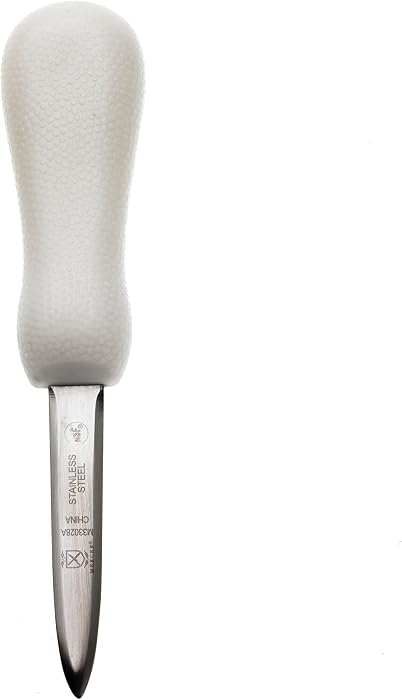
Dexter-Russell Sani-Safe 2.75" New Haven Oyster Knife

All-around shucking

Our Score 96/100
Care
Hand wash
Handle
Textured Sani-Safe
Blade Style
New Haven, curved tip
Blade Length
2.75 inches
View on Amazon

The bent tip found the hinge on the first oyster we opened with it, and that's not a small thing. The New Haven tip is angled just enough to drop into the seam at the back of the shell, so opening starts with a light push rather than a shove. The 2.75-inch blade is short enough that the work happens at your wrist, and the shell lifts instead of shattering.

What puts this one ahead of the other New Haven knives in this guide is what happens after the fiftieth shell. The carbon steel stays stiff — no flex, no set, no wobble where the blade meets the handle — and the textured Sani-Safe grip is the surest thing here once your hands are wet. We also like that the handle is ambidextrous and slightly squared, so it doesn't rotate as you turn the knife.

It's hand wash only, which matters with carbon steel: dry it before it goes back in the drawer or you'll find spots along the edge. The other trade-off is width. The blade is thick enough to be strong, and on the smallest, tightest oysters in a batch it has to be worked in where the Victorinox slips straight through.

Eight inches overall puts the balance point back in your palm rather than out at the tip, and that's where the control comes from. Worth noticing if every shucker you've owned has been short and handle-heavy.

Worth Noting

  • Blade is thick for the smallest oysters
  • Carbon steel must be hand washed and dried
Our Verdict

We recommend it as the default oyster knife: a stiff bent tip that finds the hinge, a handle that stays put when wet, and no drama after a hundred shells.

Check Latest Price
2

Victorinox Hooked Tip Oyster Knife Best for Tight Hinges

Victorinox Oyster Knife 2-3/4-Inch Hooked Tip New Haven Style Blade

Small, tight oysters

Our Score 95/100
Care
Dishwasher safe
Handle
SuperGrip synthetic
Blade Style
New Haven, hooked tip
Blade Length
2.75 inches
View on Amazon

The hooked tip on this one is finer than the Dexter's, and that taper is the whole reason to buy it. On the small, tight-shelled oysters — the ones where a thicker blade needs two or three attempts to find the seam — the hook slides in on the first or second try. We noticed it most on the little ones that usually get left for last at the end of a tray.

The rest of the knife is built for a kitchen that doesn't baby its tools. The blade is stainless, the whole thing is dishwasher safe, and Victorinox backs it with a lifetime warranty against defects. There's a slight swell to the SuperGrip handle that keeps it from turning in a wet palm, and the tip is fine enough that the oyster comes away without tearing.

The trade is feel. A fine point on a big, knobby shell means more probing before you find the hinge, so if you shuck palm-sized Gulf oysters you'll want the Rockland Guard's heavier blade instead. For small oysters, a couple of dozen at a time, and a knife that gets rinsed in the machine afterward, this is the pick.

Worth Noting

  • Fine tip needs more probing on large shells
Our Verdict

Ours for tight, small oysters: the fine hooked tip goes where thicker blades have to be worked, and it can go straight into the dishwasher.

Check Latest Price
3

OXO Good Grips Oyster Knife Best for Beginners

OXO Good Grips Stainless Steel Non-Slip Oyster Knife

Beginners, wet hands

Our Score 94/100
Tip
Bent
Care
Dishwasher safe
Handle
Soft, non-slip
Weight
3.17 oz
View on Amazon

Wet hands are where shucking goes wrong, and the OXO is built around that problem. The handle is fat, soft, and rubbery, and it stays put even when your palms are slick. We handed it to the least experienced shucker at the table, and by the end of the first dozen they were opening shells without help — about the highest compliment you can pay a beginner's knife.

The bent tip does the same job as the New Haven knives, and the proportions are friendly: 6.75 inches overall, which puts your hand right up against the shell. It's dishwasher safe, the stainless doesn't complain about a sink full of dishes, and the handle is big enough to give you real torque on a stubborn shell without squeezing.

That handle is also the catch. It's the largest here, and small hands will find it a lot to wrap around, which is the opposite of the control a beginner needs. It's a fit question rather than a flaw, but it's worth thinking about if your hands run small. For everyone else it's the most forgiving knife on this list to learn on.

Worth Noting

  • Bulky handle is a lot for smaller hands
  • Bent tip can take a set if you lean on it
Our Verdict

We hand this to beginners: the fat soft handle keeps a wet grip, and it opens a dozen without complaint.

Check Latest Price
4

Mercer Culinary Boston Style Oyster Knife Best Budget

Mercer Culinary Boston Style Oyster Knife with Poly Handle

Budget spare knife

Our Score 93/100
Handle
Textured polypropylene
Blade Style
Boston, rounded tip
Blade Length
3 inches
Blade Material
High-carbon steel
View on Amazon

The cheapest knife here is also the most sensible one to learn on, as long as you understand what a Boston pattern does. The 3-inch blade is straight with a rounded tip, so instead of hooking the hinge you slide it in at the bill and run it around the shell to cut the muscle. That blunt point is deliberate safety design: if your hand slips, there's no needle aimed at your palm.

We like the handle more than the rest of the knife. The textured polypropylene grip stays put when wet, wipes clean in seconds, and is the reason this one gets picked up as a spare or handed to a guest. What you give up is hinge authority: on a deeply cupped oyster the rounded tip has to be walked in, the blade is stamped rather than forged so it flexes a little, and the edge out of the box is workmanlike rather than sharp. For clams, a second shucker at the table, or a knife that lives in a beach bag, none of that hurts.

Worth Noting

  • Rounded tip needs more work at the hinge
  • Edge arrives workmanlike rather than sharp
Our Verdict

We keep one as a spare: the rounded Boston tip is forgiving on the hand and it costs less than any other knife here.

Check Latest Price
5

Rockland Guard Oyster Shucking Kit Best Kit for Large Oysters

Rockland Guard Professional Oyster Shucking Kit

Large Gulf oysters

Our Score 92/100
Blade Length
3.5 inches
Blade Material
420 stainless steel
Included Gloves
EN388 Level 5, size Large
View on Amazon

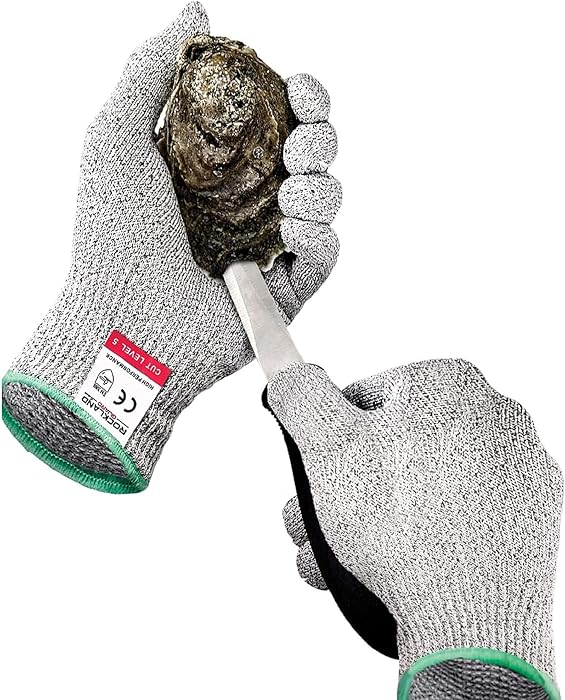
Three and a half inches is a lot of blade for an oyster knife, and that's exactly why we keep this kit for big shellfish. It's the longest blade here — nearly an inch more than the Dexter — and the extra length turns a thick-shelled oyster into a lever problem instead of a strength problem. This is the kit we set out when the oysters are Gulf-sized.

The knife is unglamorous in a useful way: 420 stainless with a bent tip, a textured handle, and a small guard that stops your hand sliding forward onto the shell when the blade lets go. It pries rather than jabs, so the shell tends to open in one piece and you're not fishing fragments out of the meat. Over a couple of dozen it never took a set.

The gloves are the other half of the pitch, and the part to think about. Level 5 protection covers the palm and fingers, not the seams between them, so a slipped tip can still leave a red line — treat them as a backstop while you learn the motion. They're also size Large only, which suits most adults and does nothing for a smaller pair of hands.

Worth Noting

  • Gloves come in one size only
  • Long blade is more than small oysters need
Our Verdict

We reach for this kit when the oysters are big: three and a half inches of stiff blade gives real leverage, and the gloves come in the box.

Check Latest Price
6

R. Murphy Duxbury Oyster Knife Best for East Coast Oysters

R. Murphy Duxbury Oyster Knife

East Coast oysters

Our Score 91/100
Handle
Polypropylene
Origin
Made in USA
Blade Shape
Pointed
Blade Length
2 inches
View on Amazon

Two inches is the shortest blade on this list, and the Duxbury turns that into an advantage. A short, thick blade puts the pivot right against the shell, so a small rotation of the wrist pops the hinge instead of a whole-arm twist. On deep-cupped East Coast oysters it was the most precise knife we used — the point finds the seam and stays in it.

The design came out of a working oyster farm: R. Murphy built it with the oystermen at Island Creek Oysters in Duxbury, Massachusetts, and makes it in the United States. You feel that in the handle, a plain polypropylene shape with no swell or texture to speak of but a secure one, and in the point, which is fine and wants a light hand. Push it like a chisel, not a dagger.

Reach is the cost. On a big Pacific oyster the two-inch blade can't get to the adductor muscle without angling, so you'll reposition more than the Rockland Guard requires. What you get back is the most precise hinge tool in this group, on a knife that weighs barely two ounces.

Worth Noting

  • Short blade struggles to reach the muscle on big oysters
Our Verdict

We like it best for East Coast oysters: the two-inch blade puts the lever at the shell, and it was designed with Massachusetts oystermen.

Check Latest Price
7

HiCoup Oyster Shucking Knife and Glove Kit Best for Gifting

HiCoup Oyster Shucking Knife and Glove Kit

Gifting

Our Score 90/100
Care
Hand wash
Handle
Pakkawood with guard
Blade Length
2.5 inches
Overall Length
6.5 inches
View on Amazon

This is the knife people pick up and comment on. The pakkawood handle has grain and a shine none of the plastic-handled knives here can match, the blade is mirror-polished, and the small guard between handle and blade looks intentional rather than molded on. If you're giving a shucking kit as a gift, this is the one that arrives looking like a gift.

It also works. The 2.5-inch straight blade is rigid and full-tang, the guard keeps your hand off the shell when the knife breaks free, and a cut-resistant glove comes in the box. What it lacks is a hook, so a tight hinge gets pushed rather than levered, and the New Haven knives here do that job with less effort. The blade is thick enough that small oysters take a little more feel.

Durability is where this one is less settled than the Dexter or the Victorinox. Blades hold up fine through an afternoon of shucking, but a snap at the tang is the failure to watch for, and it's why we don't recommend it for a bushel at a time. Buy it for the table, the gift, or the person who wants a knife that looks like something.

Worth Noting

  • Straight blade needs more push at the hinge
  • Durability is uneven under heavy use
Our Verdict

We recommend it as a gift: the pakkawood handle and guard look far better than the rest, and it shucks fine if you don't need a hooked tip.

Check Latest Price
8

SPEENSUN Oyster Shucking Knife Best for Tidy Storage

SPEENSUN Oyster Shucking Knife – Oyster Shucking Knife

Tidy storage

Our Score 89/100
Care
Hand wash
Handle
Pakkawood
Included
Gloves and leather sheath
Blade Material
3CR14 stainless steel
View on Amazon

A leather sheath and a pakkawood handle make this the tidiest kit here. It goes back in the drawer without tangling in the utensil pile, and it's one of the few in this group you can leave out on the counter without it looking like a hardware store display. The blade is thick and stiff with an oversized guard ahead of the handle, and a pair of Level 5 cut-resistant gloves comes in the box.

In use it's a solid mid-pack shucker. The point is narrow, the blade has enough mass to twist a shell open without flexing, and the handle's curve sits in the palm. Two things to know before you order. The glove is the weakest part of the package, so check the sizing chart rather than assuming, and the curved handle that feels good in a static grip can rub when you're wiggling the blade into a hinge — noticeable past a dozen or so.

Worth Noting

  • Included glove runs small
  • Curved handle can rub during long sessions
Our Verdict

We like it as the kit that stays tidy: sheath, wooden handle, and a blade stiff enough to twist, as long as you sort out your own glove.

Check Latest Price
9

WENDOM Oyster Knife Shucker Set

WENDOM Oyster Knife Shucker Set – Oyster Knife Shucker Set Oyster Shucking Knife and Gloves Cut Resistant Level 5

Starter kit

Our Score 88/100
Handle
Textured plastic
Blade Length
2.6 inches
Set Contents
2 knives, glove pair, cloth
Blade Material
3CR13 stainless steel
View on Amazon

Two knives and one pair of gloves is the honest way to describe this set, and it explains who it's for: one shucker who wants a spare blade, or a beginner who wants everything in a single box. If you're planning to put a friend to work beside you, know that only one of you gets a glove.

The knives are ordinary — thick 3CR13 blades with a textured handle and a small guard, hand wash only, built to open a normal oyster all night. The 2.6-inch blade is short enough to give leverage on a hinge and short enough to make reaching the muscle in a big shell a chore. The glove is decent and washes up fine, and the cloth in the box earns its place wiping grit off the rim before you serve.

What you're really buying is a complete starter kit near the bottom of the price range, and that's a fair trade as long as you know it. If you already own a decent glove, put the same money into one good knife instead — the Mercer plus a pair of gloves you've chosen yourself will serve you better than two knives you don't need.

Worth Noting

  • Only one pair of gloves in the set
  • Blades flex on large, tight oysters
Our Verdict

We recommend it as a starter box: two serviceable knives, a glove, and a cloth in one package, though only one person gets protection.

Check Latest Price

How We Tested 14 Oyster Knives

We started by researching the market—reading reviews, comparing blade shapes, and noting which knives came with cut-resistant gloves. We filtered out anything with a flimsy guard or a handle that looked slick when wet, then narrowed it to 14 knives: classic New Haven and Boston styles, plus a few kits. Over five months, we shucked oysters at home on weeknights, at backyard roasts, and during a couple of clambakes. Each knife got the same workout: a pile of Blue Points and Kumamotos, plus a few cherrystones for good measure.

We watched how the tip entered the hinge, whether it needed a wiggle or popped in cleanly, and how much force it took to twist the shell open. After every dozen oysters, we checked the tip for bends or burrs and noted if the handle got slippery. For the kits, we wore the gloves while shucking and deliberately ran the blade against the palm to see if the cut-resistant material held up. We also paid attention to blade size—a wider Boston blade felt different on a small Kumamoto than a narrow New Haven tip.

Ease of use came down to fatigue: did our hands cramp after 20 oysters? Appearance was a smaller factor, but we noted handle finishes that looked cheap or felt rough. Value was judged on performance per dollar—a knife that shucked cleanly and stayed sharp after five months earned its keep. We didn’t test in a lab; we tested at the kitchen island with a bowl of ice and a towel, which is exactly where most people shuck.

How to Choose an Oyster Knife

Start With the Tip: Hinge or Bill

New Haven-style knives like the Dexter-Russell, the Victorinox, and the OXO carry a bent or hooked tip made to drop into the hinge at the back of the oyster. Boston-style knives like the Mercer are straight with a rounded point, and you work them in at the bill and run them around the shell instead.

For deep-cupped East Coast oysters a hooked tip saves real effort. For a nervous beginner the Boston profile puts a blunt point toward your palm instead of a needle, which is why we point new shuckers there first. Learn the motion on a straight blade, then move to a hook once it feels automatic.

Stiffness Matters More Than Sharpness

The failure that ruins an oyster knife isn't dullness — it's a tip that bends or snaps because the steel is thin or the heat treatment is cheap. You feel it the first time a shell fights back: a good blade levers without flexing, and a weak one takes a set and never sits right again.

Carbon steel holds a stiff edge but wants hand washing and immediate drying. Stainless New Haven knives trade a little bite for easier care, and a dishwasher-safe one is a genuine convenience if you shuck often. Buy for stiffness first; it's the one property you can't restore at home.

The Holding Hand Deserves Equal Thought

The knife hand gets the attention, but the hand gripping the shell is the one that gets cut. A folded towel does most of the work: it grips the oyster and stops it skidding across the counter. A cut-resistant glove is worth adding while you learn — look for an EN388 Level 5 rating and, more important, a snug fit, since a loose glove bunches at the fingertips and costs you control.

Treat that glove as a backstop rather than armor. Cut-resistant is not cut-proof, and the protection thins at the seams and between the fingers, which is exactly where a slipped tip ends up.

Match the Blade to the Oyster in Front of You

Blade length is a leverage decision, not a size contest. The R. Murphy Duxbury's 2 inches put the pivot right against the shell, which is why it feels so precise on small, tight oysters. The Rockland Guard's 3.5 inches give you a longer lever for thick Gulf shells, at some cost in finesse on the little ones.

If you buy one kind of oyster most of the time, buy for that size. If you take whatever looks good at the counter, a 2.75-inch New Haven blade sits in the middle and handles both ends.

What a Kit Is Actually For

A kit bundles a knife with gloves and sometimes a sheath, a cloth, or a second knife. The knife is still the part that matters; the extras run from genuinely useful (a stiff sheath, a glove that fits) to filler. The extra worth paying for is a second knife — one to lend a guest, or a spare when the first is in the sink. That's the sensible case for the WENDOM set, which pairs two knives with a single pair of gloves.

If you already own a glove you like, buy the knife on its own and put the difference into steel.

Frequently Asked Questions

Final Verdict

The Dexter-Russell is the oyster knife we tell people to buy. The bent New Haven tip seats in the hinge with a light push, the carbon steel stays stiff through a long session, and the textured handle is the most secure wet-hand grip in this group. Dry it by hand and it will outlast the fad.

If the oysters you buy run small and tight, the Victorinox's finer hook needs less probing and can go in the dishwasher. For a tray of thick-shelled Gulf oysters, the Rockland Guard kit's long blade and included gloves do the work with less effort than anything else here.