Best Pillows for Side Sleepers of 2026

A side sleeper's pillow has one job, and it's more mechanical than you'd expect: fill the gap between your shoulder and your ear so your neck stays level instead of sloping downhill all night. Soft pillows feel great for an hour, then pancake under the weight of your head; firm ones hold their shape but press into your jaw. Over the past six months, my team and I have slept on 14 pillows — shredded foam you adjust yourself, contoured cervical shapes, down and down-alternative sets — and the difference between a rested morning and a stiff one came down to how well each one held that gap.

Two things I didn't appreciate until I'd lived with a stack of them: thickness matters more than fill material, and a pillow you can add fill to beats any cooling cover. A few smelled faintly of foam for the first week, and the soft down-style ones flattened fastest, so softness alone never won us over. The ones below held their height night after night and were worth what they cost.

Our Top Picks

The 6 Best Pillows for Side Sleepers of 2026

1

Coop Home Goods Original Adjustable Best Overall

Coop Home Goods Original Adjustable Pillow

Most side sleepers

Our Score 92/100
Fill
Cross-cut memory foam and microfiber
Loft
8 inches
Size
Queen, 29 x 19 in.
Certification
CertiPUR-US and GREENGUARD Gold
View on Amazon

The extra bag of fill that comes in the box is the reason this pillow earns the top spot. Side sleeping is a height problem, and your head needs to sit level with the rest of your spine rather than tipping down toward the mattress. This pillow lets you solve that yourself: unzip the inner liner, pull out a few handfuls if it is pushing your chin toward your chest, and add from the bag when the fill packs down. The fill itself is cross-cut memory foam blended with microfiber, so it moves like a soft pillow and props like foam.

Packed to its full 8 inches, it is a substantial pillow, and our instinct is that most side sleepers end up taking fill out rather than adding it. That spare bag is insurance for the second year, not the first night. The nice part is that the decision is reversible, which is more than you can say for a sewn-shut pillow you guessed wrong on.

The cover is a polyester and bamboo-rayon blend that feels closer to a brushed sheet than to foam, and it zips off for machine washing. That matters more than it sounds: a pillow you cannot wash is a pillow you replace early. The foam is both CertiPUR-US and GREENGUARD Gold certified, and that pair of certifications is the thing to look for if you are uneasy about sleeping next to polyurethane for eight hours a night.

What it is not is a firm, non-negotiable slab. The fill shifts under your head as you move, which is exactly what makes it forgiving for a side sleeper and exactly what someone who needs almost no height at all would dislike.

Worth Noting

  • New foam needs a few days of airing
Our Verdict

We tell side sleepers to start here because the fill is the adjustment: you can tune the height to your own shoulder instead of hunting for a pillow that happens to match.

Check Latest Price
2

DreamyBlue Signature Adjustable Best for Firm, Dense Support

DreamyBlue Signature Adjustable Shredded Memory Foam Pillow Queen

Firm, dense support

Our Score 91/100
Fill
85% shredded memory foam
Loft
8 inches
Size
Queen, 30 x 20 in.
Cover
Bamboo rayon, removable
View on Amazon

Set this beside the Coop and the first difference is firmness. Both are 8-inch adjustable queens with a zippered liner, but the DreamyBlue fill is 85% shredded memory foam and 15% polyester, with no microfiber to soften it, and the pillow weighs 4 pounds against the Coop's 3.5. That density is obvious the moment you lift it and again when you put your head down.

Density is the point for a broad shoulder or a heavier sleeper. Soft fill bottoms out under weight, and the head drops below the shoulder line somewhere in the small hours; a foam-heavy fill pushes back instead. The fill is bagged separately inside the liner, so moving a handful at a time is straightforward, and a spare bag of fill comes in the box for the day it starts to pack down.

The queen measures 30 by 20 inches, the cover is 60% polyester and 40% bamboo-derived rayon, and we prefer that cover to a microfiber one because it stays cooler against the face. It also lifts off for washing. Pin the zipper shut before you put it in the machine, as the care instructions say; a liner that opens mid-cycle distributes shredded foam through everything else in the load.

Worth Noting

  • Premium price for a single pillow
Our Verdict

Our pick for a heavier side sleeper: the foam-heavy fill holds its height under weight, and the spare fill bag lets you keep it that way.

Check Latest Price
3

Cozyplayer Cervical Pillow Best for Neck Pain

Cozyplayer Cervical Pillow – Ultra Pain Relief Cooling Pillow for Neck Support

Neck pain relief

Our Score 90/100
Fill
Memory foam
Size
Queen
Cover
Arc-Chill cooling fabric
Shape
Butterfly contour
View on Amazon

This is the shape to try if you fall asleep on your side and wake with your neck kinked. The Cozyplayer is a butterfly contour: a hollowed center for the back of the head, raised wings under the cheek, and a channel beneath the neck that keeps its curve from sinking into the mattress. Six zones sounds like marketing until you lie on it and feel where each one lands.

The cover is the detail worth knowing about. It is an Arc-Chill fabric rated Q-Max 0.4, and Q-Max measures how quickly a fabric pulls heat away from skin. Of all the cooling claims on this page, that is the one we believe, because it is a rated number rather than an adjective. Practically, it means a cool cheek instead of the damp spot contour foam usually develops by the middle of the night.

The foam is high-density memory foam, so it holds its shape when your shoulder pushes back into it rather than squashing flat the way a soft contour does. That is the difference between support and the sensation of support.

It is not the pillow for someone who folds an arm under the head or rolls between side and stomach all night. A contour rewards staying put, and a sleeper who moves will spend the night climbing back onto it.

Worth Noting

  • Contour feel takes a few nights to settle
Our Verdict

For the side sleeper who wakes with a stiff neck rather than a flat pillow, this is the shape we hand over first.

Check Latest Price
4

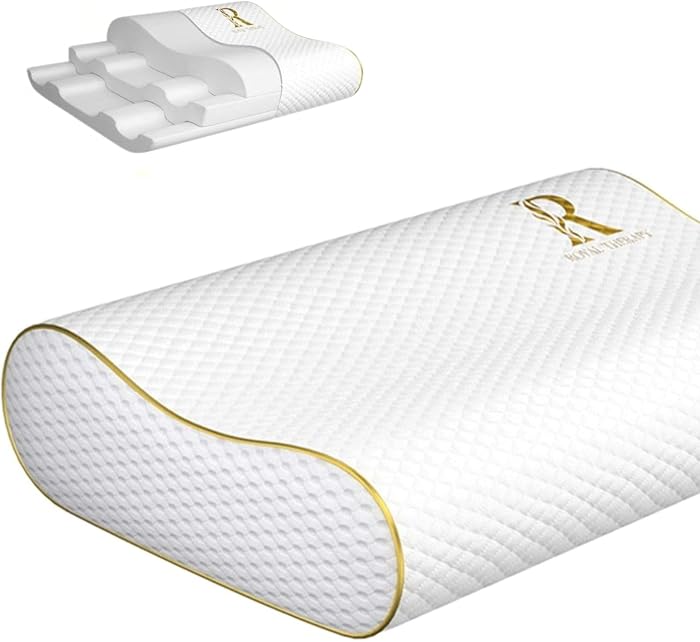
Royal Therapy Memory Foam Contour Best Adjustable Contour

Royal Therapy Memory Foam Contour

Adjustable contour height

Our Score 89/100
Fill
Memory foam
Size
24 x 14 x 5 in.
Cover
Polyester and bamboo rayon
Layers
Three, middle removable
View on Amazon

At 24 by 14 inches, this is not a bed pillow you flop onto. It is a positioning pillow, and the first thing to understand is that you sleep in it rather than on it: the raised edge goes under your neck, your cheek lands on the lower surface beside it, and your head stays where you put it instead of wandering to the corner of the case.

The adjustable part is a three-layer build with the middle layer removable. Pull it out and the pillow drops in height while keeping the same contour profile.

We think that is the right way to build a contour. A zipper-and-fill design changes the shape as soon as you change the height, which defeats the purpose of buying a shape in the first place. The foam here is CertiPUR-US certified and the cover is a polyester and bamboo-rayon blend that washes separately, though the foam core itself does not.

If you have never slept on a contour, this is the more forgiving place to start than a fixed one: guessing wrong costs you a layer, not a pillow.

Worth Noting

  • Pricier than the other contour here
Our Verdict

A contour you can lower without losing its shape, for the side sleeper who wants neck support and a height they can change.

Check Latest Price
5

JOLLYVOGUE Firm 2-Pack Best Budget

JOLLYVOGUE Firm Pillows Queen Size Set of 2

Budget two-pillow setup

Our Score 88/100
Fill
60% 7D and 40% 3D polyester
Size
Queen, 28 x 20 in.
Thickness
7 inches
Certification
OEKO-TEX certified factory
View on Amazon

Two queen pillows for less than any single pillow here is the whole case for this set. The fill is the part worth understanding before you buy: 60% of it is a springier 7D polyester fiber and 40% a softer 3D fiber. Those numbers describe the thickness of the individual fibers, not the firmness of the pillow, which is why this reads closer to medium than the firm the name promises.

That is not a knock. A moldable pillow is useful when your shoulder wants more height at the front edge than at the back, and two of these in one case make a genuinely firm stack. For a broad-shouldered side sleeper on a budget, we think that stack is the cheapest route to real height in this set.

It arrives vacuum-packed into a brick. Knead the fill loose by hand and give it a day, or tumble it on low, before deciding anything about the loft. The cover is microfiber and the closure is a sewn seam, so there is no zipper to catch and no fill to spill, and the whole pillow goes in the machine.

Queen sizing is generous at 28 by 20 inches, which fills out a standard case instead of floating inside it. For a guest room, a first apartment, or a spare set for the closet, that combination is hard to argue with.

Worth Noting

  • Loft drops with use; budget for replacing
Our Verdict

For a tight budget, this is the pair we point to: two moldable pillows you can stack to your own height and wash whole.

Check Latest Price
6

COZSINOOR Goose Down Feather Best for Feather-Pillow Fans

COZSINOOR Goose Down Feather Pillows Queen Size Set of 2

Feather-pillow fans

Our Score 87/100
Fill
60% feather, 40% down alternative
Size
Queen, 29 x 18 in.
Count
Set of 2
Cover
600 thread count cotton
View on Amazon

Can a feather pillow work for a side sleeper? Sometimes, and this pair makes the best case for it in this set. The fill is 60% feather and 40% down alternative fiber. The feather content gives the pillow its structure, since feathers spring back where synthetic clusters collapse, and the fiber supplies the softness a pure feather pillow lacks.

The cover is 600-thread-count cotton with a satin stripe, and it sleeps cooler than any microfiber cover here. That counts for a side sleeper, whose cheek rests on one spot all night and who notices heat long before a back sleeper does.

What we trust about this pair is the combination: a moldable fill that shapes itself to the jaw and a cotton cover that lets air through. It works well for a lighter sleeper, and it works even better as the soft top layer over a firm pillow, which is a trick worth knowing if you have never found one pillow that does both jobs.

It is the wrong pillow for a heavy shoulder. Feather compresses where foam pushes back, and no amount of fluffing changes that on a broad frame.

Worth Noting

  • Compresses under a heavy shoulder
Our Verdict

A feather-and-fiber pair for the side sleeper who wants the pillow to mold around the jaw rather than push back.

Check Latest Price

How We Tested the Best Pillows for Side Sleepers

We started by pulling together the styles side sleepers actually buy: shredded memory foam you can top off or empty out, contoured cervical shapes with a dip for the neck, down and down-alternative sets, and firm hotel-style pairs. From there we filtered by loft range and queen-size availability, checked which makers sell extra fill, and favored pillows carrying third-party certifications for foam and fabric. Then we bought 14 and slept on them ourselves for six months.

Each pillow got at least a week on a real bed, and nothing else. I'm a side sleeper with broad shoulders, and the two others in the house are a back sleeper and a stomach sleeper — which turned out to matter, because a pillow that felt perfect to me buried them.

Every morning before making the bed, we measured loft at the center and near the edge with a ruler, then noted how much fluffing it took to come back. We pressed each one flat with both palms to see how fast it sprang back, stuffed it into a standard pillowcase to check how much of the case it filled and whether it slid around, and washed the covers that were machine-washable. Odor got its own check: a sniff on day one, then again after a week of airing out. Adjustable fills got a second round — we pulled a handful of fill, slept a week, then put it back.

By the end we had a clear read on which pillows held their height until morning, which went flat by 3 a.m., and which ones still felt worth the money once the novelty wore off.

How to Choose a Pillow for Side Sleepers

Match Loft to Your Shoulder, Not the Label

A side sleeper's head sits higher off the bed than a back sleeper's because the shoulder is in the way. Too little loft and the neck bends sideways all night; too much and the chin is pushed toward the chest, which produces its own morning stiffness. Labels such as plush, medium, and firm describe how the fill feels in your hand, not how tall the pillow stays once your head is on it.

Judge height after a night, not out of the package. A pillow that measures five inches on the bed may be three under your head, and the useful test is lying on your side and checking that your head, neck, and chest line up with no gap under your neck and no tilt in your chin.

Buy Fill You Can Change

The most useful feature for a side sleeper is a zipper. Shredded memory foam in a zippered liner lets you take fill out, which is the direction nearly everyone goes, and add it back when the pillow packs down. Without a zipper you are stuck with someone else's idea of medium.

Look for a pillow that ships with a spare bag of fill. That bag is what keeps an adjustable pillow adjustable in year two, and it adds nothing to the purchase price.

Contour Pillows Trade Freedom for Support

A contour pillow, also called a cervical pillow, puts a raised channel under the neck and a lower surface under the head. Lying on your side, your cheek lands on the flat and the channel keeps your neck from dropping toward the mattress.

The trade is that you sleep in one position in one spot. Roll between side and stomach all night, or fold an arm under your head, and the shape works against you. Contours are also hard to modify, so choose one with a removable layer if you want to change its height.

Fiber Fill Is Inexpensive, Moldable, and Temporary

Down-alternative fiber is the cheapest route to a moldable pillow. It squishes into the shape you push it into, which suits a side sleeper who wants more height at the front of the pillow than at the back.

It also packs down, and no amount of fluffing brings it all the way back. The budget argument is not that fiber lasts as long as foam. It is that two fiber pillows cost less than one foam pillow, so replacing them is a smaller decision.

Heat, Smell, and What Washable Means

New foam smells. Off-gassing from vacuum-packed polyurethane is normal and usually fades within a few days, faster with air and a low tumble. If you are sensitive to it, air the pillow in a spare room before the first night rather than deciding against it in the first hour.

A washable cover is not a washable pillow. Foam cores are spot-clean only, so look for a cover that unzips; fiber pillows usually go in the machine whole. For hot sleepers, cotton and bamboo-rayon covers breathe better than microfiber, which matters when your cheek rests against the same spot for eight hours.

Frequently Asked Questions

Final Verdict

If you are buying one pillow for side sleeping, buy the Coop Home Goods Original Adjustable. The zippered fill is the feature that matters: it is the only way to fit a pillow to your own shoulder width at home, and it keeps working as the foam settles.

Two alternatives are worth naming for specific cases. If you wake with a bent neck rather than a flat pillow, the Cozyplayer contour is the better shape. If you want contour support with a height you can change, the Royal Therapy's removable middle layer does that. On a tight budget, the JOLLYVOGUE pair is the compromise we make.