Best Pizza Stones of 2026

A pizza stone is supposed to fix the one thing a home oven can't — a pale, limp bottom crust. The trouble is that a bad one fails quietly: a hairline crack after the second preheat, a pie welded to the surface, a slab so heavy you stop lifting it out of the cabinet.

I've spent the past six months baking on a dozen stones, from thin tile sets to thick slabs to kits that throw in a peel and cutter. Round versus rectangular turned out to matter less than the two things nobody prints on the box: preheat time and thickness.

A modest stone left in a 500-degree oven for a full hour will out-bake a pricey one that's been in for fifteen minutes, and a thick slab holds heat under a wet, heavy dough but is a two-handed lift. A stone wider than your rack also blocks the airflow your oven needs, which is why size matters more than most shoppers expect. The picks below are the ones I kept reaching for.

Our Top Picks

The 8 Best Pizza Stones of 2026

1

Old Stone Pizza Stone Best Overall

Old Stone Pizza Kitchen Rectangular Pizza Stone for Oven and Grill

Family pizza night

Our Score 92/100
Size
14 x 16 inches
Material
Stoneware
Thickness
0.43 inch
Max Temperature
1450 °F
View on Amazon

Sixteen inches long and fourteen wide, this is the largest baking surface in this roundup, and the size is most of why it wins. A 14-inch pie has room to spare, two 10-inch pies sit side by side, and a batch of baguettes or a tray of vegetables fits without crowding. It is stoneware, 0.43 inch thick, and rated to 1450°F.

What we noticed during our bakes was the evenness: the base colored from edge to edge rather than scorching over the oven's hot spot and staying pale everywhere else, which is the difference between a stone that is working and one that is merely hot. It also seasons as it goes, darkening into something that looks like it has been in the kitchen for decades. We happen to like that; it does nothing to how the stone bakes.

There is nothing to grip on a stone this size, so the routine that works is leaving it on the rack and sliding finished pies onto a board. Moving it while it is hot is a two-mitt, both-hands job. Set it up once and it stays put, which is the right way to think about this one: a stone that lives in the oven, not one you tuck into a cabinet after dinner.

Release is the single thing you have to manage. Bare dough on a properly preheated stone will grab, so dust the peel with cornmeal or flour, or start the pie on parchment and slide it off after a few minutes. Do that and this is the stone we reach for when the pie actually matters.

Worth Noting

  • Needs a 16-inch rack with clearance on both sides
Our Verdict

Our pick for most kitchens: a 14-by-16-inch stoneware slab that browns a crust evenly from edge to edge and takes grill heat as easily as oven heat.

Check Latest Price
2

Unicook Pizza Stone Best Value

Unicook 15 x 12 Inch Rectangular Pizza Stone for Oven and Grill

Budget oven baking

Our Score 91/100
Size
15 x 12 inches
Material
Cordierite
Thickness
0.6 inch
Max Temperature
1450 °F
View on Amazon

If the Old Stone is more surface than your oven or your wallet wants, this is where we send people. Fifteen by twelve inches, 0.6 inch thick, cordierite, rated to 1450°F, with a plastic dough scraper in the box. The thickness is what we noticed in use: it shrugs off the second pie of the night instead of sulking after the first, and that stored heat is the whole reason to spend on a stone.

New cordierite can give off a smell through its first few heating cycles, so burn it in with the windows open or out on the grill before dinner depends on it. After that the routine is a scraper, warm water and a brush, no soap, and a willingness to live with stains that will not change how it bakes. The included scraper is genuinely useful for the burnt cheese phase every new stone goes through.

It has also earned its keep as a baking stone for baguettes and a tray of roasting vegetables, where the same heat soak that crisps a pizza base gives bread a proper oven spring. That versatility is why we rate it so close to the top pick despite the plainer finish.

Worth Noting

  • Can crack when a cold stone meets high heat
Our Verdict

The smart-money pick: a thick 15-by-12-inch cordierite stone rated to 1450°F, and the one we point to when the budget is the deciding factor.

Check Latest Price
3

Cuisinart 3-Piece Pizza Set Best for Grill

Cuisinart 3 Piece Pizza Grilling Pack

Grill pizza

Our Score 90/100
Weight
5.7 lb
Included
Stone, folding peel, cutter
Material
Ceramic and stainless steel
Stone Size
13 inches round
View on Amazon

Most pizza kits throw in a wooden paddle and call it a day. Cuisinart's is metal with a hinge in the middle, which means it folds down for storage, slides under a wet dough without the drag you get from a thick board, and does not soak up dishwater or warp on the drying rack. The hinge is the kind of detail that decides whether a peel stays within reach or migrates to the back of a cabinet.

The stone is a 13-inch round of cordierite, and the round shape suits a kettle grill or a kamado where a rectangle would hang over the coals. Set it on the grate over indirect heat, close the lid, and it does what a stone is supposed to do: pulls moisture out of the base and gives you a crisp underside instead of a pale one. The set is five and a half pounds, light enough to carry out with the tongs.

Where it earns its keep is the peel and the cutter, both of which feel like real tools rather than filler. The cutter is an actual wheel on a solid handle instead of the flimsy disc most kits ship. Dough still grabs this stone if you get lazy with the flour, which is true of every stone here and not a reason to skip it.

Worth Noting

  • 13-inch round caps pies at about 11 inches
  • Premium price for a three-piece set
Our Verdict

The set we carry outside: a 13-inch cordierite stone, a folding stainless peel that stores flat, and a cutter that is not an afterthought.

Check Latest Price
4

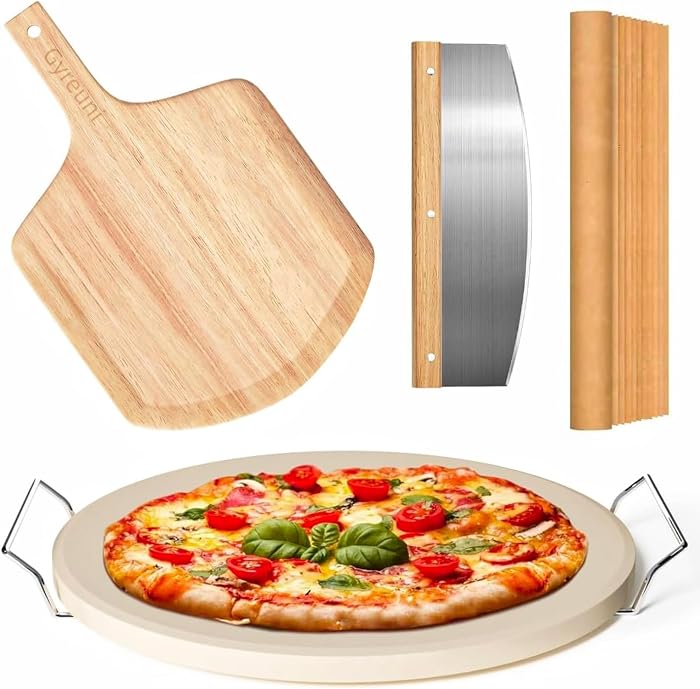
Gyreuni 13-Inch Pizza Stone Set Best Complete Set

Gyreuni 13-Inch Pizza Stone Set – 13 Pizza Stone for Oven and Grill with Pizza Peel

New pizza makers

Our Score 89/100
Included
Peel, rack, cutter, parchment
Material
Cordierite
Thickness
0.6 inch
Stone Size
13 inches round
View on Amazon

The serving rack is the piece we did not expect to care about. A stone comes out of a hot oven and has to go somewhere, and the rack holds it level above the counter while you cut, which is one less thing to solve while the cheese is still moving. It is the sort of accessory that looks like padding in a listing and turns out to be the reason the set stays on the counter.

Everything else is here too: a 13-inch round stone, 0.6 inch thick and rated to 1472°F, an oak peel, a steel wheel cutter and ten sheets of parchment. The cutter handles a Chicago-style square better than the rolling wheels we have tried, and the stone itself is as thick as any round one in this group.

Thirteen inches round suits a household of two and a grill; for a full 16-inch pie or a sheet of bread, a rectangle is the better shape. The parchment is what makes the kit forgiving: build the first few pies on it and you learn the feel of the stone without losing dinner to a peel that stuck.

Worth Noting

  • Wooden peel needs prompt drying to avoid splitting
Our Verdict

The most complete starter kit here: a 13-inch stone, oak peel, cutter, parchment and a serving rack that keeps a hot stone off the table.

Check Latest Price
5

Onlyfire Pizza Stone Kit Best Kit With a Metal Peel

Onlyfire 4 pcs Pizza Stone & Peel Set

Replacing wooden peels

Our Score 88/100
Peel
14 x 16 inches, aluminum
Included
Stone, peel, spatula, cutter
Stone Size
15 inches round
Max Temperature
2200 °F
View on Amazon

Wooden peels warp, split and mold, and those three failures are why a lot of people give up on homemade pizza. Onlyfire skips wood on the business end: the tray is a 14-by-16-inch aluminum sheet on an 11-inch wood handle with a hanging cord, so it goes under a loaded 15-inch pie without bowing and wipes clean instead of absorbing whatever you spilled three weeks ago.

The stone is a 15-inch round of cordierite rated to 2200°F, which is far past anything a home oven or a gas grill will produce. That headroom is the point: the stone is not the weak link when you close the lid on a hot grill, and a 15-inch circle drops into a kettle grill where a rectangle would not.

There is a stainless spatula in the box as well, useful for lifting a slice or rescuing a calzone that has other ideas. Buy the kit for the peel, though; the spatula and cutter are bonuses, and a 15-inch round stone bakes a 12-inch pie with room to work the peel underneath.

We reach for this one when the peel matters more than the surface area. A metal peel you can hang on a hook and hose off is the difference between pizza night and pizza night you keep postponing. If you already own a good peel, the Unicook gives you the same cordierite in a rectangle without the extras.

Worth Noting

  • Round stone leaves oven corners unused
  • Premium price for a four-piece kit
Our Verdict

For anyone who has already ruined a wooden peel: an aluminum peel, a 15-inch cordierite stone and 2200°F of headroom for grill nights.

Check Latest Price
6

Outset Pizza Stone Tiles Best for Personal Pizzas

Outset Pizza Grill Stone Tiles For Oven and Grill

Small ovens

Our Score 85/100
Pieces
4 tiles
Material
Cordierite
Thickness
0.375 inch
Tile Size
7.5 x 7.5 inches
View on Amazon

Four small stones beat one big one when the pizzas are personal. Each tile is 7.5 inches square and 0.375 inch thick, and two by two covers the same ground as a 15-inch stone. The point is control: each piece comes off when its own crust is done, the plain one for the kid and the loaded one that needs another minute, and they slide into a toaster oven, an RV oven or a kettle grill that would never take a 15-inch slab.

What you trade for that flexibility is heat reserve. At 0.375 inch these are the thinnest stones in this group, so they cool faster between rounds than a 0.6-inch slab and want a longer sit on the rack before the next batch. Keep the gaps between tiles narrow but not tight, and give the whole arrangement room so the seams do not turn into pale stripes across the crust.

Worth Noting

  • Personal-pizza size only
Our Verdict

Four 7.5-inch cordierite tiles that let each person build their own pie and pull it when it is right, which is what small ovens and mixed company need.

Check Latest Price
7

GOFOWRK Pizza Stone Set Best for Full Kit Buyers

GOFOWRK Pizza Stone Set – Pizza Stone 5 PCS Set

Full kit buyers

Our Score 84/100
Included
Stone, metal peel, cutter, scraper, brush
Material
Cordierite
Thickness
0.6 inch
Max Temperature
1470 °F
View on Amazon

Five pieces arrive in this box: the rectangular stone, a metal peel, a rocker cutter, a dough scraper and a silicone brush. The stone is 0.6 inch thick and rated to 1470°F, which is the specification that matters most, and it is as thick as anything rectangular in this group.

The metal peel is the reason to pick this over a wooden-peel kit. It will not warp in the sink or grow anything between pizza nights, and a scraper plus a warm-water rinse is the whole cleaning routine. Anyone who has thrown away a molded paddle will recognize the appeal.

The rocker cutter and the dough scraper are the two extras that earn their drawer space: one push through a 15-inch pie instead of a lap around it with a wheel, and a bench scraper that doubles as the cleaning tool, lifting burnt bits off a cooled stone without soap. It is the kind of kit that makes you wonder why you were about to buy a wooden paddle at all.

Where this lands is simple. If you want one box that covers a rectangular stone and every tool around it, this is it, and the metal peel makes it a better long-term buy than a wooden-peel set. If you already own a peel and a cutter, the Unicook is the same cordierite without the extras.

Worth Noting

  • Silicone brush is an odd inclusion
  • Bulky to move in and out of a hot oven
Our Verdict

The most complete rectangular kit here: a 0.6-inch stone, metal peel, rocker cutter and scraper, and a heat rating with room for the grill.

Check Latest Price
8

Culinary Couture Pizza Stone Set Best for Oven-Only Use

Culinary Couture Pizza Stone Set – Large Pizza Stone for Oven and Grill Set

Oven-only use

Our Score 83/100
Included
Stone, peel, cutter
Material
Cordierite
Thickness
0.4 inch
Max Temperature
1000 °F
View on Amazon

Fifteen by twelve, cordierite, 0.4 inch thick and rated to 1000°F. That last number is the one to read twice. For an oven that tops out around 550°F it never comes up, and for a grill you are running wide open it is a hard stop, which tells you exactly which kitchen this stone belongs in.

Baking-wise it does what a stone should: the base crisps, and because it is thin it comes up to temperature with the oven rather than lagging behind it. Cleaning is a rinse and a brush once it has cooled, with no soap and no scrubbing at the marks that baked-on cheese leaves behind.

As a first stone it earns its place. It is big enough for a proper pie, thin enough to heat through on a weeknight, and priced so that a crack down the road is an inconvenience rather than a loss. As a grill stone or a long-term buy it is not the one; the 0.6-inch stones here carry more heat and take more abuse for a little more money.

Worth Noting

  • 1000°F ceiling rules out hard grilling
  • Peel is undersized for the stone
Our Verdict

A full-size rectangular set for a small outlay that bakes a crisp base, best kept to oven temperatures and paired with a better peel.

Check Latest Price

How We Tested a Dozen Pizza Stones

We started by narrowing the field to stones that fit a standard oven rack with a couple of inches left on every side for air to move, then compared material, thickness, weight, and whether a set's peel and cutter were worth having. Sets were priced per usable piece, so a four-tile kit had to earn its place like any single slab.

Every stone went into a 500-degree oven for a full hour, and we mapped surface temperature at the center, corners, and edges with an infrared thermometer at the 45- and 60-minute marks. Then we baked the same dough — same weight, same sauce and cheese load — and compared where the bottom browned first and how evenly the color ran from middle to rim.

Crust was judged from the underside: whether it set within the first two minutes, whether it blistered, and whether a slice lifted clean with a peel or spatula. We tested stickiness deliberately, going bare, then with a dusting of flour, cornmeal, and parchment, to see which stones grabbed a wet dough and which let go. A few also got a loaf of bread and a tray of cookies, since a stone that only does pizza is harder to justify.

Durability got the hardest workout: we lifted each stone in and out of a hot oven with mitts, slid it onto a cool rack after baking, and checked monthly for hairline cracks, which is where most of them fail. A kitchen scale settled the weight question, since a slab you dread moving stops getting used. After the first several bakes we smelled each stone for odor and cleaned it as the maker instructs, then set the cost of the stone or set against the number of pies it turned out before showing wear.

How to Choose a Pizza Stone

Start With the Footprint, Not the Material

Measure the rack before you fall for a big rectangle. A 14-by-16 stone needs a rack at least that wide, plus an inch or so of air on each side so the oven can circulate around it; cram it wall to wall and the edges of your crust will show it. Grills are tighter still, which is why a 13-inch round stone drops into a kettle grill where a rectangle would hang over the coals.

If you bake in a toaster oven, an RV oven or a small apartment range, four 7.5-inch tiles fit where a full slab simply will not. Smaller pieces mean smaller pies, but a pie you can bake beats a stone you cannot close the door on.

Thickness Buys Heat, Material Buys Forgiveness

Thickness is the most useful number on the box: a 0.6-inch cordierite slab stores more heat than a 0.4-inch one, and stored heat is what keeps the base browning after the toppings have stopped cooking. The cost is a longer preheat and more weight to wrestle.

Cordierite is the default because it takes thermal shock better than dense ceramic, while stoneware seasons and browns beautifully but stains and wants gentler handling. Treat a 2200°F rating as headroom rather than performance: your oven tops out somewhere near 550°F, and the stone only needs to survive that.

Most Sticking Is Technique, Not the Stone

Dough welding itself to the surface is nearly always a cold stone or a dry peel. Preheat the stone with the oven, for as long as the oven takes to come up to temperature and then a good while longer, and load the pie on cornmeal, flour or parchment. The Gyreuni set's ten parchment sheets are a quiet luxury for wet dough.

Never oil the stone itself. Oil polymerizes into a sticky brown layer that is far harder to remove than a scorch mark, and it does nothing for release that a dusting of cornmeal will not do better.

Judge the Kit by the Peel

A set is only as good as the paddle in it. Wood is traditional and gentle on dough, but it warps, splits and molds if it stays wet, so dry it standing up rather than in a rack full of dishes. Metal slides under a wet dough more easily and never absorbs anything, which is why the Onlyfire and GOFOWRK kits appeal to us.

Whatever the material, check the peel against the stone. A peel narrower than the surface you are loading onto is how pizzas land upside down on the oven floor, and several sets here ship exactly that mismatch.

Cleaning: Scrape, Rinse, Dry, Repeat

No soap, no soak, no dishwasher. A porous stone absorbs detergent and hands it back to the next pie, which is why every maker's care note says the same thing. Let the stone cool completely, scrape off the crusted bits with a spatula or the scraper from the kit, rinse under warm water and dry it fully before it goes back in the oven.

Dark patches are seasoning, not dirt, and they will not change how the stone bakes. What does change it is a crack, and the way you get one is sudden temperature change: a cold stone into a hot oven, a hot stone onto a cold counter, or a splash of cold sauce on a screaming-hot surface.

Frequently Asked Questions

Final Verdict

For most kitchens the Old Stone is the one to buy. Sixteen inches of stoneware bakes evenly across the whole surface, takes grill heat as happily as oven heat, and does not ask for any special handling beyond a cornmeal-dusted peel. It is the least fussy stone here, and the surface area is worth the rack space.

If the budget decides, the Unicook is a thick slab of cordierite for less. And if your pizza happens on the grill, the Cuisinart set's folding metal peel is the piece that changes the whole routine.