Best Pocket Knife Sharpeners of 2026

The first sign is never dramatic. You're halfway through a box or a stick you meant to whittle, and the blade skates instead of biting. A pocket sharpener is cheap insurance against that moment — the real question is which one you'll actually have with you when it happens.

My team and I spent four months with 16 of them, from credit-card-sized stones to five-stage fold-outs with diamond rods, ceramic notches, carbide cutters, and leather strops. What separated them wasn't the marketing: how fast each raised a working edge, whether it handled straight and serrated blades, whether the housing survived a dozen trips in a pocket, and whether the extras — a fire starter, a whistle — earned their bulk.

One thing I'd tell a first-time buyer: coarser isn't better. Carbide revives a battered edge fast, but lean on it every week and you'll eat the blade alive; ceramic and diamond are slower and gentler. Each pick below earned its spot for a different reason, so the right one comes down to how you carry.

Our Top Picks

The 9 Best Pocket Knife Sharpeners of 2026

1

Work Sharp Guided Field Sharpener Best Overall

Work Sharp Guided Field Sharpener

Field and EDC

Our Score 97/100
Abrasives
Diamond, ceramic, leather strop
Edge Types
Straight and serrated
Angle Guides
20 and 25 degrees
Sharpening Stages
5
View on Amazon

The Work Sharp Guided Field Sharpener earns the top spot here because it packs a full sharpening sequence into a packable tool: 220- and 600-grit diamond plates, ceramic rods, and a leather strop. That range is what we want in a field sharpener, since it lets you repair a rolled edge, refine it, and finish it without carrying three separate tools. The built-in 20- and 25-degree guides are the detail that makes the sequence usable for someone who does not sharpen every day.

In use, the coarse diamond plate gives you enough bite to reset a dull blade, while the fine plate and ceramic rod let you finish without jumping to a separate stone. We liked the hook groove in the ceramic rod and the broadhead wrench in the body; they are small field extras that do not get in the way of the knife work. The leather strop is the piece that turns a sharp edge into a cleaner one, and it is a useful addition at this size.

The trade-off is weight. It is heavier than the ultralight touch-up tools here, but that heft buys a full sharpening sequence and a strop. For a pack, glove box, or tackle box, we think it is the right balance; for a shirt-pocket kit, the smaller options make more sense.

Worth Noting

  • Five surfaces take practice to sequence
Our Verdict

We recommend the Work Sharp Guided Field Sharpener as the best default for pocket and hunting knives because its five abrasives and angle guides cover repair, honing, and stropping in one packable tool.

Check Latest Price
2

AccuSharp Knife Sharpener Best Budget Pull-Through

AccuSharp Knife Sharpener

Quick drawer touch-ups

Our Score 96/100
Handle
Ambidextrous ergonomic
Weight
1.28 oz
Abrasive
Diamond-honed tungsten carbide
Edge Types
Straight and serrated
View on Amazon

For a knife that is dull right now, the AccuSharp is the fastest answer here: a couple of pulls through the tungsten-carbide slot and you have a working edge again. The ergonomic handle fits either hand, and the compact body is easy to keep in a kitchen drawer, glove box, or tackle box. We like that it handles straight and serrated blades.

We reach for it when a utility knife, mower blade, or beat-up camp knife needs a quick reset and we do not want to set up a stone. It is also the one we hand to someone who does not sharpen often, because the preset slot takes the guesswork out of the angle. That speed and simplicity are the whole point.

Worth Noting

  • Leaves a coarser edge than diamond or ceramic
Our Verdict

We keep the AccuSharp in the budget slot because it revives a dull working blade in a few quick pulls and is inexpensive enough to stash in a drawer, truck, or tackle box.

Check Latest Price
3

Victorinox Dual-Knife Sharpener Best for Swiss Army Knives

Victorinox Dual-Knife Sharpener Perfect for Straight Blades

Swiss Army knives

Our Score 95/100
Design
Pocket-sized pencil shape
Weight
1.44 oz
Abrasives
Pre-sharpening stone and ceramic
Edge Types
Straight blades
View on Amazon

If your everyday knife is a Swiss Army knife, this is the sharpener that makes the most sense: it is pocket-sized and built around straight blades rather than trying to do everything. The body has a pre-sharpening stone on one side and a ceramic notch on the other, so you can touch up an edge without unpacking a full kit.

The two-part design is simple by intention. The stone handles the pre-sharpening work, and the ceramic notch is there for the final hone; you are not switching between four different surfaces or guessing which slot to use. That makes it a natural companion to a Swiss Army knife, whose steel and blade geometry are happy with light, frequent maintenance.

We like the V-shaped ceramic end for a quick hone, and the compact body disappears into a pocket or pouch. The limitation is edge type: this one is for straight blades. For a traditional folder or a Swiss Army knife, that is a fair trade for the size. If you need to rescue a chipped edge, a coarser diamond tool is the better fit.

Worth Noting

  • No serrated-edge slot
Our Verdict

We recommend the Victorinox Dual-Knife Sharpener for anyone carrying a Swiss Army knife or another straight-bladed folder, because its pocket-sized stone-and-ceramic design is simple to keep with the knife.

Check Latest Price
4

SHARPAL 101N 6-in-1 Sharpener Best Survival Multi-Tool

SHARPAL 101N 6-in-1 Pocket Knife Sharpener & Survival Tool

Survival and camping

Our Score 94/100
Extras
Ferro rod and whistle
Weight
2.4 oz
Abrasives
Carbide, ceramic, 400-grit diamond
Functions
6-in-1
View on Amazon

The first thing you notice about the SHARPAL 101N is everything beyond sharpening: a ferro rod, a whistle, and a lanyard hole. That sounds like gadget bloat, but in a small pack it earns its place, because the sharpening part is not an afterthought. You get a coarse carbide slot, a fine ceramic slot, and a tapered 400-grit diamond rod in a body that weighs 2.4 ounces.

We found the diamond rod the most useful part for serrations, fish hooks, and touching up a blade without hogging off metal. The preset slots are simple enough to use with cold hands, and the whole thing disappears into a pocket or a small pouch. It is the sharpener we want in a bug-out bag or a motorcycle tool kit, where one item doing several jobs matters.

The extras are the weak point: the fire starter and whistle are backup gear, not a survival system you should rely on without testing them. Treat them as a bonus and choose this one for the sharpening surfaces first. If you want a bare, lighter touch-up tool, the Smith's Pocket Pal is the better fit.

Worth Noting

  • Bulkier than a bare touch-up sharpener
Our Verdict

We like the SHARPAL 101N for a survival kit because it adds a ferro rod and whistle to a capable carbide, ceramic, and diamond sharpener without taking up much space.

Check Latest Price
5

Lansky Blademedic Best for Serrated Blades

Lansky Blademedic – Lanksy Blademedic 4-in-1 Knife Sharpener

Serrated edges

Our Score 93/100
Body
Metal
Weight
3.53 oz
Abrasives
Tungsten carbide, ceramic, diamond
Sharpening Options
4-in-1
View on Amazon

Serrated edges are where many compact sharpeners quit, but the Blademedic keeps going: a tapered diamond rod folds out for serrations, gut hooks, and fish hooks, while carbide and ceramic slots handle straight blades. The four options give you a coarse reset, a ceramic hone, and a diamond rod in one small package. The rod holds itself closed magnetically, so it does not flop open in a bag.

We liked the metal body, which feels sturdier in a pack than the plastic-bodied tools here, and the well-anchored components do not rattle around. The carbide slot is still aggressive, so we use it to reset a damaged edge, not to finish a good one. For a hunting pack or tackle box, the combination of straight-edge and serration tools is the reason to pick it.

The tool is not as small as the ultralight sharpeners here, but that extra size buys the metal body and the four options. It is the one we reach for when a blade has teeth.

Worth Noting

  • Ceramic inserts need frequent cleaning
Our Verdict

We recommend the Lansky Blademedic when serrations matter, because its four sharpening options include a tapered diamond rod that reaches into serrated edges and hooks.

Check Latest Price
6

Smith's Pocket Pal Best Ultralight EDC

Smith's PP1 Pocket Pal Knife Sharpener Preset Carbide & Ceramic Stone

Ultralight everyday carry

Our Score 92/100
Length
3.5 in
Abrasives
Carbide, ceramic, diamond
Edge Types
Straight and serrated
Sharpening Stages
2 plus diamond rod
View on Amazon

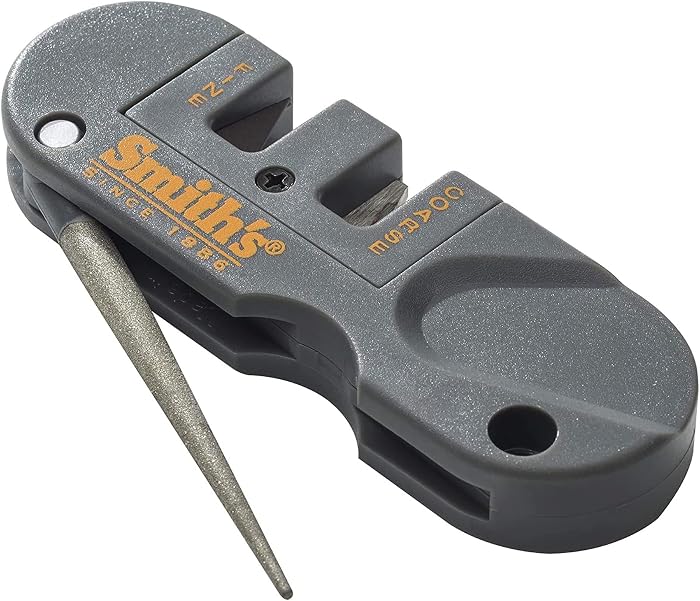
The Pocket Pal is a featherweight tool with a two-stage pull-through: a coarse carbide slot, a fine ceramic slot, and a fold-out diamond rod for serrations and fish hooks. It is small enough to hang from a lanyard or drop in a tackle box, and the plastic body keeps the weight down.

The diamond rod is the piece that makes it more than a simple pull-through. It reaches into places the slots cannot, and it is useful for gut hooks and serrated blades. The two-stage slots are preset, so you do not have to think about angle when you are in a hurry.

We like the rod most because it adds real capability without bulk, and the whole tool is small enough that we forget it is in a pocket. The plastic body does not feel as solid as the metal-bodied Lansky, but for occasional touch-ups on a working knife, that is an acceptable trade. It is a great one to keep in a glove box or a fishing bag, and the low weight makes it easy to own several and actually have one with you.

Worth Noting

  • Carbide slot removes metal quickly
Our Verdict

We keep the Smith's Pocket Pal in the ultralight slot because it is tiny and still gives you carbide, ceramic, and a fold-out diamond rod for pocket knives.

Check Latest Price
7

Fallkniven DC4 Best Premium Field Stone

Fallkniven DC4 Diamond/Ceramic Whetstone

Premium field use

Our Score 91/100
Sheath
Leather
Abrasives
Diamond and ceramic
Dimensions
3.94 x 1.26 x 0.35 in
View on Amazon

The DC4 is a sharpening stone that rides in a pocket: a 3.94-inch diamond-and-ceramic plate with a leather sheath that doubles as a strop. It is a different approach from the pull-through tools here, and that is the appeal.

One side is diamond, the other ceramic. The diamond side cuts quickly, and the ceramic side refines the edge without carrying two stones. Use it wet or dry, depending on the steel and your preference.

The leather sheath is more than a cover; it gives you a surface to finish the edge after the stone. The compact size is right for a pack or a jacket pocket, and the flat plate gives you more contact than a short rod.

We liked the control this stone gives you: you set the bevel and work the whole edge at your own pace. That control is also the catch, because freehand sharpening takes practice and the DC4 is not the tool for someone who wants a guided slot. It is more expensive than the pull-through options here, but it is also a more permanent-feeling piece of kit. If you already know how to hold an angle, this is a lovely stone to carry.

Our Verdict

We recommend the Fallkniven DC4 for a premium field stone, because the diamond-and-ceramic plate and leather sheath give you more control than a pull-through in a package that still fits a pocket.

Check Latest Price
8

Smith's DCS4 Diamond Combination Sharpener Best for Larger Field Jobs

Smith's DCS4 4” Diamond Combination Sharpener

Larger field jobs

Our Score 90/100
Extras
Fish hook groove
Handle
Rubber grip with thumb guard
Abrasives
Coarse and fine diamond
Stone Size
4 in
View on Amazon

A bench stone shrunk to field size: the DCS4 gives you a four-inch two-sided diamond surface in a handle that protects the stone when it is packed.

The coarse and fine sides let you reset and refine, and the micro-sharpening pad and groove handle fish hooks and pointed tools. The interrupted diamond surface is designed to cut faster and clear swarf.

The rubber grip and thumb guard give you something secure to hold when your hands are cold or wet. The handle also stores the stone, so you are not carrying a loose abrasive in a pack.

We liked the combination of a larger sharpening surface and a handled design; it is the one here that feels closest to a bench stone without becoming a bench stone. The DCS4 is bigger than the pocket tools, so it makes more sense in a hunting pack or truck box than in a shirt pocket. For those larger field jobs, the extra surface is worth it.

Worth Noting

  • Needs freehand angle control
Our Verdict

We recommend the Smith's DCS4 when you want a larger stone for field work, because its four-inch diamond surfaces and handled design give you more room to sharpen than a pocket rod.

Check Latest Price
9

Kershaw Ultra-Tek Sharpener

Kershaw 9" Ultra-Tek Sharpener

Light edge maintenance

Our Score 89/100
Shaft
Oval
Weight
2.4 oz
Storage
Shaft stores in handle
Abrasive
600-grit diamond
View on Amazon

The diamond rod hides inside the handle, so the Ultra-Tek carries like a pen and sets up by unscrewing the shaft and reversing it.

That is a neat piece of design: you get a full-length rod without a separate case, and the closed tool is compact enough for a pack or glove box. The shaft is oval rather than round, which gives you a wider contact patch.

The 600-grit diamond is fine enough for daily touch-ups. It leaves a working edge without the aggressive bite of a carbide slot, and the oval shape makes it harder to put a bad angle on a blade.

The compact shape makes it easy to carry in a pack or glove box, and the fine grit is forgiving on an edge you already like.

We liked the Ultra-Tek most for maintenance, not repair. It is the tool we reach for when a pocket knife is still cutting but starting to drag, and it is easy to use without a setup. That makes it a light-duty rod rather than a rescue tool, which is the right role for its 600-grit surface.

Worth Noting

  • Diamond coating can peel with hard use
Our Verdict

We recommend the Kershaw Ultra-Tek for light edge maintenance, because its 600-grit oval diamond shaft is easy to carry and hard to misuse on an already sharp blade.

Check Latest Price

How We Picked and Tested Pocket Knife Sharpeners

We started by gathering every pocket-sized sharpener with a real following, then cut the list by price and size: it had to disappear into a jacket pocket or a glove box, and it had to cost little enough that you'd buy it without a second thought. That left 16 units — folding carbide pull-throughs, guided multi-stage sharpeners, diamond rods, combination stones, and a ceramic pencil-style tool.

Testing ran four months, and most of it happened where a sharpener actually lives. One sat in the kitchen drawer for breaking down boxes and touching up a paring knife, one rode in a tool bag in the garage, and one clipped into a pack for weekend hikes and two car-camping trips. Every unit got the same dulled blades: a stainless folding knife, a fixed-blade camp knife, a serrated bread knife, and a fish hook.

Each session started with dulling the blade on a brick, then counting strokes until it shaved paper cleanly. We noted whether the blade sliced or tore, whether the guide held its angle or let the edge wobble, how much steel the carbide cutters took off compared with the ceramic and diamond surfaces, and how long each tool took to set up and stow. Housings, hinges, and stones got checked for rattle every few uses.

We also dropped each one onto concrete from waist height, let them bang around in a bag with keys for a month, and looked at whether the abrasive still bit or had clogged with steel dust. Then we asked what the money bought — better abrasive and a sturdier body, or a plastic shell and a gimmick — and whether a fire starter or whistle pulled its weight or was just dead weight.

How to Choose a Pocket Knife Sharpener

Decide Between Touch-Ups and Reprofiling

Start with the edge you are trying to fix. A pull-through carbide slot is the quickest way to put a working edge on a dull utility blade, but it removes metal fast and leaves a coarser finish. A diamond plate or ceramic rod is slower, though it gives you more control and removes less steel. We reach for a two-stage tool when we want both: a coarse side for a damaged edge and a fine side for maintenance. If you sharpen often, a finer abrasive will keep a good knife in shape without thinning the blade.

Carry Size and Grip Matter More Than You Think

Carry size is a real trade-off, not just a number on a listing. An ultralight sharpener disappears into a pocket and is easy to have with you, but it can feel small when you are applying pressure with cold hands. A heavier tool is still packable and gives you more to hold, which matters when the blade is dull and you need to work the abrasive. Look for a lanyard hole, a textured grip, or a body that fills your hand; those details make more difference in the field than another fraction of an ounce.

Match the Abrasive to the Edge

Match the abrasive shape to the edge. A flat stone or a ceramic notch works well on a straight pocket knife, but it cannot reach into serrations or a fish hook. A tapered diamond rod is the piece that gets into those spaces, and it is also useful for touching up a gut hook. If your knife has teeth, make the rod a priority. If you only carry a plain-edge folder, a simple stone or pull-through slot is enough.

Plan for Abrasive Life and Maintenance

Abrasives need care if you want them to last. Diamond surfaces load up with metal and swarf, so wipe or rinse them after use and let them dry before packing them away. Carbide teeth wear and cannot be resharpened, which is why replaceable or reversible carbide is worth looking for. A metal body is not automatically better, but it protects the abrasive in a pack. Check whether the sharpening surfaces can be cleaned or replaced before you count on the tool for years.

Do Not Pay for Extras You Will Not Use

Extras are only worth paying for if they replace something you already carry. A ferro rod and whistle make sense in a survival kit, but they should not decide the purchase if the sharpening surfaces are not what you need. A broadhead wrench or fish-hook groove is useful for hunters and anglers; a lanyard hole is useful for everyone. We prefer a sharpener that does the knife work well and skip the gadgets over one that does several jobs poorly.

Frequently Asked Questions

Final Verdict

For most people, the Work Sharp Guided Field Sharpener is the one to buy: it covers more edge work than any other tool here and still fits in a pack. If you carry a Swiss Army knife and want the smallest useful companion, the Victorinox Dual-Knife Sharpener is the better fit. If you want an ultralight backup that disappears into a pocket, the Smith's Pocket Pal is the one we tuck away.