Best Rice Cookers of 2026

A rice cooker is a heating element, a thermostat, and a timer — nothing exotic. What separates a basic one-touch pot from a fuzzy-logic machine is how it reads what's happening inside: the simple ones wait for the water to boil off and trip a sensor, while the better ones adjust the heat as the rice absorbs it, which is the difference between grains that separate and a sticky mass with a scorched bottom. I've owned both kinds. I've scrubbed both kinds.

Over the past eight months, my team and I cooked through 11 rice cookers, from three-cup compacts to 10-cup machines with steamer baskets and sauté modes, making jasmine, brown, sushi rice, and porridge. Two things shoppers tend to overlook: the inner pot coating matters more than the capacity printed on the box, and keep-warm is the setting you'll use most, so a cooker that dries rice out by 7 p.m. is no bargain. We weighed both heavily.

What follows are the ones that earned permanent counter space, for small households and big batches alike.

Our Top Picks

The 4 Best Rice Cookers of 2026

1

Cosori 10-Cup Rice Cooker Best Overall
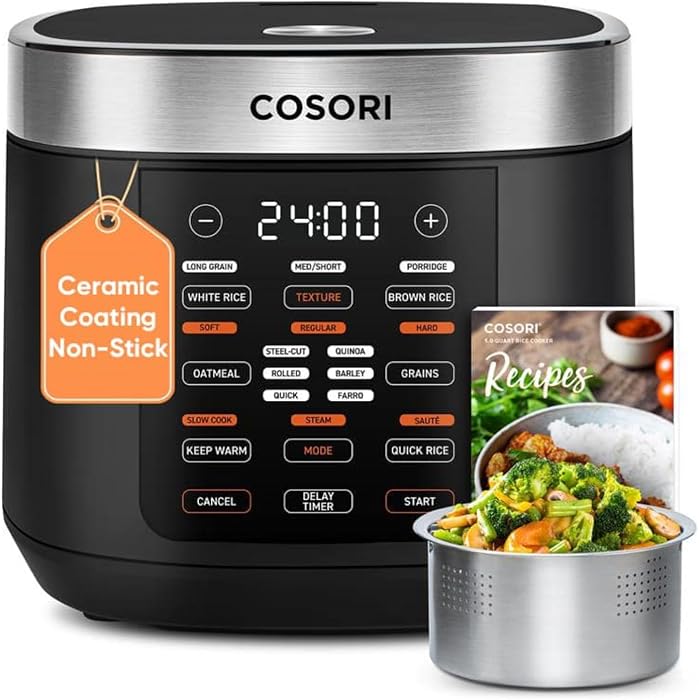
Cosori Rice Cooker 10 Cup

Most home kitchens

Our Score 96/100
Inner Pot
Ceramic-coated nonstick
Keep Warm
24 hours
Cooked Capacity
20 cups
Cooking Functions
18
View on Amazon

Eighteen functions is more than most of us will ever press, but the Cosori's menu is the rare one where the extras earn their space. Texture is the setting we kept coming back to: white rice can be soft, medium, or firm, which is the difference between rice that props up a curry and rice firm enough to roll sushi. The ceramic-coated pot is heavier and slicker than the thin nonstick liners on budget machines, and it lifts out along with a stainless steamer basket, both dishwasher-safe. That combination is why we recommend it to most households; nothing about cooking rice in it feels like a project.

What earns it the top slot is range rather than any single setting. Ten cups of raw rice becomes twenty cooked, so the same pot handles a family dinner, the leftovers, and a second batch for fried rice the next day without coming near the fill line. The fuzzy logic adjusts soak and steam time by grain and texture, and the gap shows up most with brown rice, which comes out tender rather than merely done, and with grains like quinoa that can easily collapse into porridge. There is a quick-rice setting for the nights you decided at 6:15, and it is a genuine shortcut rather than a nice label.

The 24-hour keep-warm is the feature we leaned on hardest. Rice held for hours stayed moist instead of crusting at the rim, and the delay timer means a batch can be waiting when you walk in, the two conveniences that turn a rice cooker from an occasional appliance into a daily one. The trade-off is size: it is the heaviest machine here at just over nine pounds and it claims roughly a foot of counter in each direction. Worth measuring before you commit a small kitchen's corner to it, and worth it if the cooker is going to live out anyway.

Two years of warranty is the longest coverage in this group, and on an appliance that runs most nights it is the detail that gave us the most confidence in handing over the top spot.

Worth Noting

  • Heavy and wide for a small counter
Our Verdict

The cooker we recommend to most households: 20 cups cooked, texture settings that actually change the rice, and a dishwasher-safe pot and steamer basket.

Check Latest Price
2

Zojirushi Neuro Fuzzy NS-ZCC10 Best Rice Quality

Zojirushi Ns ZCC10 Neuro Fuzzy Rice Cooker and Warmer (White)

Rice purists

Our Score 95/100
Wattage
680 watts
Inner Pot
Spherical nonstick
Keep Warm
Automatic and extended
Rated Capacity
5.5 cups
View on Amazon

The Neuro Fuzzy is slower than everything else here, and that is not a flaw to work around. It is the purchase. A plain one-touch cooker switches on and waits for the pot to run dry; this one runs a soak and steam cycle tuned to the grain and the texture you chose, with separate settings for white rice at three firmness levels, sushi rice, mixed rice, sweet rice, semi-brown, brown, rinse-free, porridge, and a quick cook. Set sushi rice and it behaves like sushi rice, which is not something we can say about a machine with one lever.

For plain short-grain rice eaten with fish or a scatter of furikake, this is the cooker we reach for first. Grains come out glossy and separate rather than clumped, and the spherical pan heats evenly enough that the bottom layer is not a crust. The extended keep-warm is just as convincing: rice held through a long dinner stayed moist instead of drying at the edges, which is where cheaper warm cycles give themselves away. The retractable cord and the timer that lets you set tomorrow's rice tonight round out a machine that asks nothing of you after the button.

The cost is real. This is the most expensive cooker in this guide by a wide margin, it holds about half what the Cosori does, and the menu takes a read-through before the first pot. What you are buying is rice quality and a settled, quiet machine that does not need supervision. If rice is a side dish in your house, spend the money elsewhere; if it is the point of the meal, this is the one.

Worth Noting

  • No steaming basket
  • Some units stop heating within a year
Our Verdict

Buy it if rice is the meal rather than a side: the Neuro Fuzzy's soak-and-steam cycles and extended keep-warm produce the best plain rice in this guide.

Check Latest Price
3

Zojirushi 3-Cup Micom Best for Small Households

Zojirushi Micom 3-Cup Compact Size

Singles and couples

Our Score 94/100
Cord
Retractable
Grain Settings
White, brown, GABA brown, steel-cut oats
Rated Capacity
3 cups
Smallest Batch
1/2 cup
View on Amazon

Half a cup of raw rice is a real batch here rather than a theoretical one, and that single number is why this compact Zojirushi has a place in a guide full of bigger pots. It takes one person from a solo bowl to a full pot without the rice coming out worse at either end, and three cups is the ceiling: enough for two people with leftovers, not enough for four at dinner. For a household that eats rice often but never in volume, that is the right shape entirely.

We recommend it to anyone cooking for one or two who is tired of choosing between a giant batch and nothing. The menus are the interesting part: a steel-cut oatmeal setting designed for the grain rather than guessed at, a GABA brown mode that holds brown rice warm for a couple of hours before cooking, and a long-grain white setting that treats basmati differently from short-grain. The fold-down handle and retractable cord mean it goes into a cabinet between uses instead of owning a piece of the counter.

It is not quick, and that is the honest trade. White rice runs close to an hour, longer than a stove-top pot and longer than the Cosori, and the result is better for the patience. The stainless exterior is easy to wipe down and the nonstick pot rinses clean, but the 11.8-inch depth means it still needs a real spot on the counter or a deep shelf.

Worth Noting

  • Caps out at three cups of raw rice
  • Priced like a full-size cooker
Our Verdict

The compact cooker for one- and two-person kitchens: a half-cup minimum, grain-specific settings, and rice that justifies the hour it takes.

Check Latest Price
4

Aroma 6-Cup Ceramic Best Budget

AROMA® 6-Cup (Cooked) One-Touch Pot Style Rice Cooker with CoreCoat™ PFAS-Free

Small budgets

Our Score 85/100
Weight
2.7 lb
Inner Pot
Ceramic, PFAS-free
Operation
One-touch
Cooked Capacity
6 cups
View on Amazon

Two things stand out at this end of the price range: a ceramic cooking surface, and a pot that is not the usual dark nonstick. The CoreCoat coating is made without PFAS, PFOA, lead, or cadmium, which is the claim we care about most in a pot rice touches every day, and the surface is slick enough that rice lifts off with the spatula instead of soaking overnight. The glass lid lets you watch the water disappear, which is more useful than it sounds when you are learning a new cooker.

We like it as a first rice cooker and as the machine for a kitchen that cannot spare another appliance footprint. At 2.7 pounds and roughly 8 by 9.5 inches, it moves from cupboard to counter with one hand, and the one-touch lever does the whole job: press it, walk away, and it flips to warm when the rice is done. Six cups cooked comes from three rice cups of raw, so the number on the box is the cooked figure. Plan on dinner for two with a bowl left over, not on feeding four.

The limits are the ones you would expect at this level. There is no timer, no delay start, and no grain settings, so brown rice means knowing your own water ratio. The pot is hand wash only, and the warm cycle is the weak point: rice left sitting can scorch at the bottom, so serve it or refrigerate it rather than parking it there for an afternoon.

Worth Noting

  • No timer, presets, or delay start
  • Hand wash only
Our Verdict

The budget pick to start with: a PFAS-free ceramic pot, a one-touch cycle, and a footprint small enough to keep in a cupboard.

Check Latest Price

How We Tested 11 Rice Cookers Over Eight Months

We started with every cooker we could find between the plain one-touch pots and the fuzzy-logic machines with multiple settings, then narrowed the field by capacity, inner-pot coating, and whether the controls made sense without the manual. That left 11, which we ran for eight months in home kitchens: a two-person apartment where the cooker lives on a sliver of counter, a family of four cooking most nights, and a household that batches rice every Sunday for the week ahead.

Every cooker got the same jasmine rice, the same rinse, and the same water ratio, and we timed each batch from pressing start to the beep. We noted whether grains came out separate or clumped, whether the brown rice and porridge settings actually behaved differently from plain white, and whether the bottom layer had browned or crusted. For ease of use, we set delay timers in a dim kitchen and counted how many buttons it took to start a batch from cold.

Temperature retention got its own test: rice left on keep-warm for 12 hours, then 24, with texture checked and the center of the pot probed each time. We washed every inner pot by hand the same night and compared the nonstick surface at week one and at month seven, looking for scratches, dull spots, and rice that started sticking. Durability showed up in smaller ways — hinges, latches, and a retractable cord that stopped retracting.

We also used the steamer baskets and sauté modes for real dinners rather than side tests, since a multifunction cooker that does four things badly isn't worth the space. Value was the last call: a cooker earned its price if we were still reaching for it by the end without thinking about it.

How to Choose a Rice Cooker

Cooked cups, raw cups, and the size you need

The box will not tell you straight. A 6-cup label can mean six cups of cooked rice made from three cups of raw, which is exactly how the Aroma 6-Cup Ceramic is rated, while a Zojirushi rated at 5.5 cups is working in raw rice cups. Rice roughly doubles as it cooks, so read the parenthesis before you compare two machines.

As a rule, one cup of raw rice makes two to three generous side servings. A couple eating rice twice a week is well served by a 3-cup machine; a family of four wants 5 cups of raw rice or more, and anyone cooking for a crowd should look at a 10-cup model. Buying bigger than you cook is the most common mistake, because a huge pot of rice for two is a pot you have to wash.

Fuzzy logic versus one-touch

A one-touch cooker is a thermostat and a heating element: it cooks until the water is gone, then flips to warm. Fuzzy logic adds a processor that soaks, ramps, and steams on a schedule, which is why the better machines offer texture settings such as soft, medium, and firm, plus separate menus for sushi rice, porridge, and brown rice.

The price gap is real, and our advice is to pay it if rice lands on the table three nights a week. A plain one-touch cooker is a fine, cheap way to find out whether you will use one at all, and the wrong thing to buy if you already know you will.

The pot, the coating, and cleanup

Pot surfaces run from plain nonstick to ceramic to coated steel. Ceramic is naturally slick and, on models like the budget Aroma here, made without PFAS, PFOA, lead, or cadmium, which is a reasonable thing to want in a pot that gets scraped twice a day. Whatever the coating, use the plastic paddle that comes in the box rather than a metal spoon.

What matters more day to day is whether the pot and lid can go in the dishwasher, because a cooker you dread washing becomes a cabinet ornament. Check the care instructions before buying: the Aroma pot is hand wash only, while the Cosori's pot and steamer basket both go in the machine.

Keep warm, timers, and where it lives

Keep-warm is not a bonus feature, it is how a rice cooker fits a schedule. A good one holds rice for hours without drying it out; a weak one scorches the bottom of the pot within twenty minutes of finishing, so if you plan to cook at noon and eat at seven, that is the specification to care about. A delay timer is the other half of the same convenience: load the pot in the morning and it starts itself.

Then measure the counter. These machines run from about 8 inches square up to more than a foot in each direction, and the largest one here is also the heaviest at just over nine pounds, which matters when you carry it to the sink.

Frequently Asked Questions

Final Verdict

For most kitchens the Cosori is the buy: 20 cups cooked, texture settings that genuinely change the rice, a dishwasher-safe pot and steamer basket, and the longest warranty in this group. It covers a weeknight batch and a dinner party with the same pot, which is why it holds the top spot.

Buy the Zojirushi Neuro Fuzzy instead if plain rice is the whole point of the meal and you want the best version of it. Take the compact Zojirushi if you cook for one or two, and start with the Aroma if you are still deciding whether a rice cooker belongs in your kitchen at all.