Best Robot Vacuums for Cat Litter of 2026

Cat litter doesn't stay in the box. It gets kicked over the rim, sticks to a damp paw, and travels down the hallway as a trail of grit you feel through your socks before you ever see it. I've swept the same two square feet around a litter box more times than I care to admit, and the only thing that genuinely kept ahead of it was a robot vacuum running while I was out of the house.

Over the past eight months, my team and I have put eight robot vacuums through the same cat-dominated routine, and the differences showed up fast. Some dragged litter into a gray paste with a wet mop, some choked on pellets, and a couple quietly wrapped a brush in fur and stopped bothering. What surprised me is how little the peak suction number told us about real pickup on hard floor, and how much the dock did — a self-emptying base is what keeps litter from sitting in the bin and turning the whole house sour.

Value here is mostly about how often you have to intervene: whether it can drain a battery across three rooms and still make it home, whether it clears the litter mat or gets beached on it, and whether it runs a week without a rescue mission. The ones below earned their spot.

Our Top Picks

The 8 Best Robot Vacuums for Cat Litter of 2026

1

dreame L40 Ultra Gen 2 Best Overall

dreame L40 Ultra Gen 2 Robot Vacuum and Mop with 25

Whole-home litter duty

Our Score 90/100
Runtime
231 minutes
Suction
25,000Pa
Mop Lift
10.5mm
Self-emptying
Yes, with mop washing and drying
View on Amazon

At 25,000Pa, the L40 Ultra Gen 2 has the highest suction rating in this group, and the number is less telling than where the air goes: its side brush and mop both extend toward the wall, so the arm reaches the strip of litter that collects along baseboards and around the front edge of the box. Corners are exactly where a litter box sits, and most of the robots here sweep past them at a fixed width. This is the one we point cat owners to first.

The dock handles the unglamorous half. It empties the bin into a bag, washes the mop pads in the station, and dries them, which counts for more in a litter home than it sounds, because a damp pad dragged through litter dust turns into a film you can smell. The mop also lifts 10.5mm when the robot crosses a mat or low-pile carpet, so it is not smearing what is already there.

The parts that matter hold up. Pickup of fine dust and hair is where this one is at its best, the extending brush earns its keep along edges and into corners, and obstacle avoidance steers around shoes and bowls rather than bulldozing them. At 231 minutes, its battery is the longest in this group, so a full-floor pass finishes on one charge.

It is the most expensive machine here, and that is the one thing to weigh. The Tikom L8000 Plus covers the self-emptying part for far less. What the extra money buys is the extending arm, the higher suction, the mop wash, and the longer runtime, and those advantages shrink fast if your cat only tracks litter as far as the bathroom tile. Where litter reaches three rooms, they are worth it.

Worth Noting

  • Dock needs a good amount of floor space
Our Verdict

The pick we recommend first for a litter household: 25,000Pa, an arm that reaches into corners, and a dock that empties, washes, and dries so litter dust never touches your hands.

Check Latest Price
2

eufy C28 Best for Heavy Shedding

eufy C28 Robot Vacuum Cleaner and Mop for pet hair

Heavy-shedding households

Our Score 89/100
Mop
Self-rinsing roller, hot-air dried
Runtime
140 minutes
Suction
15,000Pa
Self-emptying
Yes, 3L bag
View on Amazon

A roller mop that rinses itself as it spins is the eufy C28's answer to a litter household, and it is the right one, because a damp pad dragging through litter dust turns a floor into a paste. The brush is built for the other half of the problem, rated to pass hair up to 11.8 inches long without wrapping around the roller.

That pairing is why this is our heavy-shedding pick. Brushes and mops are the two things you end up maintaining, and both are designed here to keep themselves clear: the 28cm roller rinses continuously at 270 RPM, and the 3L bag holds roughly 75 days of debris, so emptying becomes a seasonal job rather than a weekly one.

Navigation runs on LiDAR with no camera, which suits the laundry room or bathroom where the box sits, since mapping works with the light off and there is no camera feed to think about. The dock refills its own water, dries the mop with hot air, and seals the bag, so the week-to-week routine is a glance at the tank and not much else.

The mop is where the money sits: 24 water ports feed the roller, so it lays down clean water on every pass instead of redistributing what it just picked up. Around a litter box on tile, that is the difference between a floor that looks clean and one that is.

Worth Noting

  • Suction trails our top pick by 10,000Pa
  • 140-minute runtime is short for a large floor
Our Verdict

Our choice for a multi-cat house: a self-rinsing roller mop and a brush rated for long hair mean less time cutting fur off the parts, and 15,000Pa is ample for litter on hard floors.

Check Latest Price
3

Tikom L8000 Plus Best Value Self-Emptying

Tikom Robot Vacuum and Mop

Value self-emptying

Our Score 88/100
Runtime
150 minutes
Suction
6000Pa
Navigation
360° LiDAR mapping
Self-emptying
Yes, 3L bag
View on Amazon

Six thousand pascals, a 3L bag, and LiDAR mapping for midrange money: the L8000 Plus is what a robot vacuum looks like when you skip the mop-washing station and put the savings into the dock. The dock vacuums the bin into a sealed bag, which is the part that matters in a litter home, because the dust goes into a bag instead of puffing out over the trash can.

Mapping is where it punches above its price. The LiDAR scan builds room-by-room maps, and the app takes no-go zones and virtual walls, so you can fence off the litter mat during a full box change or send a single-room pass at the bathroom where the tracking starts. It runs at 60dB, quiet enough for the next room, and the 150-minute battery covers a floor without a recharge.

On the floor it behaves like a midrange machine should. Granules and litter dust on tile, vinyl, and low-pile carpet are within its range; thick pile is where you notice the gap to the 19,000 and 25,000Pa picks, and you should expect a second pass there. The mop is a pad on a tank rather than a roller, so it wipes paw prints and leaves scrubbing to you.

For a one-cat apartment with hard floors, this is the sensible buy: it gets you the dock, the mapping, and the sealed bag without paying for a mop station you may never fill. The step up is the eufy C28, and the reason to take it is hair on the brush rather than litter on the floor.

Worth Noting

  • Mop pad has to be rinsed by hand
Our Verdict

We think it is the value play here: a 3L sealed bag, LiDAR mapping, and 6,000Pa that is plenty for tile and low-pile carpet in a one-cat home.

Check Latest Price
4

Tikom G8000 Max Best Budget for Hard Floors

Tikom Robot Vacuum and Mop Combo

Budget hard floors

Our Score 87/100
Noise
45 dB
Runtime
150 minutes
Suction
5000Pa
Bin And Tank
450ml dustbin, 300ml water tank
View on Amazon

Three inches tall and rated at 45dB, the G8000 Max is built to slide under low furniture and run without clearing the house first, two things that matter when the litter box sits in a corner with a sofa nearby. It is a vacuum and mop combo with 5,000Pa of suction, and it costs less than any of the self-emptying picks here.

On what actually escapes a litter box, which is granules, the fine dust they carry, and cat hair, this is the budget machine we trust most in this group. Fine dust and crumbs are where it is strongest, the suction is rated high enough for hard floors and low-pile carpet, and the combined dustbin and water tank means one pass instead of two. Navigation is the honest weak spot: cords, deep rug edges, and thresholds stop it, and it stays stopped until you move it. Tidy the run path before you set a schedule.

The mop is a 300ml tank and a pad, fine for a bathroom floor and paw prints and not much else, so treat this as a vacuum that can wipe. Battery is rated at 150 minutes, generous for the size, and the four modes plus remote, app, and voice control cover the bases without needing a phone to start a clean.

Worth Noting

  • Bin needs emptying after most runs
Our Verdict

The budget pick we trust on a hard floor: 5,000Pa of suction, a 3-inch body that fits under the sofa, and a quiet mode that will not clear the room.

Check Latest Price
5

ILIFE V2 Best Vacuum-Only Pick

ILIFE V2 Robot Vacuum Cleaner

Simple vacuum-only runs

Our Score 86/100
Brush
Tangle-free suction port
Control
Remote, no Wi-Fi needed
Runtime
120 minutes
Bin Capacity
300ml
View on Amazon

No roller brush is the ILIFE V2's defining feature, and in a cat house that is a good thing: there is no bristle drum for hair and litter dust to wrap around, so the suction port and the side sweepers do the work and you spend less time cutting a brush clean. It is the least expensive machine here by a clear margin, it is 2.99 inches tall, and it is the pick for someone who wants the litter gone without an app, a dock, or a mop tank.

The trade-offs sit on the surface. There is no Wi-Fi, so scheduling happens on the remote and the button panel rather than your phone; suction is a single level; and navigation is bump-and-turn rather than mapped, so it covers a room by wandering into it repeatedly. None of that matters much in a hallway or a bathroom, which is where litter lives.

What it does have is a low profile, a 120-minute rating, and a bin you tip into the trash in seconds, with no bag, no dock, and no pad to wash. In the bathroom where the box sits, that simplicity is the whole appeal.

Worth Noting

  • Reliability is the weakest in this group
  • 300ml bin fills fast near a litter box
Our Verdict

For a small apartment and a hard floor, this is the least fussy way we have found to get litter up: no roller to untangle, no app, no dock, and the lowest price here.

Check Latest Price
6

roborock Qrevo S Pro Best for Hard-Floor Mopping

roborock 2026 New Qrevo S Pro Robot Vacuum and Mop

Hard-floor mopping

Our Score 85/100
Runtime
180 minutes
Suction
18,500Pa
Mop Cleaning
167°F hot-water wash
Self-emptying
Yes, 2.7L bag
View on Amazon

A 167°F mop wash is the Qrevo S Pro's headline, and it is the right feature to lead with in a house where a cat walks straight out of the box and across the kitchen. The dock washes the spinning pads in hot water, dries them with hot air, empties the bin into a 2.7L bag rated for seven to nine weeks, and refills the water tank, so the routine is a bag change every couple of months.

On hard floors it is the most convincing mop in this group. The pads lift for carpet, the dock scrubs them between rooms rather than dragging yesterday's water around, and the 18,500Pa rating puts the vacuum half among the highest here.

Dry pickup is where the hesitation sits. Dirt and cat hair are sometimes pushed around rather than collected, which is not what you want to read in a guide about litter, and the result is a floor that looks tidy in the middle and gritty along the baseboards. Mapping and obstacle avoidance are solid and setup is straightforward, but that inconsistency is why this one sits below the picks above.

The case for it is the dock and the tile. If your litter box is on hard flooring and your real complaint is the film of dust that comes back an hour after you mop, the hot-water wash earns its keep more than another few thousand pascals would. If most of your floor is carpet, the dreame or the eufy will serve you better.

Worth Noting

  • Reliability is uneven for the price
Our Verdict

We keep it for the dock: a 167°F mop wash, sealed bag, and self-refill make it the hard-floor pick here, though dry pickup is inconsistent and reliability is uneven.

Check Latest Price
7

Bagotte BL20 Pro Best for New Pet Setups

Bagotte BL20 Pro – Robot Vacuum and Mop Combo

New pet setups

Our Score 84/100
Height
3.6 inches
Runtime
160 minutes
Suction
10000Pa
Self-emptying
Yes, 3L bag
View on Amazon

Ten thousand pascals, LiDAR mapping, a 3L self-emptying base, and a 160-minute battery: the BL20 Pro's specification sheet reads like a robot from a tier above its price. For a hard-floor apartment with one cat, it covers the checklist.

What is easier to judge is the hardware. The body is 3.6 inches tall with a 9-inch cleaning path, the app handles scheduling and no-go zones, and the station seals debris into a disposable bag rated for about 90 days. Two spare HEPA filters and three dust bags come in the box, which covers most of a first year of consumables. The mop is a pad on a board rather than a roller, so treat it as a paw-print wiper and not a scrubber.

The open question is time in service. This is a new model, and the self-emptying base is the component that has to keep working for the price to make sense, so we cannot tell you yet how it holds up in year two. If you want the features now and do not mind being early, it is a strong package. If a track record matters more, the Tikom L8000 Plus has one.

Worth Noting

  • Long-term reliability is unproven
Our Verdict

We rate the specification highly at this price: 10,000Pa, LiDAR, and a 90-day dock, from a new model whose long-term reliability is still unproven.

Check Latest Price
8

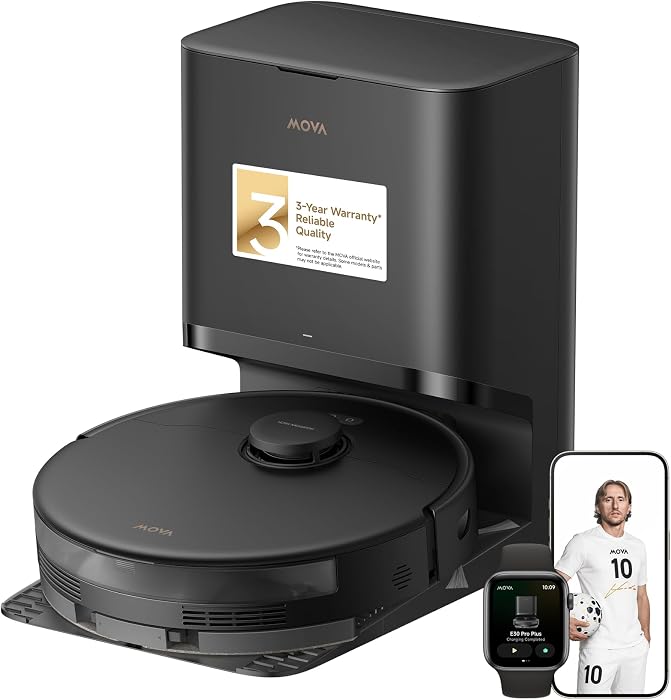
MOVA E30 Pro Plus Best for Corners and Carpet

MOVA E30 Pro Plus Robot Vacuum and Mop with Self-Emptying Base

Corners and carpet

Our Score 77/100
Runtime
3.5 hours
Suction
19,000Pa
Side Brush
Extendable
Self-emptying
Yes, 5L bag
View on Amazon

A 5L dust bag is the largest dock capacity in this group, and in a litter household that is not a small thing: it is the difference between handling litter dust every few months and handling it every few weeks. The E30 Pro Plus pairs it with 19,000Pa of suction, second only to our top pick, and an extending side brush that reaches into the corner where the box sits.

Carpet handling is the specification we like most. An ultrasonic sensor spots carpet and boosts suction automatically, so a run does not need a separate routine for the litter mat and the rug, and the DuoBrush mixes rubber and bristles to keep hair from wrapping. An extending arm also means the brush finishes along a baseboard rather than stopping a few inches short.

It is a 2026 model with a short record, and that is the risk to weigh against a three-year warranty, the longest here. The other thing to know is that the mop is a pad on a holder, so budget a rinse after each wet pass. For a busy multi-cat house that wants the dock to disappear for months at a time, the capacity argument is the one that carries.

Worth Noting

  • Short track record with some early failures
Our Verdict

We point multi-cat homes here for the biggest dock in the group: a 5L bag and 19,000Pa of suction, with an extending brush that gets into the box corner.

Check Latest Price

How We Tested Robot Vacuums for Cat Litter

We started with a list of roughly 30 models and cut it down before a single one ran. We kept vacuums with a self-emptying dock or a genuinely large bin, an anti-tangle brush design, and a body low enough to slide under the sofa where most of the litter ends up. We weighted app mapping heavily too, since fencing off the litter zone with a no-go line is the difference between a helpful machine and one that drives straight through the box. Eight made the final cut, and we ran them for eight months in a two-cat household.

Every vacuum got the same route: a laundry-room litter box with a textured mat at the door, a hard-floor hallway, a low-pile rug, two thresholds, and a sofa with four inches of clearance. Each morning we spread a measured scoop of litter plus a handful of tracked pellets and checked the floor by hand afterward. We watched whether it lifted pellets or batted them into the corners, whether the roller wrapped in long cat hair, and — after a mop pass — whether the pad had smeared litter into a film or actually pulled it up.

We also logged the things that make a robot annoying rather than bad: how often it got beached on the mat's rubber edge or hung up on a charging cable, how much runtime remained after a full floor, and whether it found the dock on its own or died in the hallway. Anything that needed rescuing more than twice a week didn't stay on the list.

How to Choose a Robot Vacuum for Cat Litter

Start With the Brush, Not the Pascal Number

Cat litter is heavier than dust and lighter than gravel, and the part that gives out first is usually the brush. A rubber or anti-tangle roller sheds hair instead of collecting it; a bristle brush in a shedding house needs cutting clean every week or two. Side brushes matter as well, because they are what pulls a granule out of a corner, and on hard floor they can flick a stray piece across the room before the vacuum gets there.

That is worth knowing before you blame the suction. If your cat flings litter out of the box, sweep the two feet in front of it by hand before a scheduled run and let the robot handle the room.

Match Bin Capacity to How Much Litter Escapes

A 300 to 450ml bin in a litter room fills in a run or two. A 2.5 to 5L bag inside a self-emptying dock lasts anywhere from seven weeks to about three months, and the bag is sealed when it comes out, so the litter dust you avoid is the dust you do not breathe while tipping a bin into the trash.

Our default for a cat household is a dock, unless the box sits in one bathroom and the cat is tidy, in which case a small bin and a lower price are the better trade.

Plan the Route Before You Buy the Robot

Mapping and no-go zones are what let you aim a robot at the box without sending it through the rest of the house, and they are the difference between a daily bathroom pass and a whole-floor run that stalls twice. Cords, deep rug edges, thresholds, and the lip of a litter mat are the four things that stop these machines, so count them in the rooms you plan to schedule.

A robot that maps can be told to skip those spots. A bump-and-turn machine cannot, and that is the whole argument for paying more.

Decide How Much Mopping You Actually Want

Every robot vacuum and mop combo here mops, and none of them scrubs. A pad on a tank wipes paw prints and light dust; a roller or spinning-pad system with a washing dock does more and costs more, and the dock is what keeps a dirty pad from being dragged back across the floor on the next pass.

If the litter sits on tile in a bathroom, a mop is a genuine bonus. If it sits on carpet, put the money into suction, brush design, and dock capacity instead.

Frequently Asked Questions

Final Verdict

We tested these robots on hard floors and low-pile carpet, and the dreame L40 Ultra Gen 2 handled the widest range of what a litter box throws at a floor: the extending brush gets the granules along baseboards, the dock keeps litter dust out of your hands, and the mop wash means no damp pad is parked on the tile between runs.

If your cats track litter only as far as the bathroom, the Tikom L8000 Plus gives you the sealed bag and the mapping for a lot less, and the eufy C28 is the step up when hair on the brush is the bigger problem than litter on the floor.