Best Robotic Window Cleaners of 2026

The first time a window-cleaning robot heads up a second-story pane, your brain runs a quick calculation: what happens when it lets go? In every model worth buying, nothing — a backup battery keeps suction alive for a few minutes after a power cut, and a tether catches anything that slips. That's the pitch: clean glass without a ladder, a lean over the sill, or a squeegee arm stretched past comfort.

I'd cleaned plenty of windows by hand and doubted a suction disc could beat a squeegee. Over seven months, my team and I ran eight of these across interior windows, a sliding patio door, and panes that normally require a stepladder. Suction ratings on the box mattered less than how a robot handled a wet pad around frames, and how much water it carried before a refill.

A machine that smears the corners costs more time than it saves, and one that looks like a flying saucer parked on your sill is a hard sell. The picks below clear both bars.

Our Top Picks

The 6 Best Robotic Window Cleaners of 2026

1

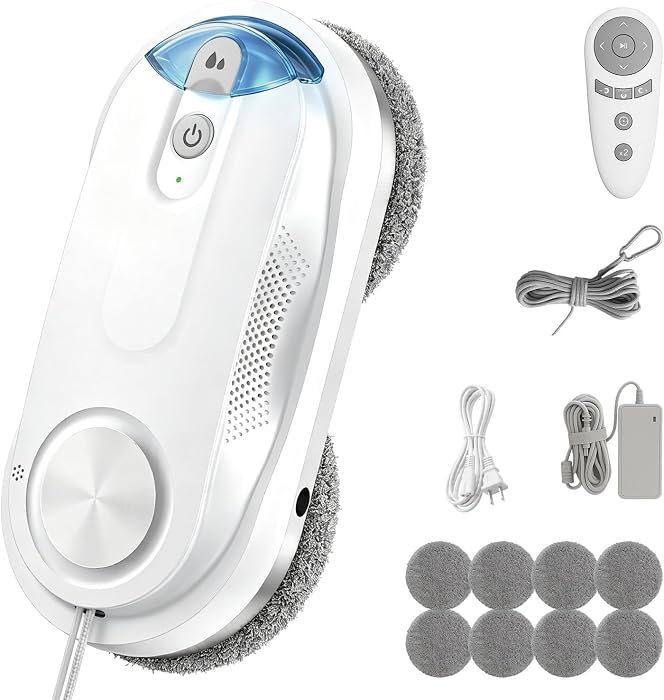
HUTT H10 Window Cleaning Robot Best Overall

HUTT H10 Window Cleaning Robot

Whole-house cleaning

Our Score 87/100
Suction
6,500 Pa
Water Tank
80 ml
Cleaning System
Round and square dual-stage
Power-off Backup
30 min
View on Amazon

Two pads, two jobs: a round pad spins at 70 RPM to scrub the glass wet, then a square pad follows to wipe it dry and polish. That sequence is the most deliberate answer to streaking in this group, and streaking is where window robots usually fall down, because haze comes from finishing a pane wet rather than from a weak spray. HUTT backs it with 6,500Pa of suction and 55N of constant pressure pressing the pad to the glass, which is the part that lifts dried-on film instead of just pushing water around. That pairing of pad sequence and pad pressure is what separates it from every other machine here.

The hardware around those pads is considered too. NAVI 7.0 maps the pane before it starts and 14 sensors handle edges and pressure, so it works the frame instead of bouncing off it. The 80 ml tank sits on the large side for this group, and HUTT rates a fill at roughly 646 square feet, enough for a whole floor of windows without a refill. At 6.19 pounds it comes off the glass easily in one hand, which matters when you're moving it between panes on a step stool.

The safety package is overbuilt in the way we want on something that lives above a drop: a rope rated to 220 kg and a 30-minute backup that keeps the fan running if the power goes. What you notice instead is the weight when you carry it upstairs. At 6.19 pounds it's more than twice the KKI's 1.1 kg, though that disappears the moment the robot grabs the glass.

Worth Noting

  • Pads are hand-washed after every run
Our Verdict

We recommend the HUTT H10 to most people: the two-stage pads handle streaks better than anything else here, and the suction, tank, and safety hardware back it up.

Check Latest Price
2

ECOVACS WINBOT MINI Best for Small Panes

ECOVACS WINBOT MINI Window Cleaning Robot

Narrow, tight panes

Our Score 82/100
Spray
Dual nozzles
Suction
7,500 Pa
Body Thickness
2.17 in
Fall Protection
9-stage system
View on Amazon

At 2.17 inches the WINBOT MINI is the slimmest machine here, and its body is bumper-free, so no plastic lip holds the pad away from the frame. That isn't a spec-sheet nicety. It's the difference between a robot that fits inside a narrow casement or a divided-light window and one that sits on the sill while you do those panes by hand.

Small glass, tight frames, bathroom windows, the sidelight next to the door: that's the work we give it. It also carries the highest stated suction figure in this group at 7,500Pa, along with dual spray nozzles and a nine-stage protection system, so the compact body doesn't feel like a downgrade in grip. What you notice instead is the scale, because a mini covers less glass per pass and a six-foot slider turns into a longer job than it would be for a full-size machine.

The spray is an ultra-fine mist, which dries quickly and leaves little to buff, but it also makes the MINI a maintenance tool rather than a recovery tool: a pane with real film on it wants a hand pass first. At this price it's the easiest way into the category, and the one here that reaches panes the rest of the group can't.

Worth Noting

  • Mini body needs more passes on big panes
  • Light mist won't cut heavy film
Our Verdict

This is the one we hand people with narrow panes and divided lights: full-size grip in a body that actually fits between the frames.

Check Latest Price
3

ECOVACS WINBOT W3 Omni Best Hands-Off

ECOVACS WINBOT W3 Omni Robot Window Cleaner with Auto-Clean & Multi-Functional

Hands-off upkeep

Our Score 80/100
Navigation
WIN-SLAM 5.0
Battery Life
130 min
Pad Cleaning
Automatic wash station
Water Capacity
1.1 liters
View on Amazon

Sixteen high-pressure nozzles and about a minute of washing: that's what the W3 Omni's station does to a pair of dirty pads between runs, and it's why this is the pick for anyone who has already owned a window robot. The worst part of owning one isn't the glass. It's the sink afterward, scrubbing grey pads while the machine sits idle.

The cleaning hardware is the most complete here. A TruEdge scrubber drops to the edge of the pane at 200 RPM, WIN-SLAM 5.0 adds Fast, Intensive, and Zone modes with obstacle detection down to a millimeter, and three wide-angle nozzles wet the glass ahead of the pad. The 1.1-liter reservoir and the 130-minute battery are both the largest in this group by a wide margin, so you can work through an afternoon of glass without a refill or a charge.

Twelve kilos is a two-hand lift, and it changes how you plan a morning: you park the station and work every pane within reach instead of carrying the robot floor to floor. Haze is the result that splits on this model. A pane that starts dusty can come out cloudy, and what decides it, as far as we can tell, is how much soil was on the glass and whether the pad seats cleanly. What we kept coming back to, though, is the tank, because 1.1 liters is more than a dozen times the 85 ml reservoirs on the rest of these picks.

Worth Noting

  • 12.22 kg makes it a two-hand lift
  • Premium price for this group
Our Verdict

If scrubbing pads is the part you hate and you have a houseful of glass, we think the station earns its premium.

Check Latest Price
4

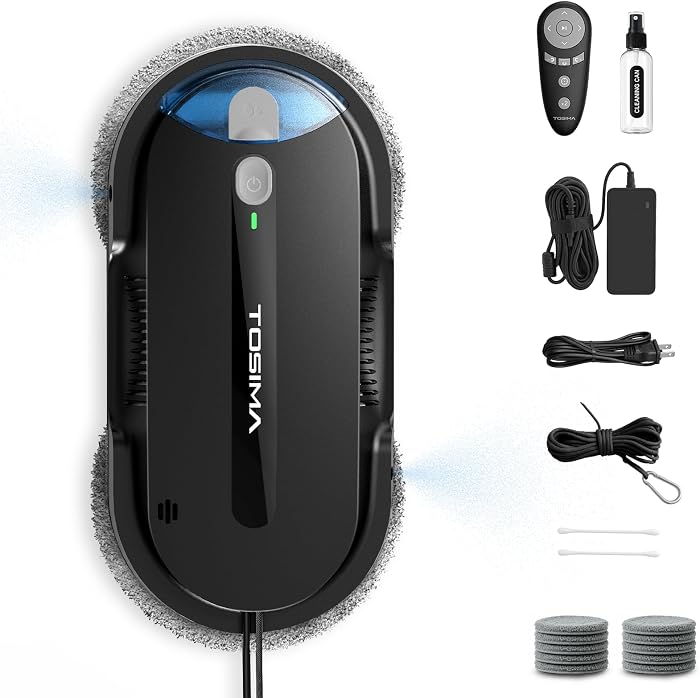
Tosima X1 Window Cleaning Robot Best for Large Windows

Tosima X1 Window Cleaning Robot

Large windows, quiet

Our Score 79/100
Spray
Dual ultrasonic nozzles
Weight
5 lb
Water Tank
85 ml
Noise Level
65 dB
View on Amazon

Five pounds and 65 decibels: the Tosima X1 is the one you can carry up a step stool in one hand and run while somebody is on a call in the next room. Those two numbers did more to change how often we reached for it than any cleaning specification on the box.

It's also the easiest of these to set up. The 85 ml tank has a viewing window, so you can check the level without unclipping anything, dual ultrasonic nozzles lay down an even mist, and it works an S-path from the top of the pane down. The remote is there for panes you want to take over. What struck us is how much of the job it does with no input at all: hang it, press once, walk away.

The limits are the usual round-body ones. Corners on a divided-light window still want a cloth, and the cord has to reach every pane you put it on, which rules out most second-story exterior work. None of that matters much on a big picture window or a bank of sliders, which is exactly where this one does its best work.

Worth Noting

  • Corners need a cloth on divided lights
  • Cord must reach every pane
Our Verdict

Our pick for large panes: light enough to move all morning, quiet enough to run while you work, and simple enough that you'll actually use it.

Check Latest Price
5

KADSKAN HCR-10 Window Cleaning Robot Best for Tight Budgets

KADSKAN HCR-10 Window Cleaning Robot – Window Cleaning Robot

Tight budgets

Our Score 78/100
Suction
5,600 Pa
Water Tank
30 ml
Safety Rope
300 lb capacity
Cleaning Path Width
5.7 in
View on Amazon

The least expensive robot here is an odd package on paper: 5,600Pa of suction, more than a couple of pricier machines in this group, bolted to a 30 ml tank that holds about two tablespoons of water. Both numbers tell the truth. It grabs the glass convincingly, and it runs dry in the middle of a big pane. For a bathroom window, a mirror, or a small picture window it's genuinely useful; for a sliding glass door it isn't.

The rest of the kit is more generous than the price suggests. Ten cleaning pads ship in the box, which is the practical answer to a small reservoir: swap a dirty pad and keep going instead of stopping to wash. The double spiral head runs a 5.7-inch path, the safety rope is rated to 300 pounds, well past the machine's weight, and the remote and three modes cover the basics. Just size your expectations to the pane.

Worth Noting

  • 30 ml tank runs dry mid-pane
  • 5.7-inch path is slow on large glass
Our Verdict

We like it as a second robot for small panes and mirrors; if your glass runs wall to wall, the small tank will frustrate you.

Check Latest Price
6

KKI X3 Window Cleaning Robot

KKI X3 Window Cleaning Robot

Corded indoor glass

Our Score 77/100
Suction
2,200–3,200 Pa
Water Tank
85 ml
Power Source
Corded electric
Backup Battery
25 min
View on Amazon

The KKI X3 runs on mains power, and its five-meter cord is also the safety rope, a single line doing both jobs. That tells you what this machine is: a plug-in tool for glass within reach of an outlet, with a 25-minute battery that exists to hold it to the pane if the power drops, not to clean a floor's worth of windows.

Inside that circle it's a tidy piece of kit. The 85 ml tank matches the biggest reservoirs here outside the ECOVACS station, dual ultrasonic nozzles wet the glass evenly, and three modes with edge detection handle panes of different sizes. At 1.1 kg it weighs less than half the Tosima X1, and hanging it on the glass one-handed takes no effort at all, which is not true of the heavier machines in this group.

The ceiling is suction: 3,200Pa is the lowest maximum here, and it's the number we watched most closely on tall exterior panes. Circular pads also trace arcs, and on dusty glass those arcs can show up as swirl marks until the pane is wiped again. Use it indoors, on mirrors, doors, and ground-floor windows, and it's good value for a simple machine.

Worth Noting

  • 3,200Pa is the lowest suction ceiling here
  • Swirl marks can show on dusty glass
Our Verdict

We rate it a good, light corded tool for indoor glass and mirrors; above the first floor, the cord and the suction ceiling get in the way.

Check Latest Price

How We Tested Robotic Window Cleaners

We started by pulling every robotic window cleaner we could find that advertised a real safety system — a backup battery, a tether, or both — then narrowed by suction rating, water capacity, and footprint, since a unit that won't fit between the glass and a window screen is useless. Eight made the cut, and we ran them for seven months.

We set each one up cold, without the manual, to see how long it took to get a first window running. Most of the testing happened where these machines actually live: interior windows in a house, a sliding patio door that collects dog nose prints, and panes above a stairwell and behind a couch where a stepladder doesn't fit. Each unit ran a full cycle on every surface, and we timed it against a squeegee and a spray bottle to see what the saved minutes added up to.

We hunted streaks with a flashlight held at a low angle across the glass — the way you notice them at sunset — and counted how many panes each tank covered before the spray ran dry. Mid-cycle, we pulled the plug to watch whether the backup battery held suction or the unit slipped. Every robot also crossed frame seams and corners repeatedly, and we noted which ones recovered on their own and which stalled until we restarted them.

Last, we tracked what you notice after the novelty wears off: whether the cloth was still damp by the third window, how loud the motor was in a quiet room, and how the thing looks parked on a sill between jobs. No one got dinged for skipping a self-cleaning dock, but leaving a film at the edges cost points.

How to Choose a Robotic Window Cleaner

Start With Grip, Backup Power, and the Tether

Suction is the headline number on any window cleaning robot and the least comparable one. This group runs from a 2,200–3,200Pa ceiling up to 7,500Pa, and makers measure differently, so read those figures as a rough order rather than an exact ranking. What you can actually check is the protection around them: a backup battery that keeps the fan running after a power cut, and a rope rated well above the machine's own weight.

Anchor that rope to something structural, such as a stair rail or a radiator pipe, rather than to the window's own handle, and set it up even on a ground-floor pane. A cord that snags on a sill peels a robot off glass faster than weak suction does, so give it slack and keep the run clear.

Why the Pad Decides Streaks More Than the Spray

Haze on glass usually comes from finishing a pane wet, not from spraying too little. A round pad scrubs well but traces arcs and can't reach a corner; a square pad polishes into corners but doesn't scrub. The HUTT H10 is the only machine here that runs both in sequence, round first for the wet lift and square second for the dry finish, and that is most of why it took our top spot.

If you buy a single-pad robot, plan on a dry microfiber pass at the edges and rinse the pad often. A loaded pad is the usual reason glass comes out cloudy, and no amount of extra water fixes it.

Tank Size and What a Fill Actually Covers

Water capacity separates these machines more than any other figure. A 30 ml tank is a small-pane tool, roughly two tablespoons, gone halfway down a sliding door. The 80 to 85 ml tanks on the midrange picks will do a window or two before a refill, and the ECOVACS W3 Omni's 1.1-liter station reservoir belongs in a different class.

Count the panes you actually clean before deciding which you need. The ultrasonic nozzles most of these use lay down a finer mist than a pump spray: less water on the glass, faster drying, less to wipe, but also less bite on genuinely dirty panes.

Thickness, Weight, and Where the Power Comes From

Profile decides whether a robot fits. The WINBOT MINI's 2.17-inch body slides into narrow casements and divided lights that a three-inch machine can't enter, and on small windows that matters more than any other dimension on the box.

Weight decides whether you get it out at all. These run from 1.1 kg to 12.22 kg, and a heavier robot is one you leave on the same floor. Power is the other split: corded machines stay light and never run out but tie you to an outlet, while battery models go where there's no socket and carry the mass to prove it.

What Navigation Gets You, and What It Doesn't

Path planning has improved enough that coverage is rarely the problem. WIN-SLAM 5.0 on the W3 Omni detects obstacles to the millimeter and adds Fast, Intensive, and Zone modes; the HUTT's NAVI 7.0 maps the pane before it starts; cheaper machines run fixed patterns with edge sensors. On one big pane the difference is time, not results.

On a window divided into small lights, no planner helps, because the robot can't cross a mullion. You move it pane by pane either way, which is worth knowing before you pay for navigation you won't use.

Frequently Asked Questions

Final Verdict

Start with the HUTT H10. Its round-then-square pad sequence is the most convincing answer to streaks in this group, 6,500Pa of suction with constant pad pressure holds it to the glass, and the 80 ml tank gets through a floor of windows before a refill. Nothing else here combines all three at a midrange price.

If scrubbing pads is the part you hate, the ECOVACS WINBOT W3 Omni's station does it for you and its 1.1-liter reservoir covers an afternoon of glass. And if your windows are narrow, divided, or awkward, the WINBOT MINI fits where the rest of these don't.