Best Saucepans with Strainer Lids of 2026

The worst moment in a pot of pasta comes after the boil: hauling a scalding pan to the sink, pinning the lid against the rim with a mitt, and hoping the noodles stay put while the water goes everywhere. A straining lid answers that with holes built into the lid itself, so you tilt and pour in place. The catch is that a lid draining too slowly is just a colander you can't take off, and the pan beneath it still has to heat evenly and feel steady when it's full. That's the whole job, and plenty of saucepans only get half of it right.

Weight is the thing people underestimate. A 3-quart pan holding two quarts of water and a pound of pasta gets heavy fast, so a pot that feels balanced on the shelf can turn clumsy one-handed at the sink, and the handle matters as much as the pan. Material drives the rest: clad stainless steel spreads heat without scorching but wants a little fat in the pan, while a good nonstick coating releases a sticky risotto in a single tilt and asks for gentler tools in return. My team cooked in 12 saucepans with straining lids over six months, and the ones worth keeping handled both halves of the job.

Our Top Picks

The 7 Best Saucepans with Strainer Lids of 2026

1

Farberware Classic 3-Quart Straining Saucepan Best Overall

Farberware Classic Series Stainless Sauce Pan with Lid

Everyday cooking

Our Score 95/100
Weight
3 lb
Capacity
3 quarts
Material
Stainless steel with aluminum core
Oven Safe
350°F
View on Amazon

The rotating lid is what sold us. Twist it one way and the holes line up with the pour spouts; twist it back and the pan seals for simmering. That sounds small until you are draining a pound of pasta at the sink and don't want to wash a colander. We also like the two pour spouts, which let us drain from either hand.

Three quarts is the size we reach for most often. It is enough for a box of pasta, a batch of mashed potatoes, or a pot of soup for two or three, but it doesn't crowd a standard burner. The stainless-steel body has an aluminum core in the base, and it heated evenly in our tests; the handles stayed cool enough to grab without a towel during stovetop cooking. It is oven safe to 350°F, so we can finish a frittata or keep a sauce warm in the oven.

Cleanup is straightforward: the pan is dishwasher safe, and the stainless interior releases food without a lot of soaking. The finish shows water spots if you let it air-dry, so we towel it off before putting it away. That is a small habit for a pan that otherwise feels ready for anything.

Worth Noting

  • Can dent if dropped
Our Verdict

We recommend this as the default straining saucepan for most kitchens: the 3-quart stainless body handles pasta, vegetables, and sauces, and the lid twists to strain without a colander.

Check Latest Price
2

AVACRAFT 2.5-Quart Straining Saucepan Best for Induction Cooktops

AVACRAFT 2.5 Quart Stainless Steel Saucepan with Glass Strainer Lid

Induction cooktops

Our Score 94/100
Weight
3.3 lb
Cooktop
Induction compatible
Capacity
2.5 quarts
Material
18/10 stainless steel
View on Amazon

Two pour spouts, one on each side, are the first thing we noticed. That sounds like a small convenience until you are draining stock from a left-handed angle or passing the pan to someone at the sink. The glass lid has straining holes on both sides too, so you can line up the holes with either spout without twisting the lid around.

We think this is the best choice here for induction ranges. The 5-ply capsule base is designed for even heat, and the 2.5-quart size is right for a double batch of grains, a pot of soup for two, or pasta for a small family. The 18/10 stainless interior has a matte finish that hides scratches better than a mirror polish, and the pan is dishwasher safe.

The glass lid is the one part that asks for a little care. It is shatterproof according to the maker, but we still hand-wash it and avoid stacking it under heavier pans. At 3.3 pounds, the pan feels steady on the burner without being a chore to lift with one hand. The handle stays cool on the stovetop, which matters when you are pouring off boiling water.

Our Verdict

For induction cooks who want to see what they are draining, this 2.5-quart pan is our pick: dual pour spouts, a glass strainer lid, and a sturdy 5-ply base.

Check Latest Price
3

Circulon A1 3-Quart Straining Saucepan Best Nonstick

Circulon A1 Series Nonstick Straining Sauce Pan with Lid

Nonstick cooking

Our Score 93/100
Cooktop
Induction suitable
Capacity
3 quarts
Material
Nonstick aluminum
Oven Safe
400°F
View on Amazon

The nonstick surface is the reason to choose this one. Circulon builds this pan with ScratchDefense, and the coating covers the outside as well as the cooking surface. We paid more attention to how little oil it took to keep eggs and sticky sauces moving, and to how easily the exterior wiped clean after a simmered tomato sauce.

The pan is 3 quarts, induction suitable, and oven safe to 400°F. That is a useful combination for a one-pan dinner: start on the burner, finish in the oven, then drain the fat or liquid through the glass lid. The straining holes sit in the rim, and the pour spouts line up with them.

We recommend it most for cooks who prioritize cleanup. The nonstick release is the best of the nonstick picks here, and the 3-quart size handles a family batch of mac and cheese or a pot of chili. The thick base feels planted on the burner, and the lid seals well enough to keep a simmer going.

Worth Noting

  • Pricier than the budget nonstick pick
Our Verdict

If you want nonstick release without giving up straining, this 3-quart Circulon is our pick: the coating wipes clean, the lid drains, and the base works on induction.

Check Latest Price
4

Farberware Glide 3-Quart Straining Saucepan Best Budget Nonstick

Farberware Glide Copper Ceramic Nonstick Straining Sauce Pan

Budget nonstick

Our Score 92/100
Cooktop
Gas, electric, induction
Capacity
3 quarts
Material
Ceramic nonstick aluminum
Oven Safe
350°F
View on Amazon

Compared with the Circulon, this Farberware is the value play. You still get a 3-quart nonstick saucepan, a glass straining lid, and a pour lip, but you spend less and give up some of the Circulon's scratch-resistant construction.

The ceramic nonstick coating is the headline. It released scrambled eggs and a flour-thickened gravy without leaving a film, and the pan wipes clean with a soft sponge. The handles are comfortable and stayed cool during a pasta boil. The glass lid's built-in strainer is the feature that makes it useful for weeknights: cook the pasta, keep the lid on, and pour the water off at the sink.

Three quarts is a practical size for two to four servings, and the aluminum body heats quickly. The handles are comfortable, and the pan balances well enough to tilt with one hand when the lid is on. The coating is not the place to use metal tongs or high heat, so treat it like a nonstick pan and it will reward you.

We think this is the right pick if you want nonstick draining on a budget and mostly cook pasta, vegetables, and sauces at moderate heat. It won't replace a stainless pan for searing, and the coating rewards gentle utensils. For the money, it covers the everyday jobs that made us reach for a straining saucepan in the first place.

Worth Noting

  • Oven safe only to 350°F
Our Verdict

This is the budget nonstick choice for draining pasta and vegetables: a 3-quart pan with a ceramic coating and strainer lid, though it tops out at 350°F in the oven.

Check Latest Price
5

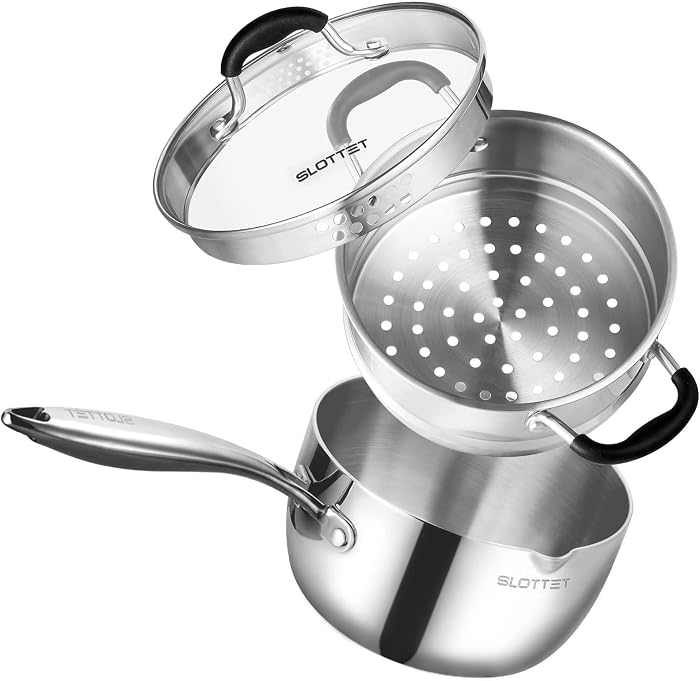
SLOTTET 2.5-Quart Straining Saucepan with Steamer Best for Steaming

SLOTTET Tri-Ply Whole-Clad Stainless Steel Saucepan with Steamer

Steaming vegetables

Our Score 91/100
Steamer
Included insert
Capacity
2.5 quarts
Material
Tri-ply stainless steel
Oven Safe
500°F without lid
View on Amazon

The steamer insert is what separates this SLOTTET from the other saucepans here. It nests inside the 2.5-quart pot and leaves room for broccoli, green beans, or dumplings, while the glass lid lets you watch the steam. That is the appeal for us: one pan does the vegetable side and then the pasta.

The rest of the pan is just as useful. The tri-ply stainless body is induction compatible, the pour spouts work with the straining holes in the lid, and the interior has measurement marks that are easy to read against a dark sauce. The silicone-wrapped handle stayed cool during a boil, and the pan is oven safe to 500°F without the lid.

We recommend it for cooks who steam vegetables often and want one pot to handle pasta afterward. The 2.5-quart capacity is a little small for a family-size batch of spaghetti, but it is right for two generous portions or a pile of greens. The steamer insert sits high in the pot, so you lose some depth when it is in place; that is the trade-off for having both functions in one pan.

Worth Noting

  • Heaviest pick in this set
Our Verdict

We reach for this one when vegetables are on the menu: the steamer insert, glass strainer lid, and 2.5-quart tri-ply body turn one pan into a steamer and a pasta pot.

Check Latest Price
6

Rachael Ray Create Delicious 2-Quart Straining Saucepan Best for Small Servings

Rachael Ray Create Delicious Nonstick Induction Saucepan with Straining Lid

Small servings

Our Score 90/100
Weight
2 lb
Cooktop
Induction compatible
Capacity
2 quarts
Material
Nonstick aluminum
View on Amazon

The 2-quart size and teal shimmer finish are what you notice first. This is a small pan, the kind that fits a single burner without hogging the stovetop, and the color makes it easy to spot in a crowded cabinet. We like it for boiling eggs, reheating soup, or making a packet of noodles for two.

We recommend it for small households and anyone who wants a nonstick pan that can drain without a colander. The glass lid has built-in strainer holes, the aluminum body heats quickly, and the stainless base is induction compatible. At 2 pounds, it is the lightest pan here, so it is easy to lift and pour with one hand.

The nonstick interior wipes clean, and the pan is dishwasher safe for nights when you don't want to hand-wash. The silicone handle stays comfortable, and the tempered glass lid seats firmly enough for a simmer. It is a cheerful, functional little pan rather than a heavyweight, and that is the right trade for quick side dishes.

Worth Noting

  • Exterior coating can scratch or peel
  • 2-quart capacity limits family batches
Our Verdict

This is our small-batch pick: a light 2-quart nonstick pan with a strainer lid and a cheerful teal finish, best for sides, noodles, and sauces for two.

Check Latest Price
7

Anolon Advanced 2-Quart Straining Saucepan

Anolon Advanced Hard Anodized Nonstick Sauce Pan/Saucepan with Straining and Lid

Sauces for two

Our Score 89/100
Weight
2.6 lb
Capacity
2 quarts
Material
Hard-anodized aluminum
Oven Safe
400°F
View on Amazon

The hard-anodized body is the reason this Anolon feels different from the other 2-quart pan here. It is thicker and more substantial in the hand, with a bronze finish and a riveted handle that feels secure when the pan is full. The 2-quart size is right for melting butter, reheating soup, or cooking oatmeal for two.

We recommend it for small, sturdy nonstick jobs, especially if you want pour spouts on both sides and a lid that can strain. The nonstick surface released scrambled eggs cleanly in our testing, and the pan is oven safe to 400°F. The straining lid has holes in the rim that line up with the spouts, so you can drain without removing the lid.

The lid is the caveat. Some shipments have arrived without it, and without the lid this becomes a plain 2-quart nonstick pan rather than the straining saucepan you ordered. Check the box before the return window closes. The hard-anodized body is still a good little pan, but the straining feature is the reason to choose this one.

Worth Noting

  • 2-quart capacity is small for families
Our Verdict

For one- or two-serving sauces and oatmeal, this hard-anodized 2-quart pan is a sturdy choice, but check that the straining lid is included before you rely on it.

Check Latest Price

How We Tested Sauce Pans with Strainer Lids

We started with more than 40 saucepans sold with straining lids and cut the field to 12 based on capacity (mostly 2 to 3 quarts), material and construction, lid design, and whether the manufacturer claimed oven and dishwasher safety. Anything with a lid that sat loosely or a pour spout that looked like an afterthought came off the list before we ever turned on a burner.

Each pan then went into a home kitchen for six months and got used the way a saucepan actually gets used: weeknight pasta, rice, reheating soup, a roux, hard-boiled eggs. We boiled the same 1 1/2 quarts of water on the same burner and timed it. Then we filled each pot with a quart of water and a handful of pasta, tilted it one-handed over the sink, and watched whether the noodles gathered at the holes or slid around the rim, and whether the spout poured clean or dribbled down the side.

For heat, we simmered tomato sauce on low for 40 minutes and checked for scorch rings and stuck fond, then whisked a roux to see whether flour caught in the corners where the base meets the wall. We weighed every pan empty and again full of water, and noted how the handle felt with a loaded pot in one hand and a mitt on the other.

Cleaning started by hand with a burned-on pot of milk and a nylon brush, then moved to the dishwasher for the pans that claimed to be safe, where we checked cycle after cycle for fading, chipping, and handles working loose. We looked at each one out of the box and again at the end, since a coating that scratches after a month of whisking tells you more about durability than any finish photo.

How to Choose a Saucepan with a Strainer Lid

Start with the size you use most

A 2-quart pan is the right size for sauces, oatmeal, and sides for one or two; a 3-quart pan is more useful for a box of pasta, a batch of vegetables, or soup for three. The 2.5-quart picks in this group split the difference, but they can feel small when you are feeding a family. Think about the largest job you do weekly, not the smallest. Also check the pan's weight and handle length: a full 3-quart pan is heavier than it looks, and a long handle needs clearance on a crowded stove.

Look closely at how the lid strains

There are two common designs. A stainless lid with rotating holes can be turned to seal or strain; a glass lid usually has fixed holes on both sides. Rotating lids are more versatile for covered cooking, while glass lets you watch the pan without lifting the lid. In either case, the holes must line up with the pour spout, or liquid will run over the rim. Two spouts make draining easier from either hand, but they also give steam another place to escape, so use the closed position for rice and other covered dishes.

Match the cooking surface to your stove and habits

Stainless steel is the more forgiving surface for high heat, browning, and oven use; it also lets you scrape with a metal utensil. Nonstick is easier to clean and releases sticky foods, but it needs gentler tools and lower heat. If you have an induction range, verify the pan is induction compatible rather than assuming from the base shape. A 5-ply or capsule base can help spread heat, but the pan's size and your burner matter just as much. Match the surface to the way you cook, not to the finish you like best.

Handles, lids, and cleanup

A stay-cool handle is worth having when you drain a full pan, but it only stays cool if it is positioned away from the flame. Glass lids need careful storage; stainless lids tolerate more knocking but hide the food. Check the oven-safe limit for the pan and the lid separately, because a lid that is fine on the stovetop may not be rated for the oven. Dishwasher-safe pans save time, though hand-washing a nonstick pan and a glass lid will keep both in better shape.

Frequently Asked Questions

Final Verdict

For most kitchens, we recommend the Farberware Classic 3-Quart Straining Saucepan. It has the most useful combination here: a 3-quart stainless body, a lid that twists to strain or seal, two pour spouts, and oven and dishwasher safety. It is the pan we reach for when pasta, potatoes, and vegetables all need the same treatment.

If you cook on induction and want to see the strain, the AVACRAFT is the better fit; if nonstick release is the priority, choose the Circulon. The Farberware Glide is the budget nonstick alternative.