Best Sauté Pans for Induction Cooktops of 2026

A sauté pan is really two pans in a trench coat: a skillet wide enough to brown chicken thighs without crowding, and a pot deep enough to hold the sauce you build in it. Induction complicates that — those cooktops only heat what they can magnetize, so a slightly domed base leaves a pale center, a scorched ring, and a pan that spins every time you stir. We cooked in 12 of them over eight months to find the ones that don't.

Flatness is the spec nobody prints on the box: on gas, a base that rocks a millimeter is a nuisance; on induction, it's the difference between a sear and a simmer. Material matters too — clad stainless builds fond for a pan sauce, while nonstick wipes clean but wants gentler tools. Size is where shoppers second-guess themselves most: a 5- or 6-quart pan feeds a family and gets heavy when full, where 3.5 quarts is the weeknight reach.

Lids, helper handles, oven limits, and dishwasher claims counted too. The picks below earned their place on a burner, not on a spec sheet.

Our Top Picks

The 8 Best Sauté Pans for Induction Cooktops of 2026

1

Circulon A1 Series 5-Quart Sauté Pan Best Overall
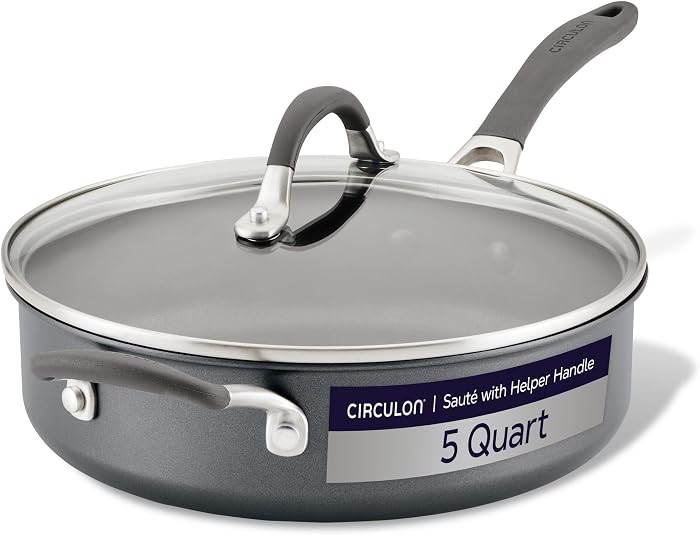
Circulon A1 Series Nonstick Induction Sauté Pan with Lid

Everyday family cooking

Our Score 95/100
Lid
Tempered glass
Base
Induction-suitable steel base
Capacity
5 quarts
Oven Safe
400 °F
View on Amazon

Induction is unforgiving about the bottom of a pan. The field only reaches what sits closest to the glass, so a base that domes — or a steel disc that stops short of the rim — leaves you with a hot circle and pale edges. Circulon builds the A1's base thick and runs it edge to edge, and that flat, full contact is the reason this is the pan we point most induction shoppers toward.

The coated surface is the practical kind of nonstick: eggs, pan sauces, and sticky rice release with a wipe rather than a soak, and the pan is rated dishwasher safe, which is rare enough among coated pans that we noticed. At 5 quarts and 5.1 pounds it's a two-hand lift when it's full, which is exactly what the helper handle is for, and the tempered glass lid sits tightly enough for a braise.

What it won't do is a hard sear. A coated pan is a wear item, and the surface that lets a frittata slide out at medium heat is the same one that keeps you from blasting a steak. Keep a bare stainless pan for that — the Cuisinart further down is the one we reach for when dinner needs color.

What settled it for us is how little thought the pan needs. No preheat ritual, no seasoning, no negotiating with a sticky patch in the middle of the floor — on a cooktop that's already particular about what you set on it, that counts for a lot. It's the pan that stays out on our stove; the stainless ones live in the cupboard.

Worth Noting

  • Oven safe only to 400 °F
Our Verdict

We recommend it to most induction cooks: a base that stays flat and heats edge to edge, reliable release, and a lid that seals, with none of the fuss of bare steel.

Check Latest Price
2

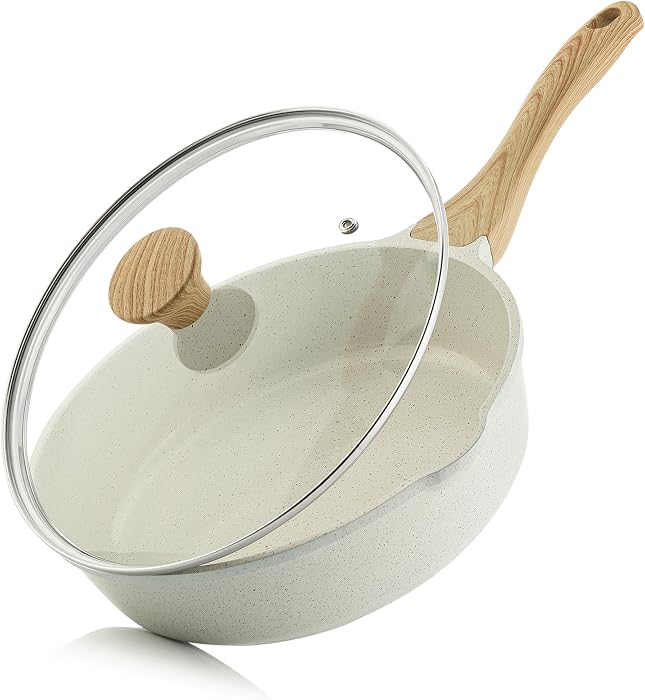
Sensarte Ceramic Nonstick 3.5-Quart Sauté Pan Best Budget

SENSARTE Nonstick Ceramic Saute Pan 10 Inch/3.5QT

Budget weeknight pan

Our Score 94/100
Depth
2.7 inches
Capacity
3.5 quarts
Diameter
10 inches
Max Temp
550 °F
View on Amazon

The first thing we noticed about the Sensarte is how little it asks of your wrist. Ten inches across with 2.7-inch sides, it's light enough to lift one-handed with dinner already in it, and the pour spout on the rim turns tipping the fat off a pound of ground beef into a one-hand job instead of a two-utensil negotiation.

It's ceramic nonstick, made without intentionally added PFOA, PTFE, or PFAS, and rated to 550 °F — hotter than most coated pans will admit to, which matters if you like a little color on your onions. The stainless base makes it induction-ready, and 3.5 quarts is the size that fits two to four people without crowding the floor.

Where it lands for us is the second-pan slot, or the first pan in a small kitchen or a first apartment. It browns well enough for vegetables and cutlets, it cleans in seconds, and it costs about as little as anything in this group. Keep it off the dishwasher and use a soft sponge, and the surface stays slippery far longer than it otherwise would. For the money and the counter space, that's a deal worth taking.

Worth Noting

  • Coating will wear before the pan does
Our Verdict

We send budget shoppers here: it's light enough to lift one-handed, releases cleanly, and takes 550 °F, which covers weeknight cooking without a learning curve.

Check Latest Price
3

Farberware Classic Series 6-Quart Sauté Pan Best for Big Batches

Farberware Classic Series Anniversary Edition Stainless Steel Sauté Pan and Lid

Big-batch meals

Our Score 93/100
Lid
Stainless steel
Base
Fully encapsulated
Weight
3.5 lb
Capacity
6 quarts
View on Amazon

Six quarts is a lot of pan, and that's the whole point. This is the Farberware you pull out for a chicken cut into parts, a pot of chili that has to feed a crowd, or meatballs and sauce for the freezer — a jumbo cooker in the old sense, wide and deep enough that a big batch stays in one layer instead of steaming itself.

The base is a full cap: a thick aluminum core wrapped in stainless, which spreads heat across that wide floor instead of leaving a hot ring where the induction coil sits. The helper handle isn't decorative at this size, the stainless lid seals in heat and moisture, and the bare body takes a metal spoon, a whisk, and a scrub pad without complaint. A limited lifetime warranty covers it.

What you give up is the easy release. Bare stainless needs a proper preheat and enough fat, or a thigh will weld itself to the floor and take its skin with it; do it right and you get fond to deglaze into a pan sauce, which no coated pan here will give you.

Think of it as the pan for the meal you'll eat for three days. The volume is what you're buying, and the stainless is what lets you attack the bottom of it with whatever's in the drawer. If your weeknights are two portions and a skillet, six quarts is more pan than you need, and it's more to wash than the 4-quart options.

Worth Noting

  • Sides can dent if knocked
Our Verdict

We recommend it for big-batch cooking: six quarts, a helper handle, and a stainless body that shrugs off metal utensils and a lifetime of chili.

Check Latest Price
4

Cuisinart Chef's Classic Stainless Sauté Pan Best Stainless for Searing

Cuisinart Chef's Classic Stainless 5.5 Qt. Sauté Pan with Lid

Searing and oven use

Our Score 92/100
Lid
Stainless steel
Weight
7.1 lb
Diameter
11.8 inches
Oven Safe
500 °F
View on Amazon

Browning is the reason to keep a bare stainless pan in the rotation, and the Cuisinart is the most straightforward way into it here. The uncoated surface lets a steak or a pan of mushrooms sit against hot metal until they're properly colored, and the encapsulated aluminum base moves heat across that wide floor fast enough to keep up.

It's also the pan that goes from the induction ring into a 500 °F oven without a second thought, which is what makes a frittata, or a braise you finish uncovered, a one-vessel job. The 11.8-inch diameter fits four chicken thighs without crowding, and at 7.1 pounds it's the heaviest pan in this group, so the helper handle earns its keep every time you move it.

Bare steel means technique: preheat until a drop of water beads and skates, add fat, and let the meat release on its own schedule rather than prying at it. That's the bargain with any uncoated pan, and it's what buys you the fond for a pan sauce.

Worth Noting

  • Heavy at 7.1 pounds with a full load
Our Verdict

We recommend it to anyone who wants a real sear: bare stainless for proper browning, oven time to 500 °F, and a helper handle for the weight.

Check Latest Price
5

HexClad Hybrid 4.5-Quart Deep Sauté Pan Best Hybrid

HexClad 4.5 Qt Hybrid Nonstick Deep Sauté Frying Pan & Lid

Metal-utensil cooks

Our Score 91/100
Lid
Tempered glass
Capacity
4.5 quarts
Diameter
11 inches
Oven Safe
900 °F
View on Amazon

The hex pattern is the whole idea: laser-etched steel islands standing in a ceramic nonstick field, so you get some of the browning of stainless with some of the release of a coated pan. It's a genuinely useful combination for one-pan cooking, and it's why this is the pan for anyone who refuses to give up metal tongs.

The 4.5-quart body is 11 inches across, oven safe to 900 °F, and built on a tri-ply aluminum core that heats quickly and evenly on an induction ring. Add a tempered glass lid, dishwasher tolerance, and a lifetime warranty, and the practical case is easy to make.

Release is where it asks for patience. This is not a true nonstick: bring it up to heat gradually, use fat, and give food a moment to let go, and it behaves; rush it on a hot ring and you'll be scrubbing the bottom. That learning curve, and a price near the top of this group, is why we don't make it the default. It's for the cook who wants sear and easy cleanup in the same skillet and will read the instructions.

Worth Noting

  • Coating can chip over time
Our Verdict

We recommend it to cooks who want metal-utensil freedom and a real sear: a hybrid surface that rewards a patient preheat, backed by a lifetime warranty.

Check Latest Price
6

Cooks Standard 4-Quart Hard Anodized Sauté Pan Best for Smaller Families

Cooks Standard 4-Quart Hard Anodized Nonstick Sauté Pan with Glass Lid

Smaller families

Our Score 90/100
Weight
4.8 lb
Capacity
4 quarts
Diameter
10.5 inches
Max Temp
500 °F
View on Amazon

Four quarts is the size we reach for most: big enough for a family dinner, small enough that a single induction ring can actually drive it. The Cooks Standard pairs a heavy-gauge hard-anodized body with a ceramic nonstick interior, and it browns evenly without the hot ring you get from thin aluminum.

What we like is how ordinary it is to use. Nothing sticks, the 10.5-inch floor holds a pile of chopped vegetables without crowding, it's dishwasher safe, and at 4.8 pounds it moves around a full pan without a fight. The tempered glass lid fits tightly and the double-riveted handles give you a real grip when you're carrying it to the sink.

The catch is the coating. Ceramic release is best in the pan's early life, and the dishwasher — convenient as it is — isn't doing the surface any favors; hand washing stretches it. This is a pan with a working life rather than an heirloom, and priced where it is, that seems like a fair exchange for how well it cooks right now.

Worth Noting

  • Glass lid is rated only to 350 °F
Our Verdict

We recommend it as a balanced everyday 4-quart: even heat on induction, a genuinely slick ceramic surface, and dishwasher convenience at a midrange price.

Check Latest Price
7

Made In 3.5-Quart Stainless Clad Sauté Pan

Made In 3.5-Quart Stainless Clad Sauté Pan

Long-term investment

Our Score 89/100
Depth
2.5 inches
Capacity
3.5 quarts
Construction
5-ply stainless clad
Cooking Surface
9.5 inches
View on Amazon

Five layers of metal, 2.5-inch sides, and a cooking surface just under 10 inches across — the Made In is the most deliberately built pan in this group, and it behaves like it. A layer of 430 stainless steel is what makes the base magnetic enough for induction, and the aluminum in the middle keeps the response quick when you drop the heat.

The 2.5-inch depth is the detail to weigh. A sauté pan is supposed to be deeper than a skillet, and this one sits closer to the skillet end — lovely for tossing vegetables and reducing a sauce, less so when you want to hold a batch of stew. What we trust is the handle: long, riveted, and far enough from the ring to stay cool while you work.

This is a pan for someone who has decided to buy once. It rewards control — lower heat, faster adjustments, a base that stays flat — and it punishes neglect no more than any other stainless. If you want one 5-quart do-everything pan for family dinners, the Circulon gets you there for a fraction of the money; if you want the last pan you buy, this is the one we point to.

Worth Noting

  • Shallow 2.5-inch sides limit braising
Our Verdict

We recommend it to cooks who want one pan for good: five-ply clad construction, quick response to heat changes, and a handle that stays cool.

Check Latest Price
8

Tramontina Signature Tri-Ply 3-Quart Sauté Pan Best for Two-To-Four Servings

Tramontina Signature Tri-Ply Clad Stainless Steel 3-Quart Saute Pan

Two-to-four servings

Our Score 88/100
Weight
4.8 lb
Capacity
3 quarts
Oven Safe
500 °F
Construction
Tri-ply clad
View on Amazon

Clad stainless usually means a serious bill, and the Tramontina is the best argument in this group that it doesn't have to. Three quarts, tri-ply construction, NSF certified, made in Brazil — it heats fast, responds when you turn the ring down, and does it for less than the other clad pans here.

The aluminum core runs up the sides as well as across the base, which is why it comes up to temperature quickly on induction and why the walls don't lag behind the floor. The 3-quart body suits two to four people, the riveted handle is comfortable in the hand, and it's dishwasher safe — a real convenience in a bare-steel pan.

Expect the finish to go cloudy. Bare stainless discolors with use and with acidic sauces, and food will stick if you don't preheat properly; neither changes how the pan cooks, and a little cleanser brings back most of the shine. What you're buying is heat and honesty, not a mirror.

Worth Noting

  • 3-quart body crowds larger batches
Our Verdict

We recommend it to anyone who wants clad stainless without the splurge: tri-ply heat, NSF certification, and a dishwasher-safe body.

Check Latest Price

How We Tested Sauté Pans on Induction

We built the shortlist by filtering for the things that actually make a pan work on induction: a magnetic base, a matching lid, and a capacity somewhere between 3 and 6 quarts. From there we spread the field across materials — clad stainless, hard-anodized nonstick, ceramic nonstick, and hybrid — and across price points, from budget workhorses to pans that cost as much as a small appliance. Twelve made the cut, and we cooked in them for eight months on a full induction range and on a portable single burner, which is a fair stand-in for a rental kitchen or a cabin.

Heat distribution got tested before dinner ever happened: I dusted a thin layer of flour across each dry base, ran the burner through its settings, and watched where the browning ring started and how far out it crept. I pressed each rim to check for rock and spun the empty pan on the burner to listen for wobble. Then I cooked the same chicken thighs, onions, and pan sauces in every pan, noting where fond formed, whether it released cleanly, and whether the sides scorched while the center lagged.

For the nonstick pans, I fried eggs without any fat and wiped them out with a paper towel. For the stainless, I deglazed with wine and vinegar, then scrubbed. Everything went through hand washing and, where the maker claimed dishwasher safety, several cycles, and I checked rivets and handles for loosening as the months went on. Capacity was measured rather than assumed — I filled each pan with water to compare real volume against the label and eyeballed usable cooking surface. I lifted each one full and one-handed, used metal utensils wherever they were allowed, and stacked them the way they'd sit in a cabinet. Value came down to what was in the box — lid, helper handle, oven rating — not the sticker alone.

How to Choose a Sauté Pan for Induction

The base comes first

Induction heats only what the magnetic field reaches, so full, flat contact counts for more than any other specification. Look for a clad or fully encapsulated base with an aluminum core, and skip thin stamped steel that warps the first time it gets left on a hot ring. A base that domes loses contact, scorches in the middle, and leaves the edges pale no matter what setting you choose. Circulon's edge-to-edge steel disc and Farberware's full-cap base are the two clearest examples of the right approach in this group.

Coated or uncoated

Nonstick buys you weeknight release and a two-second cleanup. Bare stainless buys you browning, fond for a pan sauce, and a surface that cannot peel. Ceramic coatings are the current default on the coated side and are rated hotter than they used to be — 550 °F on the Sensarte — but every coating is a consumable, and none of them enjoy a dry pan over a screaming burner. Buy stainless if you sear; buy coated if you want eggs and sauces to wipe out.

Match the size to the ring and the table

Three to four quarts covers two to four people; five to six quarts is family territory, and it's the point where a helper handle stops being optional. Match the base to your largest induction ring rather than to the pan's advertised diameter — a base much narrower than the ring wastes heat around its edge, and one much wider heats unevenly unless the core is substantial. Picture the pan full, too: six quarts of chili is a two-hand lift even on a light body.

Lids, handles, and heat ceilings

A glass lid lets you watch a braise without lifting it; a steel lid takes more oven heat and adds weight. The lid often sets the oven ceiling rather than the pan — the Cooks Standard's body is rated to 500 °F while its glass lid stops at 350 °F — so check both numbers before the whole thing goes in the oven. Pour spouts, stay-cool handles, and a helper handle opposite the main one are the small details that decide whether a big pan feels like a tool or a chore.

Frequently Asked Questions

Final Verdict

The Circulon A1 5-quart is the pan we recommend by default: its base sits flat and full on an induction ring, the coating releases without a soak, and the lid and helper handle make a full pan easy to move around.

If you want a hard sear and a pan you can deglaze, the Cuisinart Chef's Classic does that better and takes 500 °F oven heat. And if you regularly cook for six, the Farberware's six quarts buy you a batch size nothing else here matches.