Best Silver Cleaners of 2026

Silver doesn't tarnish because you neglected it. Sulfur compounds in the air — and in rubber bands, felt, and last night's eggs — reach the surface and turn it yellow, then brown, then black. So the real question isn't whether to clean it, but how much rubbing you're willing to do. I've spent the past four months testing 16 silver cleaners, from pastes to dips to treated cloths, on flatware, jewelry, and a few pieces that had been sitting in a drawer since the 1980s.

Format matters more than you'd expect. A dip can lift a year of tarnish off a spoon in under a minute, but it smells like a chemistry lab and can be harsh on silver plate and antiqued finishes. Creams and pastes give you more control and a brighter shine, though they cost you elbow grease and a careful rinse. Treated cloths and wipes are for upkeep between real cleanings.

The surprises were in the details: which ones smelled so strong I had to open a window, which left gray residue in the engraving, and which containers went far enough to justify the price. The picks below cover all of it.

Our Top Picks

The 8 Best Silver Cleaners of 2026

1

Wright's Silver Cleaner & Polish Best Overall

Wright's by Weiman Silver Cleaner and Polish Cream

All-round silver care

Our Score 97/100
Pack
Two jars with cloth
Formula
Ammonia-free cream
Safe On
Silver, plate, gemstones
Protection
Anti-tarnish coating
View on Amazon

The job that settled our top pick was a boxed set of inherited flatware that had gone nearly black in a basement. Cream polish is what that kind of tarnish wants: enough body to cut decades of oxide off a spoon bowl, enough slip to work around a monogram without scuffing it. Wright's does that without ammonia, which matters the moment a piece has stones set into it.

What earns it first place is the combination rather than any single ingredient: two jars of cream and a polishing cloth in one purchase, with a formula that leaves a protective film so tarnish takes longer to return. The pair of jars is the practical part — one under the kitchen sink for flatware, one in the drawer with the jewelry. It's also labeled for silver plate, pewter, chrome, and porcelain, so the odd candlestick doesn't need a product of its own.

Where a cream loses to a dip is time. This is a rub-on, buff-off job, and on pierced handles, beaded rims, or a chased tray the residue settles into the recesses and needs a soft brush to lift out. Spread it thin and it's manageable; slather it on and you'll spend the next hour digging polish out of pattern.

One thing that surprised us is how far a jar goes, since you're laying down a film rather than filling a scratch. If your silver is jewelry only and the tarnish is light, the cloth further down this list does the same work with less cleanup. For the serving pieces, the plate, and anything set with stones, this is the tub to keep.

Worth Noting

  • Two jars is more than a jewelry-only routine needs
Our Verdict

We recommend the Wright's two-pack as the default: it cuts heavy tarnish, is gentle enough for stone-set jewelry, and includes the cloth you need to finish the job.

Check Latest Price
2

Connoisseurs Polishing Cloth Best Polishing Cloth

Connoisseurs Polishing Cloth

Jewelry touch-ups

Our Score 96/100
Size
14 x 14 inches
Formula
Two-step dry cloth
Protection
Anti-tarnish treatment
View on Amazon

We keep this one out on the dresser rather than shut in a drawer, and the reason is size: fourteen inches square is wide enough to fold around a chain and pinch the links between thumb and cloth, or to lay a bracelet flat and work without chasing it across the table. The two-step routine is as simple as it gets — the pale inner cloth lifts soil and leaves an anti-tarnish treatment, the darker outer cloth buffs the shine back up. No paste, no rinsing, no sink.

What a dry cloth won't do is rescue a piece that has gone black. It handles the yellow-brown film that shows up between wears and the haze on a chain that has sat in a drawer, and it's the fastest thing here for a ring you want to wear tonight. Ten years in a basement is a cream job.

One practical note: the treated side can leave a film on skin and fabric, so don't polish a necklace while you're wearing a white shirt. Work over a paper towel and wash your hands afterward.

Worth Noting

  • Turns black with use and can't be laundered back
Our Verdict

Buy it if your silver needs brightening rather than rescuing — this is the cloth we reach for between polishings, not after a decade in a box.

Check Latest Price
3

Hagerty Flatware Silver Dip Best for Flatware

Hagerty Flatware Silver Dip

Full flatware sets

Our Score 95/100
Volume
16.9 fl oz
Formula
Dip with basket
Dip Time
10 seconds or less
View on Amazon

A perforated basket sits inside the jar, and that small piece of plastic is most of why this dip works: drop four forks in, lower the basket, lift it out, and nobody has to fish around in the solution. The label is blunt about timing — ten seconds, no longer, or the surface can discolor.

For a full flatware set, nothing here is faster. Tarnish comes off the bowls and out of the joints where tines meet the handle, places a cloth can't reach and a cream only smears around. A service for twelve that takes an evening with polish and a rag becomes a session at the sink.

Plan for the smell and the rinse. The solution is sulfurous enough that we work with a window open and the fan running, and every piece needs cold water the moment it comes out — leaving the dip to dry on the metal risks a dull patch. It's also bare-metal work: keep pearls, opals, and anything glued in a setting out of the basket.

Worth Noting

  • Removes tarnish but leaves the shine to a cloth
Our Verdict

For a flatware set, this is the pick: a ten-second dip does what an evening with a rag won't, as long as you can open a window.

Check Latest Price
4

Weiman Silver Cream 3-in-1 Best Budget Cream

Weiman Silver Cream Cleaner 3-in-1

Budget cream polish

Our Score 94/100
Form
Liquid polish
Volume
8 fl oz
Safe On
Silver, plate, gold, brass, copper
Protection
Anti-tarnish technology
View on Amazon

This is the least expensive way here to get a real silver polish rather than a cloth or a wipe, and it does the core job: a thin film on a soft cloth, a little pressure, a clean section of cloth to buff, and the tarnish is gone. One bottle also covers silver, silver plate, gold, brass, copper, and aluminum, which is more range than most households need and exactly right if the shelf is mixed.

The formula leans on mild abrasives plus corrosion inhibitors, and it leaves enough behind that pieces stay bright for a while rather than a week. Where it asks for patience is on badly neglected silver: the shine comes from the buffing, not the bottle, so a piece that has gone fully black wants two passes with a fresh cloth between them.

Set against our top pick, it's one bottle with no cloth and no second jar, which is exactly the reason to choose it. If you already own polishing cloths and just need the polish itself, paying for a bundled kit is money spent on things you have. There's no chemical bite to it either, which we appreciated at a kitchen counter.

Worth Noting

  • Sold as the bottle alone, no cloth included
Our Verdict

Our budget cream: the same core job as the top pick, one bottle instead of two, and it works on brass and copper as readily as silver.

Check Latest Price
5

Hagerty Silversmiths' Polish Best No-Rinse Polish

Hagerty Silversmiths' Polish

No-rinse polishing

Our Score 93/100
Volume
8 fl oz
Formula
Non-abrasive lotion
Rinsing
Not required
Protection
Tarnish preventive
View on Amazon

Some silver can't be rinsed. A wood-backed brush, a piece with felt or leather in the base, an antique with a patina you're trying not to disturb — all of them want a polish you can buff off dry. That's what this blue lotion is for.

It's a non-abrasive lotion rather than a paste, so it goes on thin and comes away with a soft cloth, and it leaves a tarnish preventive behind. On a display piece that means the shine holds longer between sessions.

Where we cooled on it is flatware. Lotion that thin works into pattern and sits there, and getting it out of the recesses of a fork takes more buffing than a cream does — a couple of pieces is fine, a whole set is a chore. For a brush handle or a bangle that shouldn't get wet, nothing else here finishes as cleanly.

The bottle also goes further than its size suggests, since you're applying a film to a small object rather than coating a tray. Our advice: keep it alongside a cream, not instead of one, if your collection includes things that can't take water.

Worth Noting

  • Sharp smell that lingers in a small room
Our Verdict

Our pick for pieces that can't get wet: it buffs off dry and leaves protection behind, though patterned flatware takes extra work.

Check Latest Price
6

Weiman Silver Wipes Best Wipes

Weiman Jewelry Cleaner

Travel touch-ups

Our Score 92/100
Count
40 wipes, two pouches
Formula
Pre-moistened wipes
Safe On
Silver, gold, brass
View on Amazon

A tub of cream does more, but a tub of cream isn't what comes out of the drawer at six in the evening when you're already late and the earrings have gone dull. That's the trade these wipes make: less cleaning power per swipe, in a format you'll actually use.

Forty pre-moistened wipes arrive as two sealed pouches, and one wipe handles a bracelet or a few rings before it dries out. They're labeled for silver, gold, and brass, so the costume pieces get a pass too. Nothing to launder afterward, and a pouch lies flat in a suitcase — you pay for that convenience per clean, which is the honest case against them.

Two things to know. The solution is strong enough to take polish off your nails, so wear gloves. And a wipe deals with film and light tarnish; it doesn't turn around a piece that has gone black, which is a cream or a dip. What it does is keep a rotation of jewelry looking like it was cleaned yesterday, and that's the job most people actually have.

Worth Noting

  • Pieces need a rinse and a dry afterward
Our Verdict

We keep these for travel and last-minute touch-ups: less power per swipe than a cream, in a format you'll actually reach for.

Check Latest Price
7

Sunshine Polishing Cloths

Sunshine 5 Polishing Cloths Jewelry Cleaner Tube Silver Brass Gold Copper

Cloths for everywhere

Our Score 91/100
Count
5 cloths in a tube
Formula
Impregnated cloths
Cloth Size
7.5 x 5 inches
View on Amazon

Five cloths, each about the size of a coaster — 7.5 by 5 inches — packed into a tube. That's small. For a ring, a chain, or a pair of earrings it's plenty, and the compact size is what lets you pinch a link between thumb and cloth. For a serving tray you'll be chasing the cloth around the silver, and a bigger square is the better buy.

The cloths come impregnated with a polishing compound and work dry, like the others here: rub, buff, done. Tarnish lifts off a chain without any wet mess to wipe up afterward, and the tube keeps the treated cloth away from everything else in a bag.

They last. A cloth keeps working long after it turns dark, so five of them is a supply rather than a sampler — one at home, one in a travel bag, one in the car, and you're set for a long while.

The case against it is simple: more passes on anything larger than a bangle. If you want a cloth in several places at once and don't mind working a smaller square, this is the pack built for exactly that.

Worth Noting

  • Small 7.5 x 5 inch cloths slow down big pieces
  • Compound can leave residue on skin
Our Verdict

Five small cloths that live wherever you polish — a good supply if you want one in several places, less so for big pieces.

Check Latest Price
8

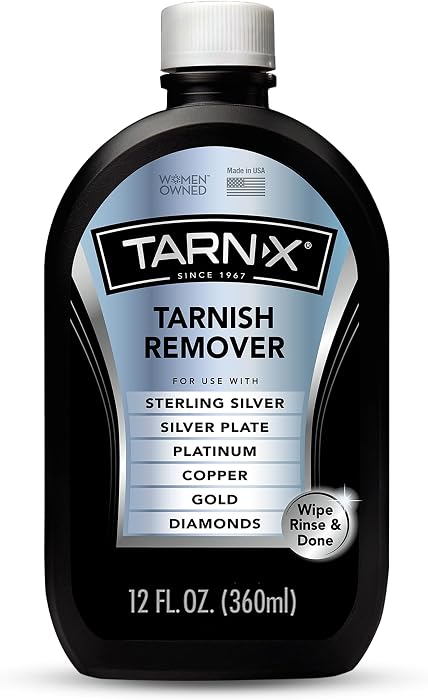
Tarn-X Tarnish Remover

Tarn-X Tarnish Remover

Heavy, patterned tarnish

Our Score 90/100
Method
Wipe and rinse
Volume
12 fl oz
Formula
Wipe-on liquid
Safe On
Sterling, plate, gold, diamonds
View on Amazon

Wiped on with a cotton ball or dipped, Tarn-X takes tarnish off in seconds with no rubbing at all. On a chain that has gone black between the links, or a pierced fork where a cloth only pushes the tarnish around, that speed is the entire argument: the liquid reaches places your fingers can't, and the oxide comes off in the rinse.

The label carries most of the technique. Rinse in cold water immediately, and don't let the liquid dry on the piece. Small items can go straight in rather than being wiped, which is faster, but keep the dip short and get them under the tap right away.

One caution before you dunk anything. The liquid pulls the dark out of recessed detail that was meant to be there, so an antique with intentional patina in the engraving comes out flatter than it went in. Keep it to plain, polished silver and jewelry.

Where it earns its place is as step one. On a badly tarnished set with deep pattern, a pass with Tarn-X takes the bulk off in minutes and a cream then finishes what's left with far less rubbing. Used that way — strip first, polish second — it saves an evening.

Worth Noting

  • Strips tarnish but leaves the shine to a polish
  • Sulfur fumes need real ventilation
Our Verdict

Think of it as step one: we use it to strip heavy oxide in seconds, then a cream or cloth brings the shine back.

Check Latest Price

How We Tested the Best Silver Cleaners

We started by pulling together what's actually sold as a silver cleaner — not general metal polish with silver slapped on the label — and filtered by whether the maker states it's safe on sterling, plate, and antiqued finishes. From there we compared price per ounce and how many pieces a container realistically covers. Anything that promised a shine without saying what it was safe on got cut.

That left 16 products, which we used over four months in the places silver actually lives: the flatware chest, the jewelry box, a serving tray that comes out twice a year, and a handful of thrift-store finds with black tarnish packed into the recesses.

With creams and pastes, we worked a small amount into a tarnished spoon bowl and a filigree pendant, counted passes, then rinsed and buffed, checking for residue caught in lettering and for fine scratches in the finish. With dips, we timed how long pieces needed, whether the basket let forks touch each other, whether a plated tray came out duller than it went in, and how much we had to ventilate the room. Cloths and wipes went onto lightly tarnished pieces, and we tracked how much surface each one covered before it turned black.

We also watched for the things reviews mention: whether tarnish crept back within a week, whether a product left a scent on the silver after rinsing, whether it stripped the dark patina out of engraved lettering, and cost per use — how many flatware settings a bottle or jar actually handled before it ran out.

How to Choose a Silver Cleaner

Match the Form to the Piece

Cloths suit jewelry you can reach: chains, rings, settings, the flat of a locket, anywhere a dry two-step rub beats mixing up a paste. Creams and lotions are for flatware, holloware, and anything carrying real oxide, because they hold mild abrasives where you put them. Dips are for volume and pattern, where a basket of forks goes in and comes out clean in under a minute.

The trap with dips is expecting a silver polish. They remove tarnish chemically and leave a clean but slightly flat surface; the luster still comes from a cloth or cream afterward. If you want one product and one step, buy a cream or a cloth, not a dip.

Check the Metal Before You Choose the Method

Sterling, silver plate, and antique silver with intentional dark recesses behave differently. Plate is the one to handle carefully: the silver layer is thin, and hard rubbing on a worn edge can take it down toward the base metal. Use the gentlest method that works and keep the pressure light.

Stones and pearls are a separate question. Dips are for bare metal, so keep pearls, opals, and anything glued in a setting out of the basket and reach for a cloth or a soft lotion instead. When you're unsure, clean the back of a handle first and watch how the finish responds.

Judge the Tarnish, Not the Silver

A yellow-brown film that dulls the shine is light tarnish, and a cloth lifts it in about a minute. Tarnish that has gone black, or that has filled the pattern of a fork, needs a cream with abrasives, or a dip if the pattern is deep and the pieces are numerous.

Buy for the worst piece you own rather than the average one. A cloth alone leaves you stuck when the tea service comes out of storage, and a dip alone leaves you with nothing for a ring you want to wear tonight.

Plan for the Smell, the Rinse, and the Buff

Dips are sulfurous; there is no version that isn't. Work at a sink with a window open, rinse in cold water immediately, and never let the liquid dry on the metal. Creams are the opposite trade: no fumes, but a genuine buff and a second clean cloth to lift residue out of pattern.

Cloths skip both, at the cost of a film on your hands and a limited appetite for heavy tarnish. Whichever route you take, keep an old soft toothbrush nearby. It is the tool that gets polish out of engraving.

Frequently Asked Questions

Final Verdict

For most households the Wright's two-pack is the whole kit: the cream takes the tarnish off, the cloth brings up the shine, and the film left behind buys you more time before the next session.

If your silver is jewelry only and the tarnish is light, the Connoisseurs cloth does the work without paste or cleanup. If a full flatware set is waiting, the Hagerty dip gets through it faster than any cream can.