Best Toshiba Microwaves of 2026

A microwave that leaves the middle of your leftovers cold is a daily annoyance, not a minor flaw. I've reheated enough oatmeal to know the difference between a machine that just runs and one that senses the load, moves heat around, and stops before the edges turn rubbery. This lineup makes the choice harder: some models use sensor cooking and inverter power, some add air-fry and convection modes, and a few trade the turntable for a flatbed. Over eight months, we've tested 12 of these countertop microwaves in ordinary kitchens.

A good one earns its counter space by being easy to use without a manual, quiet enough for an open kitchen, and consistent from plate to plate. The hard part is that more features can mean more to learn, a sleek finish can show every fingerprint, and you have to decide whether the extras are worth paying for. We kept all of that in view, along with how the interiors held up after months of daily use. The picks below are the ones that got the balance right.

Our Top Picks

The 6 Best Toshiba Microwaves of 2026

1

Toshiba 1.2 Cu. Ft. Countertop Microwave Best Overall

Toshiba 1.2 Cu. Ft. Countertop Microwave

Everyday reheating

Our Score 89/100
Sensor
Humidity sensor
Capacity
1.2 cubic feet
Turntable
12.4 inches
Output Power
1,000 watts
View on Amazon

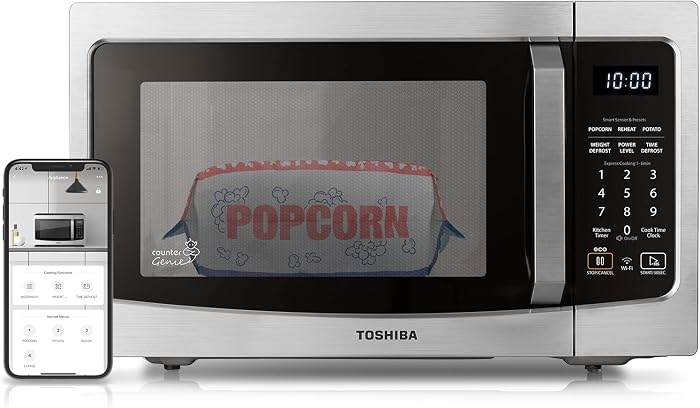
The 1.2-cubic-foot Toshiba is the model we recommend first because it gets the everyday job right: a full dinner plate fits on the 12.4-inch turntable, and the humidity sensor takes over the guesswork on leftovers and vegetables. We appreciate that the sensor adjusts time and power rather than making you choose a number, especially when you are reheating a bowl you did not measure. The keypad is just as important. It is a straightforward button layout with one-touch start, ten power levels, mute, and eco mode, and we find that easier to use with wet hands than a fussy touchscreen.

The size is a good middle ground for a normal kitchen. At 20.6 inches wide by 14.6 inches deep, it needs a dedicated counter spot but not a huge one, and the 31.1-pound body is manageable to lift into place. We like the black stainless finish; it looks more considered than a plain black box, and the removable glass turntable comes out for cleaning. The cavity also has enough height for a covered bowl, which is the kind of small margin that makes a microwave less annoying every day.

The one-year limited warranty is worth registering, and the controls are simple enough that guests can use it without a tutorial. We recommend it for a first apartment, a family kitchen, or anyone replacing a basic countertop unit without paying for features they will not use. It is not the most feature-heavy Toshiba here, but it is the easiest one to live with.

Worth Noting

  • Long-term durability is uneven
Our Verdict

We recommend it as the default Toshiba for most kitchens: the 1.2-cubic-foot cavity, sensor reheat, and straightforward keypad make daily reheating easy.

Check Latest Price
2

Toshiba 1.3 Cu. Ft. Smart Microwave Best Smart Microwave

TOSHIBA Smart Microwave Oven with Sensor Reheat

Smart-home kitchens

Our Score 88/100
Capacity
1.3 cubic feet
Turntable
12.4 inches
Output Power
1,100 watts
Smart Control
Alexa and app
View on Amazon

Alexa control is what separates this 1.3-cubic-foot Toshiba from the simpler models here. You can use voice commands through an Echo device to start or stop cooking, and the Toshiba app gives you a second way to manage the microwave. The physical keypad stays put for manual cooking, which we like because a smart appliance should not make routine reheating harder. The 12.4-inch turntable also keeps the familiar carousel, so you are not trading away plate rotation for voice control.

We recommend it for a connected kitchen because the core microwave is still strong: 1,100 watts, sensor reheat, ten power levels, and a mute function. The 1.3-cubic-foot cavity gives you a little more room than the 1.2-cubic-foot pick, and the stainless finish looks sharp on an open counter. The smart features are the reason to choose it over the top pick, not the only reason to own it.

The features that matter most day to day are the ones you touch: a quick-start button, a clear keypad, and a mute setting for early mornings. The smart layer is a bonus for hands-free starts and stops, and it is best treated that way. If voice control is not part of your routine, put the savings toward the basic model and spend the difference on groceries.

Worth Noting

  • Alexa pairing can be inconsistent
  • Voice control requires a separate Echo
Our Verdict

Choose this one if you want Alexa and app control without giving up a conventional turntable; we think its 1.3-cubic-foot capacity and 1,100 watts suit connected kitchens.

Check Latest Price
3

Toshiba 1.3 Cu. Ft. Flatbed Inverter Microwave Best No-Turntable Microwave

TOSHIBA Flatbed Microwave Oven with Inverter Technology

No-turntable cleaning

Our Score 85/100
Capacity
1.3 cubic feet
Turntable
None (flatbed)
Output Power
1,200 watts
Sensor Menus
11 smart menus
View on Amazon

The flatbed is the reason to look at this Toshiba. There is no turntable ring to lift out, no carousel to center, and no crumb trap around the spindle, so a spill wipes up with one pass. We like that for a household that reheats bowls and rectangular containers, because the dish slides in without hunting for the ring. The 1.3-cubic-foot cavity handles dinner plates, and the 1,200-watt inverter gives it the strongest power story in this group.

Inverter power is the other draw. Instead of pulsing on and off at full blast, it can throttle down, which is what you want for melting butter, softening cream cheese, or reheating a delicate sauce. The 11 sensor menus cover the usual pizza, pasta, and vegetable duty, and the controls are simple enough to learn without the manual. It is also a low-noise design, which matters if the microwave sits near a living area.

The controls are simple, and the mute function keeps the beep from carrying through an open kitchen. We recommend it for a cook who values cleanup and a stable surface over a traditional carousel. It is the microwave for someone who has already decided that the turntable is the part they do not want to deal with.

Worth Noting

  • No turntable means no automatic rotation
Our Verdict

We pick it for anyone who hates cleaning around a turntable; the flatbed, 1,200-watt inverter, and simple controls make it a strong no-turntable choice.

Check Latest Price
4

Toshiba 2.2 Cu. Ft. Inverter Microwave Best for Large Families

TOSHIBA Countertop Microwave Oven with Inverter

Large-family meals

Our Score 81/100
Capacity
2.2 cubic feet
Turntable
16.5 inches
Output Power
1,200 watts
Exterior Width
24.4 inches
View on Amazon

At 2.2 cubic feet, this Toshiba is the largest microwave here, and it is built for a household that heats more than a plate at a time. The 16.5-inch turntable is the widest in the group, so a big casserole or a platter fits without being wedged in. The 1,200-watt inverter gives it the power to match the space, and the six sensor menus help when you do not want to guess at a casserole.

We recommend it for large families and anyone who regularly reheats two dishes at once. The quiet operation is a real plus in an open kitchen, and the child lock on the door and keypad is useful around young kids. The stainless interior and simple touch controls keep it from feeling like a commercial appliance, even though it is big. The interior light also helps you see a full platter without opening the door.

The one-year warranty is worth registering, and the capacity is the reason to choose it over the smaller models. We recommend it when a big platter or two bowls at once is the normal order of business. It is not the microwave for a tight galley kitchen, but that is a matter of fit rather than performance.

Worth Noting

  • 24.4-inch width needs a big counter
  • Durability is uneven
Our Verdict

For a big household, we recommend this 2.2-cubic-foot inverter model because it handles large platters and two dishes at once.

Check Latest Price
5

Toshiba 1.0 Cu. Ft. Air Fryer Combo Microwave Best Compact Air Fryer Combo

Toshiba 1.0 Cu. Ft. Air Fryer Combo Microwave

Compact air frying

Our Score 80/100
Capacity
1.0 cubic foot
Turntable
12.4 inches
Output Power
1,000 watts
Cooking Functions
8-in-1 with air fry
View on Amazon

The trade this microwave offers is counter space for versatility. It is a 1.0-cubic-foot air fryer combo, so it takes up less room than a separate microwave and basket fryer, and the 12.4-inch position-memory turntable lifts out for cleaning. The 8-in-1 control set covers air fry, bake, broil, and combination cooking, plus the usual defrost and reheat functions.

We like it for a small kitchen where a second appliance is not realistic. The air fry mode uses a top fan and heating element, and the cavity is rated to fit a whole chicken or a 12-inch pizza, so it is more capable than its footprint suggests. The microwave side is a familiar 1,000 watts with a child lock, so it still handles morning oatmeal and leftover dinner.

We recommend it for singles, couples, or a small kitchen that wants air frying without another appliance. The microwave side is still the star for quick reheats, and the child lock is a sensible extra. If you already own a dedicated air fryer you love, this is not the upgrade; the appeal is consolidation.

Worth Noting

  • Air-fry cycles run longer than a dedicated fryer
  • Control panel takes patience
Our Verdict

We recommend this compact combo when counter space is tight and you want air frying in the same footprint; the controls take patience.

Check Latest Price
6

Toshiba OptiChef Pro Max 1.3 Cu. Ft. Microwave Best for Premium Connected Cooking

TOSHIBA OptiChef PRO MAX Air Fryer Combo Microwave Oven

Premium connected cooking

Our Score 79/100
Display
2.4-inch color screen
Capacity
1.3 cubic feet
Output Power
1,100 watts
Smart Control
Alexa compatible
View on Amazon

The OptiChef Pro Max is the most expensive microwave here, and the premium is mostly in the interface and connectivity. The 2.4-inch color screen, Alexa compatibility, and air-fry mode are what set it apart from the plainer Toshiba models. That is a lot of technology in one countertop appliance, and it only makes sense if you will use it.

The core is a 1.3-cubic-foot microwave with 1,100 watts, an inverter, and a humidity sensor. The ceramic-enamel interior is a practical detail for cleanup, and the air fryer uses a top fan and heating element to crisp small batches. The 25 programs cover more ground than most people will ever learn, but the screen makes them easier to find.

We like the screen for preset cooking, but it also replaces numbered keys, so punching in a time can feel slower than a plain keypad. Alexa is a bonus rather than the main event, especially if you do not already own an Echo. The air fryer is best for snacks and small meals, not a family-size batch of fries.

The screen earns its keep when you are cycling through air-fry presets, and the chime is pleasant enough that you will not rush to mute it. That polish is what the extra money buys; the microwave function itself is not dramatically better than the simpler 1.3-cubic-foot models.

Worth Noting

  • Frozen foods can need extra time
Our Verdict

This is the premium connected pick for cooks who will use the color screen, Alexa, and air fryer; we don't think it's worth it for reheating alone.

Check Latest Price

How We Tested These Countertop Microwaves

We started by surveying the current countertop lineup, comparing capacity, wattage, sensor cooking, inverter power, air-fry and convection modes, control layouts, and finishes. We read owner feedback on reliability, value, noise, and durability, then narrowed the field to 12 units across the size and feature range. Testing ran for eight months.

We used them where microwaves actually live: morning oatmeal and coffee reheats, lunch leftovers, dinner vegetables and defrosted chicken, weekend air-fry snacks and popcorn, and sensor-reheat plates pulled straight from the fridge. We noted whether leftovers heated evenly or came out with cold centers, whether sensor modes stopped at the right time, and whether inverter or flatbed designs changed the result. We timed how quickly we could set common tasks without the manual, listened to fan hum and door thunks, and tested mute and eco settings during early mornings.

We also checked fingerprints and smudges on black stainless and stainless finishes, paired app and voice controls where available, and opened and closed doors hundreds of times to watch for scratches, staining, or control glitches. At the end, we compared what each unit added for the money—sensor cooking, app control, air-fry modes—and whether those extras earned their counter space.

How to Choose a Toshiba Microwave

Size the Cavity Before the Wattage

We put capacity ahead of wattage because it changes what fits, not just how big the box looks. A 1.0-cubic-foot model handles a dinner plate and a bowl but leaves little room for a casserole; 1.2 or 1.3 cubic feet is the comfortable middle for most kitchens. Step up to 2.2 cubic feet only if you routinely heat large platters or two dishes at once, and measure the exterior width too: the largest Toshiba here is 24.4 inches wide. Leave the vents open and check the path to the counter before ordering.

Turntable or Flatbed?

A turntable moves food through the microwave field, which helps with even heating and is the familiar choice. A flatbed uses a stirrer or inverter and gives you a stable, uninterrupted floor, so rectangular dishes slide in easily and there is no ring to clean around. We prefer a flatbed when cleanup is the daily annoyance and a turntable when you want conventional rotation for a dish that needs it. Neither design guarantees even results; stirring and resting still matter.

Power, Inverter, and Sensor Controls

Output wattage matters more than the input figure on the label: 1,000 watts is enough for everyday reheating, while 1,200 watts gives you more speed and headroom. An inverter is worth considering if you melt butter, soften cream cheese, or reheat sauces, because it can throttle power instead of switching full blast on and off. Sensor reheat uses humidity to judge the finish, but it works best when you cover the food and use a microwave-safe bowl. Do not expect a sensor to brown or crisp.

When an Air Fryer Combo Makes Sense

A combo microwave saves counter space by replacing a separate basket fryer, and it can turn out decent fries, vegetables, and small batches of chicken. It is not a one-for-one swap: air-fry cycles often run longer than a dedicated fryer, the cavity limits batch size, and the controls take more learning. We recommend one when consolidation matters more than speed. If you air-fry family-size portions several times a week, keep a standalone fryer and choose a simpler microwave.

Smart Features and the Controls You Touch

Alexa and app control are conveniences, not cooking improvements. They are worth paying for when hands-free starts help you, or when a screen makes preset cooking easier; they are not worth it if you always punch in a time. Test the pairing early, because smart setup is the part most likely to disappoint, and check that the keypad or touchscreen still makes manual cooking simple. Mute and child-lock functions are more useful day to day than a long preset list.

Frequently Asked Questions

Final Verdict

For most kitchens, the 1.2-cubic-foot Toshiba is the one we recommend: it has the sensor controls, roomy turntable, and simple keypad that make daily reheating easy. If Alexa is part of your routine, the 1.3-cubic-foot smart model is the better fit. For a no-turntable kitchen, choose the flatbed inverter; for a big family, the 2.2-cubic-foot model earns its counter space. Start there unless one of those specific needs changes the decision.