Best Under-Sink Water Filters of 2026

Fill a glass from the kitchen tap, catch a whiff of chlorine, and you understand why people go looking for an under-sink water filter. A pitcher in the fridge door handles the taste, but it eats a shelf, runs dry mid-recipe, and nobody in my house ever remembers to refill it. Filtering at the source fixes both: every drop comes out cleaner, and the counter stays clear.

The catch is everything you can't see from above the counter — cramped pipes, a second faucet that needs somewhere to go, and the small dread of a fitting that drips for a week before anyone notices. My team and I spent eight months installing and living with 11 systems, from reverse osmosis units with their own faucet and tank to direct-connect filters that feed the tap you already have. The ones that stayed weren't the ones with the longest spec sheet; they went in without drama, poured at a decent clip, and still tasted clean months later.

Our Top Picks

The 8 Best Under-Sink Water Filters of 2026

1

iSpring RCC7AK-BN Best Overall
iSpring RCC7AK-BN NSF Certified

Maximum contaminant removal

Our Score 96/100
Footprint
15.5"L x 16"W x 18"H
Filtration
6-stage RO with remineralization
Daily Output
75 GPD
Certification
NSF/ANSI 58
View on Amazon

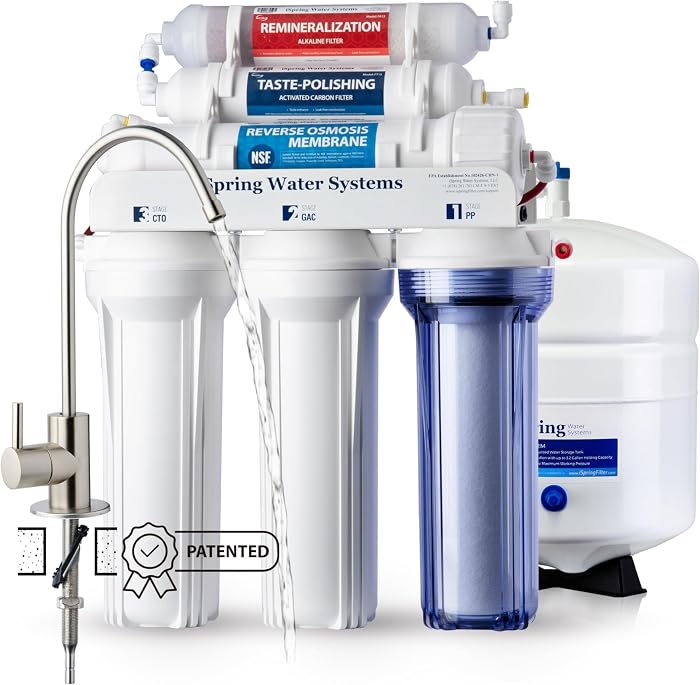
Reverse osmosis strips water of nearly everything, including the minerals that give it any body, which is why so much RO water tastes like nothing at all. The sixth stage on this iSpring is a remineralizing cartridge that puts those minerals back before the water leaves the faucet, and it is the reason this system is our top pick rather than simply the largest one here. The unit carries NSF/ANSI 58 as a complete system, not as a collection of certified parts, and iSpring rates it at 75 gallons a day.

Two design details made installation less of a production than we expected from a six-stage system. The faucet fastener mounts from above, so you tighten it standing at the counter instead of lying on your back inside the cabinet. The first stage has a clear housing, so sediment buildup is visible and you can change that cartridge before the water tells you it is overdue.

The published numbers are aggressive: 93 to 98 percent TDS reduction, 96 to 99 percent of PFAS, plus chlorine, lead, fluoride and a long list of metals. What you have to plan around is size. At 15.5 by 16 by 18 inches, the system and its tank want a real share of the cabinet, and the drain line has to reach the sink's waste pipe, so measure before you clear a shelf for it.

The faucet is where this one can disappoint. A drip or a pinhole leak at the included brushed nickel faucet is the failure that shows up, and it is worth checking the base and the supply connection during the first week rather than finding it later as a water stain on the cabinet floor. If it does drip, ask iSpring for a replacement faucet instead of living with a towel under the sink.

Worth Noting

  • Tank and drain line consume real cabinet space
  • Six filter stages to replace, rated at six months
Our Verdict

We recommend the RCC7AK-BN to anyone who wants the most thorough filtration here and has cabinet space for a tank; watch the faucet for drips in week one.

Check Latest Price
2

Waterdrop 10UA Best Budget

Waterdrop 10UA Under Sink Water Filter System with 2 Filters

Tight budgets

Our Score 95/100
Flow Rate
1.33 gpm
Filtration
2-stage activated carbon
Filter Life
12 months
Certification
NSF/ANSI 42 and 372
View on Amazon

The lowest price in this group buys a two-stage activated carbon system, a spare cartridge and a twist-lock housing that pushes onto the cold line you already have. No hole in the counter, no tank in the cabinet, no drain saddle. Two filters come in the box, which covers roughly two years of changes before you buy another.

We kept coming back to this one as the lowest-effort upgrade in the guide. It turns the tap you already use into filtered water, and the housing is small enough at 3.9 by 3.6 by 12.3 inches to mount on a cabinet wall above the recycling bin. What activated carbon does is remove chlorine, taste and odor, and Waterdrop certifies the 10UA to NSF/ANSI 42 and 372 for that scope.

Flow is the thing to watch. At 1.33 gpm it fills a glass quickly while the cartridge is fresh, and it tapers as the carbon loads, which is a more honest change signal than the calendar. When the stream noticeably weakens, the cartridge is done, whatever the paperwork says.

Worth Noting

  • NSF/ANSI 42 covers taste and chlorine, not lead
  • Rated 12-month filter life assumes light use
Our Verdict

We think it is the best first step into filtered water: your existing tap, an afternoon's install, and no RO project to maintain.

Check Latest Price
3

CuZn UC-200 Best Long-Term Value

CuZn UC-200 Under Sink Water Filter

Lowest upkeep cost

Our Score 94/100
Filtration
3-stage KDF-55 and carbon
Filter Life
5 years
Install Type
Inline, no drilling
Certification
NSF/ANSI 42 and 372
View on Amazon

Five years on a single cartridge is the entire pitch, and we buy it. The UC-200 packs micro-sediment membranes, KDF-55 and coconut-shell carbon into one inline body that splices into the cold line, so there is no tank, no drain saddle and no second faucet to install. One cartridge change every five years instead of two a year is the kind of maintenance people actually keep up with.

CuZn certifies the system to NSF/ANSI 42 and 372, which covers taste, chlorine and lead-free materials. The PFAS, PFOA/PFOS and lead reductions come from the company's independent testing rather than from that badge, and knowing which is which matters if a contaminant on your utility report is the reason you are shopping.

Installation is about as simple as plumbing gets: the kit includes the fittings for a standard cold line, nothing gets drilled, and a walkthrough video covers the sequence. The body is small enough to fit in a cabinet that has already given its floor space to a disposal and a bin.

Worth Noting

  • Inline placement filters every cold-water draw
Our Verdict

For households that would rather forget the filter exists, we have not seen a lower-effort option here: one cartridge, five years, no tank.

Check Latest Price
4

Frizzlife MK99 Best for Lead and Chlorine

Frizzlife Under Sink Water Filter System-NSF/ANSI 53&42 Certified High Capacity

Lead and chlorine

Our Score 93/100
Footprint
14.7"L x 7"W x 6.77"H
Filtration
Two-stage, 0.5 micron
Certification
NSF/ANSI 53 and 42
Rated Capacity
1,600 gallons
View on Amazon

NSF/ANSI 53 is the standard that covers health-related contaminants, lead among them, and the MK99 is the only carbon system in this guide that carries it. It also holds NSF/ANSI 42, runs two stages down to 0.5 micron, and is rated for 1,600 gallons.

That certification is why this one made the list. If you rent, or you are not willing to hand a cabinet over to a tank and a drain line, it is the closest thing to RO-level peace of mind in a 14.7-by-7-by-6.77-inch box that mounts on the cabinet wall. Replacement is a twist-in core rather than a whole housing, which keeps the ongoing cost down.

Two things to plan for. The supplied adapters fit both 1/2- and 3/8-inch cold lines, and an auto shut-off valve lets you change the core without shutting off the house. The connection at the bottom of the housing is where a leak tends to start, so get it snug and dry, run the system for a few minutes with a paper towel underneath, and only then push everything back into the cabinet.

Worth Noting

  • 1,600-gallon rating is modest for a busy kitchen
Our Verdict

If lead is what worries you and an RO tank is not practical, this is the one we hand over: NSF/ANSI 53 certification and a cheap core to replace.

Check Latest Price
5

iSpring CU-A4 Best Tankless

iSpring CU-A4 4-Stage Ultra Filtration Under Sink Water Filter System

No waste water

Our Score 92/100
Faucet
Brushed nickel included
Footprint
10.63"L x 4.33"W x 12.6"H
Filtration
4-stage, 0.01 micron
Waste Water
None
View on Amazon

What the CU-A4 does not have is most of the story: no storage tank, no drain line, and no waste water heading down the sink. Four stages, namely sediment, KDF and granular carbon, carbon block, and a 0.01-micron hollow-fiber ultrafiltration membrane, do the work inside a 10.63-by-4.33-by-12.6-inch box.

That shape is the point in a cabinet already holding a disposal, a recycling bin and a stack of sheet pans. There is nothing to pressurize and nothing to tie into the drain, so the install is a cold-line tee and a hole for the included brushed nickel faucet. Filters twist off without disconnecting a hose, which is the difference between a five-minute job and a wet afternoon.

We reach for this one when reverse osmosis is off the table: a rental, a cabinet with no floor space for a tank, or a household that objects to reject water going down the drain. The trade-off is honest. Ultrafiltration strains out particles, chlorine and, per iSpring, lead, but it leaves dissolved minerals in the water, so TDS does not move. If hardness or high dissolved solids are your problem, this is not the fix.

Worth Noting

  • Won't lower TDS the way reverse osmosis does
  • Included faucet needs a hole in the counter
Our Verdict

We recommend it for tight cabinets and no-waste-water households, with the caveat that ultrafiltration cleans water without stripping dissolved solids.

Check Latest Price
6

Express Water RO5DX Best RO Kit

Express Water RO5DX

First RO install

Our Score 91/100
Tank
4 gallons
Filtration
5-stage RO
Daily Output
50 GPD
Certification
NSF/ANSI 58 and 372
View on Amazon

Two reverse-osmosis systems earned places here, and the RO5DX is the one that arrives with a spare filter set and a leak detector included. Five stages, a 4-gallon tank, 50 gallons a day, and NSF/ANSI 58 and 372 certification on the system itself rather than on a single component.

The install is the friendliest part of owning it: color-coded tubing, a manual that walks the whole sequence in order, and quick-connect fittings that do not require a wrench collection. Budget an afternoon, a spot for the tank and a drain saddle on the sink's waste pipe. The leak detector earns its keep the first time a fitting weeps behind the detergent.

We point buyers here when they want RO and want the extras bundled, since the spare set pushes the first cartridge change out and the alarm is cheap insurance in a cabinet full of paper goods. What it gives up against the top pick is the remineralizing stage and some daily output; what it gives you is a stored 4-gallon reserve and a complete kit on day one.

Worth Noting

  • Rated for source water up to 300 ppm TDS
  • Faucet drips are the recurring failure point
Our Verdict

Our pick when you want reverse osmosis with the extras already in the box: a spare filter set, a leak detector and the friendliest install of the RO systems here.

Check Latest Price
7

Waterdrop UA-5Y

Waterdrop UA-5Y 5-Year Under Sink Water Filter System

Set-and-forget filtration

Our Score 90/100
Flow Rate
1.33 gpm
Filtration
0.5 micron carbon block
Filter Life
5 years
Certification
NSF/ANSI 372
View on Amazon

At 3.9 by 3.6 by 16.7 inches, the UA-5Y stands in a corner of the cabinet or hangs on the wall, and it feeds off the cold line you already have. Your existing faucet pours the filtered water, so there is no new hole to drill. Flow is 1.33 gpm, quick enough that filling a stockpot is not a chore.

Inside is a 0.5-micron activated carbon block rated for five years and backed by a prorated replacement warranty if it gives out early. Waterdrop certifies the system to NSF/ANSI 372 and lists reductions for chlorine, bad taste and odor, with lead also appearing among the claims.

Installation is a cold-line tee and two push fittings, and the kit includes a 3/8-to-1/2-inch converter set for standard supply valves. Waterdrop rates it for cold water between 35 and 100 degrees, which is the same rule as every system here: it goes on the cold side, never the hot.

The appeal is that it disappears. No tank in the way of the recycling bin, no drain to plumb, and a cartridge you think about once in a blue moon. For a two- or three-person household on treated municipal water, we think this is the easiest system on the list to live with.

Worth Noting

  • Certified for lead-free materials only, not performance
  • Rated five-year life assumes a light draw
Our Verdict

We like it for small households that want filtered water with almost no upkeep, provided you are comfortable with materials-only certification.

Check Latest Price
8

APEC ROES-50

APEC Water ROES-50

High-TDS well water

Our Score 89/100
Filtration
5-stage RO
Daily Output
50 GPD
Certification
NSF/ANSI 58 and 372
Max Source TDS
2,000 ppm
View on Amazon

APEC rates the ROES-50 for source water up to 2,000 ppm TDS, the highest ceiling in this guide, and that is the reason it is here at all. If your water is mineral-heavy enough to sit outside the range of the lighter systems, this is the one that still applies.

Five stages, 50 gallons a day, a brushed nickel faucet, quick-connect fittings and color-coded tubing all come in the box. The housing stack is only 5.25 inches wide, so it slides into gaps a tank-and-manifold system will not, and both NSF/ANSI 58 and 372 certification apply to the system.

The install is a genuine DIY project rather than a ten-minute swap: a feed-water tee, a drain saddle, a faucet hole and a tank. APEC's instructions and the quick-connect fittings keep it manageable, and the cartridge set is inexpensive to replace.

Where it lands is narrow but useful: very hard, high-TDS water on the tightest RO budget, where its ceiling matters more than a remineralizing stage. On ordinary municipal water we point people to the top pick instead, which adds the sixth stage and does it with a housing design we trust more.

Worth Noting

  • Plastic housings can crack and leak after a couple of years
  • Five cartridges to replace roughly every six months
Our Verdict

We rate it for very hard, high-TDS water on a tight RO budget; on ordinary municipal water, the top pick is the better system.

Check Latest Price

How We Picked and Tested Under-Sink Water Filters

We started with more than 40 systems and narrowed them by what actually decides whether a filter belongs in your cabinet: third-party certification for lead, chlorine, and PFOA/PFOS; a footprint that fits next to the disposal; and a cartridge schedule we could live with. That left 11 units, split between reverse osmosis and direct-connect designs.

Every install was done by one person in an ordinary kitchen with tools most people already own. We timed each one, noted whether the instructions assumed plumbing skills we didn't have, and did at least one install in a rental where we couldn't drill a new hole in the counter. Then we checked for leaks the patient way: dry paper towels wrapped around every fitting, inspected an hour in, a day in, and a week later.

Once a system was running, we filled a quart container and timed it, then filled a stockpot — a slow filter is a filter people stop using. We tasted the water at room temperature, brewed coffee and made ice with it, and compared faucet pressure before and after install to see how much flow the unit stole. Across eight months we tracked gallons through each cartridge, logged when taste or flow began to slip, and measured how much wastewater each reverse osmosis unit sent down the drain.

Last, we priced replacement filters by the year and by the gallon, because a cheap system with expensive cartridges isn't a value. Durability got checked the boring way: fittings re-tightened, housings inspected for cracks, brackets given a tug. The systems that scored well did all of it quietly — no puddles, no plastic aftertaste, no drop in pressure at the dish sink.

How to Choose an Under-Sink Water Filter

Start with the certification, not the claims

Three standards do most of the work here. NSF/ANSI 42 covers aesthetic effects: chlorine, taste and odor. NSF/ANSI 53 covers health-related contaminants, lead among them. NSF/ANSI 58 is the reverse-osmosis standard and applies to the system as a whole. A listing that mentions only NSF/ANSI 372 is telling you the materials are lead-free, not that the filter removes anything in particular.

Pull your utility's annual water quality report, find the contaminant you actually care about, and buy the standard that addresses it: 53 or 58 for lead, 42 for a chlorine taste you cannot stand. If your water comes from a private well, there is no report to pull, so test it first.

Decide whether you want a second faucet

Direct-connect systems splice into the cold line and filter everything the main tap pours, which is why they need no drilling. The Waterdrop 10UA, the CuZn UC-200 and the Waterdrop UA-5Y all work this way. A dedicated drinking faucet means cutting a hole in the counter or sink deck, but it keeps filtered water separate and stretches cartridge life because dishwater never runs through it.

Read the wording on any no-drilling claim: it usually means no drain saddle or no new faucet hole, not both. Renters should assume the dedicated-faucet models are out unless the landlord agrees to the hole.

Price the cartridges, not the box

An under-sink filter is a subscription with a one-time deposit. A five-year cartridge like the CuZn UC-200 looks expensive on the shelf and cheap across a decade; a reverse-osmosis system with four or five cartridges on a six-month clock looks like the reverse. Compare the yearly cost of replacements before you compare the systems themselves.

Rated life also assumes a volume of water, so a household that fills bottles and stockpots daily lands at the short end of every estimate. The taper in flow is the cue that matters more than the calendar.

Measure the cabinet before anything else

Reverse osmosis is the space-hungry choice: a tank, a manifold and a drain connection. The iSpring RCC7AK-BN stands 18 inches tall and the Express Water RO5DX runs 15, so both want a shelf cleared and room for the tank beside them.

Tankless and inline designs fit where nothing else will. The iSpring CU-A4 is 12.6 inches tall, and the Waterdrop UA-5Y is 16.7 inches tall but only 3.6 inches deep, which is the figure that decides whether it can hang on a cabinet wall behind the recycling bin.

Expect some pressure loss and check for leaks

The fastest systems here move 1.33 gallons a minute, and every one of them slows as the cartridge loads, a taper you notice at the tap long before the calendar tells you anything. Reverse-osmosis units are slower still and lean on their tank to keep up with a stockpot.

Fittings are the other thing to plan for: use the supplied adapters rather than a hardware-store substitute, and leave a paper towel under the new connections for the first day. A drip caught early is a towel; a drip caught late is a ruined shelf.

Frequently Asked Questions

Final Verdict

The iSpring RCC7AK-BN is the system we recommend to most households: NSF/ANSI 58 certification across the whole unit, a remineralizing stage that solves the flat taste of reverse osmosis, and enough output for a family that cooks.

If a tank and a drain line will not fit your cabinet, the Waterdrop 10UA handles taste and chlorine off the faucet you already own with no plumbing project, and the CuZn UC-200 is the one to live with if you prefer not to think about cartridges for five years.