Best Wüsthof Kitchen Knives of 2026

There's a specific moment when a kitchen knife stops cutting and starts crushing — the tomato that dents instead of slicing, the onion that slides instead of staying put. That's when people start looking for something better, and many land on the same German name. A good knife fixes the small friction that makes prep feel like work, and it keeps doing it for decades.

The chef's knife I've owned longest has outlasted three apartments, and what I notice when I pick up a lesser one is balance — where the weight sits when you're halfway through a pile of carrots. Over the past eight months, my team and I have cooked with 12 Wüsthof knives, from paring knives to carving sets, and the ones that kept landing in the sink were the ones that felt like an extension of the wrist.

Factory sharpness varies more than you'd expect even within a single lineup, and heavier isn't automatically better — a thick bolster can tire your hand mid-prep. The picks below cover what a home kitchen actually needs.

Our Top Picks

The 8 Best Wüsthof Kitchen Knives of 2026

1

WÜSTHOF Classic 6" Chef's Knife Best Overall

Wüsthof Classic 6" Chef's Knife

Everyday all-purpose cooking

Our Score 96/100
Handle
Polyoxymethylene (POM)
Weight
6.4 oz
Blade Length
6 inches
Construction
Forged
View on Amazon

Six inches is the number that decides this knife, and it is why we hand it to anyone who asks for one good Wüsthof. The blade is forged from a single piece of high-carbon stainless steel, tempered to 58 HRC, with a full tang running through a triple-riveted POM handle — so it carries the solidity of a forged knife without the length that makes an eight-inch blade feel like a lot of steel on a small board. Wüsthof's own claim is that its PEtec edge arrives 20 percent sharper and holds that edge twice as long; what we can tell you is that it comes out of the box ready to work.

Control is where it earns the top spot. At 6.4 ounces there is enough mass for the blade to fall through an onion, but the shorter length keeps the tip exactly where you put it, which shows up when you are dicing shallots, trimming beans, or working around a chicken carcass on a crowded counter. The balance sits close to the bolster, the handle fills a palm without a ridge digging in, and the transition from blade to grip is smooth enough that a pinch grip feels natural rather than forced. Of everything here, it is the knife we pick up when we do not want to think about which knife to use.

The price sits in the middle of this group, which is about right for a forged German chef's knife — you are paying for steel that will outlast the handle and an edge that comes back with a few passes on a steel. If you cook for one or two and your prep is mostly vegetables, herbs, and chicken, this is the whole argument for buying one good knife instead of a block of indifferent ones.

Worth Noting

  • Six-inch blade is short for whole squash and large roasts
Our Verdict

This is the Wüsthof we point most home cooks to first: a balanced, sharp, easy-to-control six-inch chef's knife that covers nearly everything an everyday kitchen asks of it.

Check Latest Price
2

WÜSTHOF Classic Ikon 8" Chef's Knife Best Full-Size Chef's Knife

Wüsthof Classic Ikon 8" Chef's Knife

Large cutting jobs

Our Score 95/100
Handle
Resilient synthetic
Weight
9.6 oz
Blade Length
8 inches
Construction
Forged
View on Amazon

Two inches separate this knife from our top pick, and they change the work it is suited to. The Classic Ikon 8-inch is a full-size chef's knife: 9.6 ounces, forged from one piece of high-carbon stainless at 58 HRC, with the line's double bolster putting weight right where your hand sits. Set it beside the six-inch Classic and the difference is plain — more edge on the board, a thicker spine, and momentum you can feel once the knife is moving.

That momentum is the point. A blade this size falls through a pile of carrots, splits a squash, and takes apart a chicken without the sawing a shorter knife forces you into. The Ikon handle is the other reason people move up to this line: sleeker than the Classic's riveted scales, with a bolster that flows into the grip instead of stepping down under your index finger. In the hand it feels like a knife you steer rather than one you press.

Our reservation is mass. Working through a bunch of parsley or shaving radishes, the weight that powers a squash cut makes the knife feel blunt and deliberate, and cooks with smaller hands notice it first. If your prep runs big and sturdy — roasts, cabbages, sheet pans of roots — that is a fair trade. If it runs delicate, the six-inch Classic is the easier knife to live with.

Worth Noting

  • The priciest chef's knife in this group
Our Verdict

Buy this one when you want a full eight inches of forged steel and a heavier, double-bolster feel — we think it is the better tool for big, forceful cutting.

Check Latest Price
3

WÜSTHOF Gourmet 8" Chef's Knife Best Budget Chef's Knife

Wüsthof 8" Gourmet Chef's Knife

First kitchens

Our Score 94/100
Handle
Polypropylene
Weight
8.47 oz
Blade Length
8 inches
Construction
Stamped
View on Amazon

This is the least expensive way into a full-size Wüsthof chef's knife, and it does not pretend otherwise: a stamped blade rather than a forged one, a polypropylene handle, 240 grams on the scale. What matters is that the shape is right — a full eight inches with a proper curve for rocking and an edge thin enough to move through an onion without forcing. For a first apartment, a rental kitchen, or a cook still deciding whether they care about knives, this is the one we hand over without wincing.

The lightness is not automatically a fault. Stamped steel is easier on the wrist through a long session of prep, and a cook with small hands may prefer it to a forged knife for exactly that reason. The handle resists heat, fading, and impact, and it wipes clean in a second. What you feel instead of heft is the work moving into your forearm — through sweet potatoes and winter squash the knife needs a push where a forged blade would fall.

Worth Noting

  • Finish is plainer than the Classic's riveted handle
Our Verdict

The least expensive full-size Wüsthof chef's knife here, and for a first kitchen or a gifted knife we think it's the sensible place to start.

Check Latest Price
4

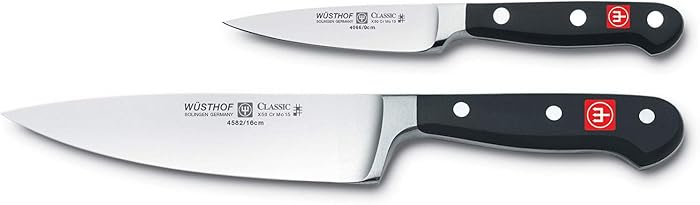
WÜSTHOF Classic 2-Piece Prep Knife Set Best Starter Set

Wüsthof Classic 2-Piece Prep Knife Set

New kitchens

Our Score 93/100
Handle
Plastic
Pieces
3.5" paring and 6" cook's knife
Construction
Forged
Blade Material
Stainless steel
View on Amazon

Most kitchens do not need twelve knives; they need two good ones, and this set is that pair. Inside are a six-inch Classic cook's knife — the same blade size and line as our top pick — and the 3.5-inch Classic paring knife, both forged, both full tang, both with the same triple-riveted handle. Bought together they cost less than the two knives priced separately, which is rare enough in a bundle that we say so out loud.

In use the pair covers more ground than the count suggests. The cook's knife takes onions, chicken, cabbage, and herbs; the paring knife handles shallots, strawberries, and anything you would rather do in the air than on a board. Both are tempered to 58 HRC and both come back quickly with a few strokes on a honing steel, and because the handles match, moving between them does not feel like switching tools.

The math only works if you need both. If there is already a chef's knife in the drawer that you like, buy the paring knife on its own and put the difference toward the bread knife. If you are replacing a tired pair or stocking a first kitchen, this is the shortest route to a workable setup — and the most useful wedding gift on this page, since it is two knives someone will actually use rather than a block with four they will not.

Worth Noting

  • No serrated knife in the set
Our Verdict

For a kitchen starting from zero, we recommend this pair before any big block: the six-inch cook's knife and the paring knife cover nearly everything.

Check Latest Price
5

WÜSTHOF Classic 7" Santoku Knife Best Santoku

Wüsthof Classic 7" Santoku Knife

Vegetable prep

Our Score 92/100
Edge
Hollow
Weight
6.24 oz
Blade Length
7 inches
Construction
Forged
View on Amazon

A santoku is not a chef's knife under another name. The 7-inch blade runs flatter along the edge, with less belly for rocking, and it drops straight down in a push cut rather than walking across the board. The hollow ovals ground into the sides break the suction that sends potato and cucumber slices climbing the blade. If you rock your chef's knife without thinking about it, this will feel like a different sport for the first week.

Then the shape clicks. Cabbage, peppers, mushrooms, and scallions fall into even slices with one forward push, and the 6.24-ounce forged blade is light enough to keep that motion going through a full sheet pan of prep. It comes out of the box razor sharp and keeps its bite with ordinary honing, which is most of what anyone asks of a knife this size.

Where we like it is as a second knife. Pair it with the six-inch Classic and you have the two shapes most vegetable-heavy kitchens actually use, and the santoku becomes the blade you reach for when a recipe says thinly sliced. It is also the knife people notice on the board, with the dimpled blade and the dark handle doing more for its looks than most knives in a drawer.

Worth Noting

  • Flat edge is awkward for rocking and chopping herbs
Our Verdict

If you chop vegetables more than anything else, this is the knife we hand you: thin slices, less sticking, and an edge that keeps its bite.

Check Latest Price
6

WÜSTHOF Classic Ikon 3.5" Paring Knife Best Paring Knife

Wüsthof Classic IKON 3.5" Paring Knife

Peeling and trimming

Our Score 91/100
Handle
Resilient synthetic
Weight
2.72 oz
Blade Length
3.5 inches
Construction
Forged
View on Amazon

A 3.5-inch paring knife at 2.72 ounces does not sound like much, but pick this one up and the mass is the first thing you notice. It is forged from a single piece of high-carbon stainless at 58 HRC with a full tang through the handle, so the blade feels planted instead of tinny — the difference between a knife that steers around a strawberry stem and one that slides past it.

The Ikon handle is why we reach for this one. It is sleeker and a little fuller in the palm than the Classic shape, and the bolster flows into the grip rather than stepping down at the index finger, which matters more on a knife you hold in a pencil grip than on a chef's knife. Peeling, coring, trimming beans, segmenting citrus: the blade is short enough to stay out of the way and stiff enough not to flex when you push.

It is also the least necessary purchase here if the prep set is already in your drawer, since that set includes a Classic paring knife of the same size. Where the Ikon earns the step up is in the hand — if you pare something most days, the handle and the extra heft are worth paying for. If the paring knife only comes out at Thanksgiving, they are not.

Worth Noting

  • Priced like a full-size Gourmet chef's knife
Our Verdict

The paring knife we pick up without thinking about it: small, sharp, and shaped so a bag of apples does not wear out your hand.

Check Latest Price
7

WÜSTHOF Gourmet 8" Bread Knife Best Bread Knife

Wüsthof Gourmet 8" Bread Knife

Crusty loaves

Our Score 90/100
Edge
Serrated
Weight
3.84 oz
Blade Length
8 inches
Construction
Stamped
View on Amazon

A dull knife does not cut bread so much as crush it. You can see the result in the crumb — squashed, gummy, and a board full of crumbs — and it is the reason a serrated blade earns a slot in a kitchen that bakes or buys good loaves.

The scallops on this 8-inch Gourmet start the cut by biting into the crust, then keep the blade tracking straight through the soft interior instead of wandering with the shape of the loaf. Eight inches crosses a wide boule in one stroke. At 3.84 ounces it is light — stamped steel, polypropylene handle — which keeps the sawing motion easy from one end of a loaf to the other and makes it comfortable in smaller hands.

It handles more than bread. Tomatoes, cake layers, and citrus all behave better under serrations, and a light blade you can steer is easier on those than a heavy one. It is also the least fussy knife here to own: wipe it, dry it, put it away.

For the money this is one of the easiest additions to a kitchen that already has a chef's knife. It will not replace one, and it is not the knife to buy first, but it is the gap most home cooks leave open longest. Ours lives within reach of the board, which for a bread knife is the whole endorsement.

Worth Noting

  • Serrated edge cannot be honed like a plain blade
Our Verdict

If your household cuts fresh bread most weeks, this is the serrated knife we recommend: sharp scallops, a light eight-inch blade, and a budget price.

Check Latest Price
8

WÜSTHOF Classic 2-Piece Carving Set Best for Roasts and Holidays

Wüsthof Classic 2-Piece Carving Set

Roasts and holidays

Our Score 89/100
Edge
Hollow
Pieces
6" carving fork and 8" hollow edge carving knife
Weight
14.1 oz
Construction
Forged
View on Amazon

Somewhere between the board and the table, a good roast gets ruined by a short knife and a wobbling grip. That is the moment this set is built for: an 8-inch hollow-edge carving knife and a 6-inch carving fork, both forged Classic pieces with the same full tangs and triple-riveted handles as the rest of the line.

The hollow edge does the work. Ovals ground into the sides of the blade let air in behind each slice, so a piece of pork loin or a brisket lifts away instead of clinging to the steel and tearing. The blade is thin enough for a proper thin slice and has enough backbone for the breast of a chicken, and the fork is what lets you hold the roast still instead of chasing it across the board.

Both pieces arrive extremely sharp, and the set has real weight to it — 14.08 ounces between knife and fork, which is what you want when you are pinning a turkey. The handles match the Classic knives you may already own, so this slots into a drawer rather than looking like a separate purchase.

Where it earns its place is the occasion. A holiday bird, a weekend brisket, a pork loin you want to slice thin for sandwiches — the set turns each of those into a two-minute job instead of a wrestling match, and it does it in front of guests, which is not nothing. It is the most giftable thing here, the kind of set that gets used at the table rather than admired in a block.

Worth Noting

  • A specialty purchase rather than an everyday knife
Our Verdict

For cooks who roast whole birds and holiday cuts, this is the pair we bring out: an eight-inch hollow-edge slicer and a fork that holds the roast still.

Check Latest Price

How We Tested Wüsthof Kitchen Knives

We started with the full lineup rather than a handful of bestsellers, then narrowed to the shapes a home kitchen actually reaches for: 6- and 8-inch chef's knives, a santoku, a paring knife, a bread knife, and two sets — one prep, one carving. That left 12 knives spanning the lighter stamped blades up to the heaviest forged ones, which we cooked with for eight months.

Testing happened in our own kitchens on weeknights, not on a bench. We broke down whole chickens, sliced tomatoes and crusty loaves, minced shallots, and batch-chopped onions until our eyes watered — then did it again the next night. To judge sharpness, we started each blade on a ripe tomato and a sheet of newspaper, then tracked how many sessions passed before it began dragging and needed a few passes on a honing rod.

For balance and ergonomics, three of us with noticeably different hand sizes took turns with each knife, noting where the pinch grip landed, whether the bolster crowded our fingers, and how our wrists felt after 20 minutes of continuous chopping. Durability got the least glamorous version of the test: we left blades wet in the sink, let a couple sit dirty overnight, and checked handles, rivets, and fit and finish for loosening or gaps after months of use. We also kept a running tally of price against what each knife actually delivered — a lower-priced stamped blade earned its spot if it held an edge, and a costly forged one lost points if it didn't.

How to Choose a Wüsthof Kitchen Knife

Forged or Stamped?

Classic and Classic Ikon are forged: one piece of high-carbon stainless steel, tempered to 58 HRC, with a full tang running through a riveted handle. Gourmet is stamped from laser-cut steel with a polypropylene handle, which makes it lighter, thinner, and considerably cheaper. A forged knife carries more mass, so it does more of the cutting for you on dense food; a stamped knife is easier on the wrist over a long session and costs less, which is exactly why it makes a good first knife.

The trap is the name. A low price on a Wüsthof almost always means Gourmet, so check the line before comparing two listings that look like the same knife. Neither is a bad buy — a stamped Wüsthof is still a German-made knife with the same blade geometry — but you should know which one you are paying for.

Which Knife Comes First?

Start with a chef's knife and add others only as your cooking asks for them. Six inches suits smaller hands, small boards, and kitchens with no spare counter; eight inches gives you more edge and more momentum for volume cooking, big cabbages, and taking apart birds. A santoku is the alternative for cooks who push-cut instead of rock. After the chef's knife, a paring knife covers the small work and a serrated blade covers bread and tomatoes.

The trap here is buying the block first. Most sets include at least one knife that never leaves its slot, and the money spent on it would have bought a better version of the knife you reach for daily. Buy one, cook with it for a month, then fill the gap you actually notice.

Handles, Bolsters, and Balance

You hold the handle far longer than you look at the blade, so it decides comfort more than steel does. Classic uses a triple-riveted POM handle with a bolster that steps down behind the heel; Classic Ikon uses a sleeker synthetic handle with a double bolster that flows into the grip and shifts weight back toward your hand. Neither is better in the abstract — the Ikon shape suits a pinch grip and a fuller hand, while the Classic shape suits a hammer grip and a straight thumb.

Think about how you hold a knife before you order. If your thumb and forefinger pinch the blade above the heel, that bolster transition matters a great deal; if you wrap all four fingers around the handle, it matters much less. Balance should sit at or just in front of the pinch point, and a knife that feels tip-heavy at the counter will feel worse after twenty minutes of onions.

One Good Knife or a Two-Knife Set?

A set makes sense only when you would buy both knives anyway. The Classic prep set pairs a six-inch cook's knife with a 3.5-inch paring knife — the two blades that do most of a home kitchen's work — and comes in below what the pair costs separately. Bigger blocks mostly add knives for jobs you do a few times a year.

Our order of purchase: chef's knife, paring knife, serrated knife, then everything else. A carving set belongs on that list only if you roast whole cuts, and a santoku only if you already know you prefer a push cut.

Keeping the Edge

A honing steel realigns an edge; a whetstone or a sharpener removes metal to create a new one. Most home cooks need the steel weekly and the stone once or twice a year. Cut on wood or plastic — glass and ceramic boards will roll an edge faster than anything else in your kitchen — and wash by hand, drying right away instead of leaving a forged knife in the dishwasher.

Store knives where the edge touches nothing hard: a block, a magnetic strip, or a blade guard in a drawer. A good knife rattling against a metal utensil loses its edge while it sits there.

Frequently Asked Questions

Final Verdict

Start with the Wüsthof Classic 6-inch chef's knife. It is forged, balanced, sharp out of the box, and short enough to control on a home board, which is why we recommend it to most cooks before anything else on this page.

If you regularly cut through squash, cabbage, or whole birds, the Classic Ikon 8-inch is the upgrade, and its extra heft is the price of doing that work well. If budget decides it, the Gourmet 8-inch is a real Wüsthof chef's knife for less and will serve a first kitchen for years.