Best Espresso Machines with Built-In Grinders of 2026

For years my counter held two appliances: a burr grinder and an espresso machine, with stray grounds living in the gap between them. One machine that grinds and brews gave me back half the counter and, honestly, better shots — coffee goes from burr to basket in seconds instead of sitting ground in a hopper all week. The catch is trusting one machine to do two jobs well, and not all of them earn it.

My team and I spent six months pulling shots on eight machines with built-in grinders, and the spread surprised me: grinders loud enough to wake the house, hoppers that barely clear a cabinet, second shots that ran noticeably cooler than the first. We weighted espresso quality first, then noise, footprint, temperature stability, reliability, and how each held up cosmetically. Which one fits your mornings depends on how much of the barista work you want to do yourself.

Our Top Picks

The 6 Best Espresso Machines with Built-In Grinders of 2026

1

Breville Barista Express Best Overall

Breville BES870XL Barista Express Espresso Machine

Everyday espresso drinks

Our Score 89/100
Weight
30.4 lb
Grinder
Integrated conical burr
Dimensions
13.8"D x 12.5"W x 15.9"H
Temperature Control
PID
View on Amazon

The part that earns this machine its place is the grinder, and specifically where it puts the coffee: straight into the portafilter, on demand, in a dose you set. No second appliance, no transfer between bins, no ground coffee going stale in a hopper between shots. Behind that sit PID-regulated water temperature and a low-pressure pre-infusion that wets the puck before the pump comes up to full pressure — the two details that separate a sweet, syrupy shot from a sharp one.

On the cup itself, this is the machine we trust most in this group. Every variable that shapes a shot — grind, dose, temperature, extraction — is yours to adjust, which is exactly what you want the morning the coffee tastes sour and you need to know why. The steam wand is manual rather than automatic, and the microfoam it turns out is worth the extra minute at the pitcher.

The physical size is what surprises people. At 30.4 pounds and 15.9 inches tall, it fills a counter and needs headroom under the cabinets, so measure from countertop to the underside of the upper cabinet before you commit. Where that space exists, this is the one machine here that works as both a first espresso machine and a long-term one.

Worth Noting

  • Shots take practice to dial in
  • Some units develop faults after a few years
Our Verdict

The one we recommend first: a grinder that doses straight into the basket, temperature you can trust, and a steam wand worth learning.

Check Latest Price
2

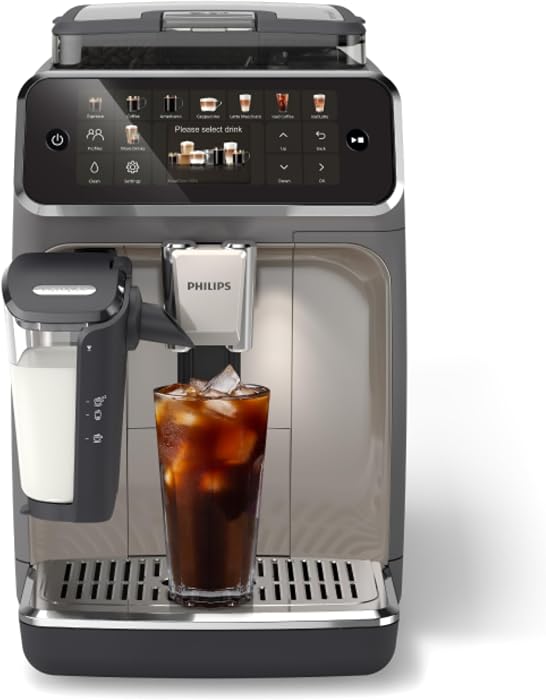
Philips 5500 Series Best Fully Automatic

PHILIPS 5500 Series Fully Automatic Espresso Machine

One-touch milk drinks

Our Score 88/100
Grinder
Ceramic burr
Operation
Fully automatic
Water Tank
1.8 liters
Milk System
LatteGo
View on Amazon

This is the machine for the person who wants a latte, not a hobby. Press the button and it grinds, tamps, brews and adds milk; twenty presets cover everything from a straight espresso to an iced coffee, and the color screen lets you shift strength, volume and milk within each one. It's ready to brew about three seconds after you switch it on, and the grinding is shielded to keep the noise down at six in the morning. You still choose beans, strength and cup size, so it isn't a pod machine with extra steps — but nothing here asks you to develop a feel for tamping, which makes it the least fussy machine in this group.

The LatteGo system is the design detail we appreciate most: the milk carafe is three parts with no internal tubes, so it comes apart and rinses instead of needing a brush pushed through a hidden channel. It's also the narrowest machine here at 9.7 inches deep, which matters on a shallow counter. What you give up is control — there's a ceramic grinder inside, but grind and dose stay the machine's business. Anyone who wants to adjust a shot halfway through the week should look at the semi-automatics here instead.

Worth Noting

  • The most expensive machine in this group
Our Verdict

Buy this if you want café-style milk drinks at the push of a button and have no interest in becoming a barista.

Check Latest Price
3

De'Longhi La Specialista Touch Best for Learning

De'Longhi La Specialista Touch Espresso Machine with Coffee Grinder

Learning with guidance

Our Score 87/100
Grinder
Italian-made conical burr
Dimensions
18.7"D x 14.96"W x 18.58"H
Brew Pressure
9 bar
Drink Presets
10 recipes
View on Amazon

Bean Adapt is the reason to look at this machine. It walks you through grind, dose, pre-infusion and brew temperature on the touchscreen, then holds those settings so the next shot starts from the same place instead of from scratch. Ten preset recipes run from espresso through flat white to cold brew, and you can take over manually whenever the mood strikes.

Under the guidance it's a proper semi-automatic: an Italian-made conical burr grinder, a stainless steel steam wand, a 22.9-pound body that stays put when you lock in the portafilter, and 9 bar of brew pressure. That last figure is worth pausing on, because it's extraction pressure rather than the pump number printed on most boxes — nine bar is where espresso is actually made.

For a beginner who wants to learn with guardrails, this is the most useful machine here: the prompts shorten the stretch where every shot tastes wrong, and the skills stay with you after you stop reading them. The catch is counter depth. At 18.7 inches front to back it's the deepest machine in this group and will overhang a narrow counter, so check the overhang before you fall for the touchscreen. It's also the newest design here, which makes long-term reliability the open question rather than a settled one.

Worth Noting

  • Deepest footprint here at 18.7 inches
  • Newest design, so long-term reliability is unproven
Our Verdict

Beginners who still want to tamp and steam should start here: the guidance shortens the learning curve without taking the craft away.

Check Latest Price
4

Ninja Luxe Café Premier Best for Coffee Drinkers

Ninja® Luxe Café Premier 3-in-1 Espresso Machine

Coffee and espresso

Our Score 86/100
Weight
31.6 lb
Frother
Hands-free dual froth
Grinder
Conical burr, 25 settings
Brew Styles
Espresso, drip, cold brew
View on Amazon

Three appliances in one cabinet: this Ninja pulls espresso in double or quad shots, brews drip coffee in three strengths, and makes cold brew two ways, all from a 25-setting conical burr grinder built into the top. If one person in the house wants a flat white and another just wants a mug of coffee, that's a real argument for a single machine instead of two.

What we like most is that the grinder doesn't get dumbed down for the sake of the drip side. Barista Assist weighs the dose as it grinds, the assisted tamper takes the guesswork out of the puck, and the dual froth system spins a whisk in the milk so you get hot or cold microfoam without holding a pitcher at an angle for a minute. It's the most versatile machine here, and the coffee is genuinely good rather than a compromise you accept for the convenience.

Two practical notes before you commit. At 31.6 pounds it's heavy to reposition, which is fine once it's placed and irritating while you're still deciding where it goes. And the plastic funnel and milk jug are the parts that wear out first, so treat them gently and confirm replacements are easy to order before you need one.

Worth Noting

  • Plastic funnel and milk jug wear out first
  • 31.6 pounds is heavy to reposition
Our Verdict

For a household split between drip coffee and espresso, this is the one machine here that covers both without a second appliance.

Check Latest Price
5

AMZCHEF CM1626 Best Budget

AMZCHEF Espresso Machine With Grinder

Tight budgets

Our Score 85/100
Grinder
Built-in, 44 settings
Steam Wand
8mm stainless steel
Water Tank
60 oz
Brew Temperature
190°F to 201°F
View on Amazon

At the bottom of this group's price range sits a machine that doesn't feel like a compromise: a built-in burr grinder with 44 steps, brew temperature you can set between 190°F and 201°F, a cold brew mode, and a 60-ounce tank. The temperature range is the detail we care about most, because it's what budget machines usually leave out — a dark roast and a light roast want different water, and here you can give each one what it needs instead of settling for whatever the factory picked.

It's also the smallest machine here at 13.4 inches tall, so it fits under cabinets that the Breville and the De'Longhi won't clear, and at 13.9 pounds it slides back easily when you need the counter. What you trade for the price is fine control at the grind step: the grinder runs on a timer you set on the touchscreen rather than offering a one-touch single or double dose, so you learn what a given number of seconds of a given bean looks like in the basket. The 8mm steam wand is manual, which is the right call at this price.

Worth Noting

  • Grind runs on a timer instead of a one-touch dose
Our Verdict

Our budget pick gives you a real burr grinder and adjustable brew temperature for far less than the rest of this set.

Check Latest Price
6

Gevi ECMI0-SS0A1 Best for Budget 58Mm Brewing

Gevi 20 Bar Espresso Machine with Grinder & Steam Wand for Latte Cappuccino

Budget 58mm brewing

Our Score 84/100
Grinder
Built-in conical burr
Water Tank
2.3 liters
Portafilter
58mm
Pump Pressure
20 bar
View on Amazon

A 58mm portafilter is the detail that makes this Gevi interesting. It's the commercial size, so baskets, tampers and distribution tools sold for serious machines fit it, which is not true of the 51mm and 54mm sizes a lot of budget machines use. Add a 20-bar pump, a 2.3-liter removable tank, a cup warmer on top and 30 grind settings, and the parts list reads like a machine costing considerably more.

It's a semi-automatic in the traditional sense: you grind by time, dose into the basket, tamp and pull, then steam milk on the wand. NTC and PID temperature control keep the brew water steady, and the box includes single and double baskets in both single-wall and dual-wall versions, so you can start on the forgiving pressurized baskets and move to the real thing once your technique catches up.

Where it earns a place in this group is the accessory question. If you already own 58mm baskets, or you plan to buy a proper tamper and a distribution tool, this is the least expensive way here to get a machine those things fit. The 16.5-inch height means it needs the same cabinet clearance as the Breville, so measure before you order.

Worth Noting

  • 16.5-inch height needs cabinet clearance
Our Verdict

A smart buy for anyone chasing 58mm baskets and a big water tank on a small budget, provided the counter clearance is there.

Check Latest Price

How We Tested Espresso Machines With Built-In Grinders

We started with more than 20 machines on the market and cut the list using a few practical filters: the grinder had to be adjustable rather than a fixed-setting blade, the machine had to fit under a standard upper cabinet with the hopper loaded, and it had to be something a household could reasonably clean and descale without a service call. That left eight machines, which we ran daily for six months.

Every machine got the same workout. On weekday mornings we ground and pulled two shots back to back, timing each one and checking the temperature of the espresso as it left the spout to see whether the second shot ran hot or cold. We measured noise with a decibel app held at arm's length while the grinder ran — the difference between machines was bigger than we expected, and it matters at 6 a.m. We also taped off each footprint on the counter, then checked clearance for the hopper, the portafilter, and a scale.

On weekends we steamed milk for cappuccinos and lattes, watching whether the froth came out silky or bubbly and how quickly the wand or automatic milk system needed wiping down. Over the six months we logged how often each machine needed its grind re-dialed, whether grounds clogged the chute or piled up in the basket, and what the finish looked like after daily milk splatter and fingerprints. We also tracked what came in the box — tampers, pitchers, portafilters — because a machine that ships without the basics is worse value than its sticker suggests.

How to Choose an Espresso Machine with a Built-In Grinder

Semi-Automatic or Fully Automatic?

Semis ask you to grind, dose, tamp and steam; automatics do all of it behind a button labeled latte. The choice is about temperament more than budget. If you want to taste the difference between two beans and understand why one shot beat the other, take a semi-automatic with a real steam wand, like the Breville Barista Express. If you want the same drink every morning without thinking about it, a fully automatic like the Philips 5500 earns its price.

The classic mistake is buying an automatic and then wishing you could change the grind halfway through a bag. Be honest about which person you are before you spend.

What the Grinder Actually Has to Do

Every machine here uses burrs rather than blades, so the grounds come out uniform. What separates them is how fine the finest setting goes and how repeatable the dose is. Time-based dosing — you set seconds on a screen — is normal at the budget end and works once you learn what a given bean looks like in the basket. Weight-based dosing, as on the Ninja, removes that step entirely.

Watch for one trap in the listings: a machine sold as coming with a grinder sometimes ships a separate grinder in the same box. Check the included-components list for a single unit with a hopper on top.

Pressure, Temperature, and the Numbers on the Box

Twenty bars is pump pressure, not brew pressure. Espresso extracts at roughly nine bar, and the extra headroom exists to push water through a fine puck, not to improve the coffee. A machine quoting nine bar of output pressure, like the De'Longhi, is telling you something more useful.

Temperature matters just as much. Look for PID control or an adjustable brew temperature, as on the AMZCHEF, because water that runs cool gives you a sour shot that no amount of grind tweaking will fix.

Portafilter Size and the Accessory Question

Baskets, tampers and distribution tools are sold by diameter, so the portafilter decides what you can buy later. 58mm is the commercial standard with the widest aftermarket; 51mm and 54mm machines work fine but limit you to what the maker sells. If you already own 58mm accessories, that single figure can settle the decision, and the Gevi is the least expensive way to get it here.

If you never plan to buy another coffee gadget, ignore this section entirely and pick on other grounds.

Fitting It on the Counter

Depth and height are where a machine that looked compact online stops fitting. At 18.7 inches deep, the De'Longhi overhangs a standard 24-inch counter once you leave room at the back for the cord, and a 15.9-inch-tall machine like the Breville needs clearance under the upper cabinets just to fill the hopper.

Measure from countertop to cabinet underside before you order, and make sure you can reach the water tank without dragging the machine forward — a rear tank on a 30-pound body becomes a daily irritation.

Frequently Asked Questions

Final Verdict

We recommend the Breville Barista Express to most people because it is the most complete machine here: a grinder that doses into the basket, temperature you can trust, and a steam wand that rewards a little practice. It is the one that stays interesting after the novelty wears off.

If you have no interest in learning any of it, the Philips 5500 makes the same drinks with one press. And if the budget is the deciding factor, the AMZCHEF CM1626 gives up less than you expect for the least money in this group.