Best Juicers for Leafy Greens of 2026

Leafy greens are where juicers go to die. A kale leaf is light and watery until it hits the auger, and then it turns into a green paste that plasters the screen, slows the flow to a trickle, and leaves you with a warm cup of foam. Apples and carrots are easy; a machine that takes a fistful of spinach without choking is the one worth owning. I've kept a green juice habit for years; over the past seven months, my team and I ran 12 juicers through it.

The differences show up fast. A wide feed chute saves you ten minutes of chopping, then means nothing if the screen clogs four ounces into a bunch of kale. Easy cleaning sounds like a footnote until you're scrubbing pulp out of a mesh basket at 6:45 a.m., so we timed teardowns and counted parts. Some left bone-dry pulp and a glass of bright green juice; others left half the water in the waste bucket. What separates the keepers is mostly what they ask of you afterward.

Our Top Picks

The 7 Best Juicers for Leafy Greens of 2026

1

Godspeeds Smoothpress Cold Press Juicer Best Overall

Godspeeds Smoothpress® Cold Press Juicer

Everyday green juicing

Our Score 90/100
Speed
58 RPM
Cleaning
Dishwasher safe
Warranty
10 years
Feed Chute
6 inches
View on Amazon

Kale is where juicers separate: thin leaves, long fiber, and a filter that wraps itself in green pulp inside a minute. The Smoothpress is the machine here that kept a full bunch of greens moving at 58 RPM without the mid-batch teardown, and that is why we put it at the top of this list. Slow rotation keeps the juice cool and barely foamed, too.

Cleaning is what sells it day to day. The toothed filter lifts out of the chamber and rinses under the tap, the pulp cup comes away with it, and every removable part is dishwasher safe. Greens are sticky in a way carrots are not, and a filter you can hold under the faucet is the difference between juicing on a Tuesday and saving it for the weekend. The 10-year warranty is the longest coverage in this group.

Two things to plan around. Capacity is listed at 473 ml, so a two-person batch means emptying the cup once; for one person it never comes up. And the 6-inch chute takes a whole apple, but greens still go in by the handful, because a wide chute saves prep on fruit rather than on leaves. At 7.9 pounds it comes out of a cabinet without a fight, which not every machine here can say.

Worth Noting

  • 473 ml capacity means emptying mid-batch
Our Verdict

We recommend the Smoothpress as the default for greens: kale and spinach move through at 58 RPM without a teardown, and the filter rinses clean in seconds.

Check Latest Price
2

Fretta F5000 Cold Press Juicer Best for Big Batches of Green Juice

Fretta F5000 Cold Press Juicer – Juicer Machines

Big green batches

Our Score 89/100
Safety
Auto-stop when lid opens
Cleaning
Hand wash only
Feed Chute
4.25 inches
Juice Container
1 liter
View on Amazon

A liter of juice sounds like overkill until you weigh a bunch of kale. Greens are the least productive thing you can feed a juicer — a sink full of leaves turns into one small glass — so the Fretta's 1-liter container means a single uninterrupted session rather than three, and the juice can go into the fridge without a second vessel.

That container is why it earns a spot, and the rest of the machine supports it. The lid cuts the motor the moment it opens, which we appreciate in a house with kids, and at 6.3 inches wide it has the narrowest footprint in this guide. The 200-watt motor is the smallest here, and that is fine: a slow auger trades speed for yield, not wattage for results.

The trade-off is prep. The feed chute is 4.25 inches, the narrowest opening in this group, so apples, beets, and oranges get cut down before they go in. If you juice a big batch once or twice a week and want a full liter at the end of it, that is a fair exchange.

Worth Noting

  • Hand wash only, no dishwasher cycle
  • 4.25-inch chute needs produce cut down
Our Verdict

Our pick for batch juicing: the 1-liter container takes a whole bunch of greens in one session, and the lid cuts the motor the moment it opens.

Check Latest Price
3

Ninja NeverClog Cold Press Juicer JC151 Best for Small Kitchens

Ninja NeverClog Cold Press Juicer JC151

Small kitchens

Our Score 88/100
Width
7.15 inches
Cleaning
Dishwasher safe
Juice Jug
24 fluid ounces
Pulp Container
36 fluid ounces
View on Amazon

Two pulp filters is the reason the Ninja is here. Green juice foams and turns pulpy in a way carrot juice does not, and being able to run kale through the less-pulp screen — then switch when you want body — is control none of the single-screen machines in this guide offer. It is also the most dishwasher-friendly pick: the 24-ounce jug, the 36-ounce pulp bin, and the filters all go in the rack.

At 7.15 inches wide it is the compact pick, which is the other half of the argument: it slides under a cabinet and can stay there. The 150-watt motor drives a slow auger rather than a spinning basket, so greens get pressed instead of flung against a mesh.

Where it gives ground is prep and noise. The feed opening is narrower than the wide-chute machines here, so apples and beets get cut, and the motor note climbs when dense fruit goes in — apples are the loudest thing we put through it. Mango and other fibrous fruit is where a jam turns up, and the reverse button clears it. Greens have run through without one.

Worth Noting

  • Narrow feed opening means extra chopping
  • One-year limited warranty
Our Verdict

In a small kitchen we reach for the Ninja: 7.15 inches wide, dishwasher safe, and two pulp filters that let you tune green juice texture.

Check Latest Price
4

YPONE Cold Press Juicer SJ-057 Best for Daily Family Juicing

YPONE Juicer Machines 2-in-1 Cold Press Juicer Easy to Clean Titanium gray

Daily family juicing

Our Score 87/100
Power
350 watts
Speed
55 RPM
Cleaning
Dishwasher safe
Feed Chute
5.8 inches
View on Amazon

The first thing we noticed with the YPONE is how little of it you hear. A 55 RPM auger on a 350-watt motor makes a low grind rather than the whine of a spinning basket, so an early-morning juice does not wake the house, and the machine stays planted through a beet instead of creeping across the counter.

What we appreciate most is how little fiddling a week of greens takes. The 5.8-inch chute takes whole apples and oranges, the twin 0.3mm strainers leave the pulp dry enough to compost without a second pass, and the parts are dishwasher safe, which is the difference between a daily habit and a weekend project.

The cups are modest — 500 and 700 ml — so a family batch means emptying between rounds, and at 4.42 kg it is not a machine you move twice a day. Leave it on the counter and neither point matters much.

Worth Noting

  • Heavy enough that cabinet storage is a chore
  • Small cups need emptying between rounds
Our Verdict

We steer families who juice most mornings to the YPONE: quiet at 55 RPM, wide enough for whole apples, and dishwasher safe when you are done.

Check Latest Price
5

TUUMIIST 3-in-1 Cold Press Juicer Best for Hands-Free Batch Juicing

TUUMIIST 3-in-1 Cold Press Juicer

Hands-free batch juicing

Our Score 86/100
Speed
60 RPM
Cleaning
Dishwasher safe
Feed Chute
6.5 inches
Hopper Capacity
3 liters
View on Amazon

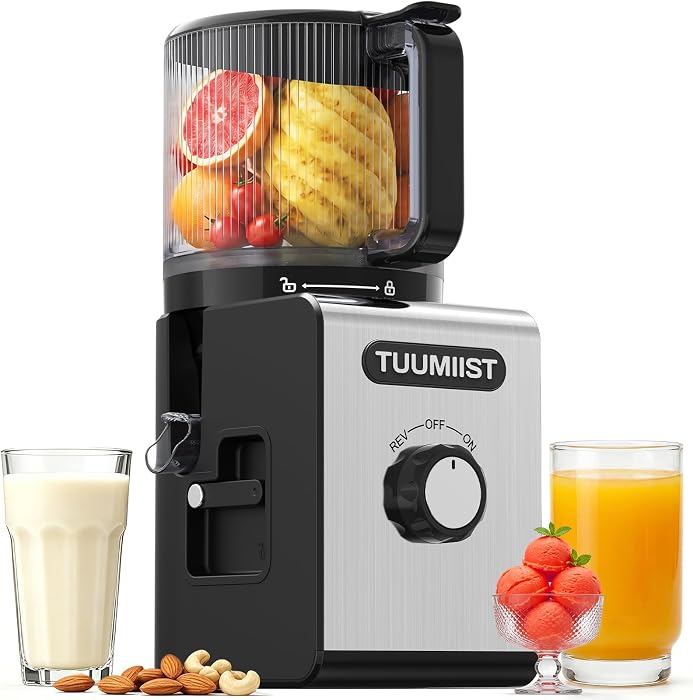
Load it and walk away is the pitch here. The 3-liter hopper takes a whole recipe of greens, fruit, and ginger at once, and the auger works through it while you get on with something else. Greens make that genuinely useful, since leaves are bulky and slow to feed by hand, though the same hopper makes this the widest machine in the guide at 13 inches.

There is no mesh screen to scrub. One strainer handles juice, nut milk, and sorbet, so the parts count is lower than most of the machines here, the rinse is quicker, and everything removable is dishwasher safe. At 60 RPM with a 350-watt motor it runs at the slow end, which is where greens want to be.

Where we hesitate is the plastic that snaps together. The handle and the locking collar are the parts to treat gently, because a cracked fitting is what ends a juicer's life, not the motor. Seat the chamber squarely, do not force the lock, and the hopper is worth the counter space it takes.

Worth Noting

  • Handle and locking parts need gentle handling
  • 13-inch width needs real counter space
Our Verdict

We put the TUUMIIST in for hands-free batch loading, with the caveat that the plastic fittings need careful handling.

Check Latest Price
6

VMIXBLE Cold Press Juicer Best for Lightweight Everyday Juicing

VMIXBLE Cold Press Juicer – Juicer Machines

Lightweight everyday juicing

Our Score 81/100
Speed
57 RPM
Filter
Metal-free
Weight
3.7 lb
Feed Chute
5.8 inches
View on Amazon

At 3.7 pounds, the VMIXBLE is the lightest machine we recommend, and in a category where most of these run seven or eight, that changes how the appliance lives in your kitchen. It comes out of a cabinet with one hand and goes back the same way, which is most of what decides whether a juicer gets used on a Wednesday.

It is also one of the few here without a mesh screen. The filter is metal-free, so it rinses instead of trapping fiber in a thousand little holes, and the 5.8-inch chute takes whole fruit. At 57 RPM with a 300-watt motor it presses slowly enough to keep the juice from heating up, and the parts are dishwasher safe.

The one quirk is the locking sequence. The chamber and lid have to be lined up with the arrows matched before the machine will run, and forcing it is where trouble starts. Do that one thing right and this is a sensible budget machine for greens and fruit both.

Worth Noting

  • Chamber must be aligned exactly before it starts
Our Verdict

At 3.7 pounds, the VMIXBLE is the machine we suggest for anyone who stores a juicer in a cabinet and wants a metal-free filter.

Check Latest Price
7

Pukomc Cold Press Juicer Best for Preset-Guided Juicing

Pukomc Cold Press Juicer with Smart Display and Brushless Motor

Preset-guided juicing

Our Score 80/100
Power
300 watts
Presets
Four modes
Cleaning
Dishwasher safe
Feed Chute
5.3 inches
View on Amazon

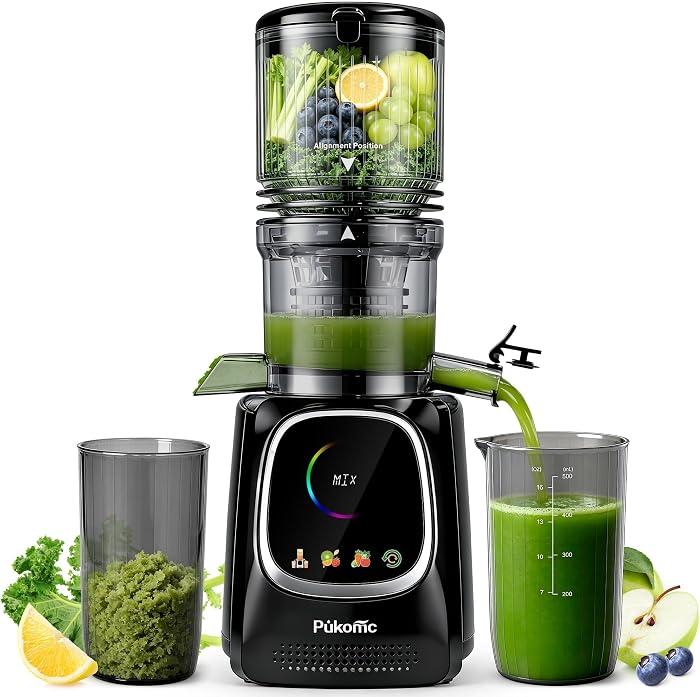
Where every other machine here gives you a switch and a reverse button, the Pukomc gives you a color touch panel with four preset modes. Whether that is a small luxury or a complication depends on the cook.

The hardware underneath is ordinary in a good way: a 5.3-inch chute, a 300-watt brushless motor that keeps the noise down, and removable parts that go in the dishwasher. Nothing here needs a manual to understand once it is assembled, which is not something every juicer in this guide can claim.

It is a tidy machine head-on at 7.64 inches wide, and the control panel wipes clean with a damp cloth — worth knowing, since wet hands and touchscreens are a poor combination. The 300 watts go through a slow auger, so greens get pressed rather than shredded.

We treat it as the pick for someone who likes a guided interface: the presets take the guesswork out of moving between soft fruit and dense roots. The caution is the collar. The chamber has to be seated exactly before the machine will start, and forcing it is where one of these can get damaged.

Worth Noting

  • 15.51-inch depth needs clearance behind it
  • Chamber must be seated exactly to start
Our Verdict

For presets rather than guesswork, we point to the Pukomc, though you should verify the counter depth before ordering.

Check Latest Price

How We Tested Juicers for Leafy Greens

We started with spec sheets and a stack of customer reviews, filtering toward slow masticating machines with fine screens, since centrifugal juicers tend to fling greens straight into the pulp bin. From there we cut the list by how the parts came apart and by price relative to yield and cleanup time — a cheap machine that throws a third of your kale in the waste bucket isn't cheap. Then we bought 12 and put them on our own counters.

Each one got at least a week as the only juicer in the kitchen: a fast morning glass before work with kale, spinach, half a cucumber, and a knob of ginger, plus a bigger Sunday batch with celery, parsley, and whatever was wilting in the drawer. We also fed whole apples and beets through every chute to see whether the wide-mouth claims held up.

We weighed produce in and juice out, then squeezed the spent pulp in a paper towel to see how much water the machine had left behind. For clogging, we ran greens for five straight minutes and watched the screen and the flow rather than stopping to scrape. After each session we broke every machine down, counted the parts, and washed them by hand, noting where pulp hid in the mesh.

Noise got measured at counter distance while a colleague took a call in the next room. We handed each machine to someone who hadn't read the manual and watched where they hesitated. Extra modes — nut milk, sorbet, reverse — got one honest run each, since a setting that doesn't work is one you paid for. Then we just kept using them, watching for cracks in the housing, staining on clear plastic, a motor that smelled hot, and an auger that started to wobble.

How to Choose a Juicer for Leafy Greens

Put the Auger First and the Wattage Second

Centrifugal juicers spin a shredder basket at thousands of RPM. Leaves hit the mesh, get flung outward, and give up very little juice, with foam from the first second. A single-auger cold-press machine turns at roughly 55 to 60 RPM and presses the fiber instead, which is why every pick here is one.

The wattage race is a distraction. Our top pick runs a 300-watt motor and one of our favorites here is 150 watts, and both handle kale better than a high-powered spinning basket does. Shop by mechanism first, then by chute size and how the filter cleans.

What a Wide Chute Actually Buys You

Chute width is sold as a time-saver, and for apples, oranges, and beets it is: a 6-inch opening takes fruit whole. Greens benefit far less. Leaves go in by the handful no matter how wide the opening is, and packing a chute tight with kale is one way to stall the auger.

If leaves are most of what you juice, weight the filter design and the cleanup above the chute number. If you also push through a lot of apples and carrots every morning, the wide chute earns its keep and the prep saved is real.

Cleaning Is the Daily Cost

Every session ends with a filter, a chamber, a pulp cup, and a juice cup, and the filter is where greens leave a mat of fiber that has to come off. Mesh screens catch the most and take longest; toothed and metal-free filters rinse faster, and anything dishwasher safe saves you five minutes a day.

Before you commit, count the removable parts and be honest about whether you'll hand-wash them. The Fretta is hand wash only, and that is a real commitment at eight in the morning.

Capacity, Noise, and Where It Lives

Greens are bulky and low-yield, so capacity is really a question about how often you want to stop. A 24-ounce jug suits one person; a 1-liter container or a 3-liter hopper suits a household or a weekly prep session.

Noise follows the mechanism — slow augers hum, fast baskets scream — and weight matters too, because a light machine can creep across the counter. Then measure the counter, not just the width: these machines run 5 to 15.5 inches deep, and the narrowest one still needs clearance behind it.

Warranty and the Parts That Break

The motor is rarely what fails first in this category. The plastic collar, handle, or lid latch that has to line up before every session is. Read what the coverage actually includes and how long it runs: the Godspeeds carries 10 years, while several machines here carry one.

Whatever you buy, seat the chamber squarely and never force a lock. That habit is worth more than an extra year of coverage.

Frequently Asked Questions

Final Verdict

If you're juicing greens most mornings, buy the Godspeeds Smoothpress. It presses kale and spinach at 58 RPM without the mid-batch teardown, the filter rinses under the tap, and the 10-year warranty is the longest coverage in this group.

If one session should fill a liter, the Fretta's container and auto-stop lid are worth the premium. If the counter is the constraint, the Ninja fits in just over seven inches.