Best Bread Machines for Whole Wheat Bread

Whole wheat is where a bread machine earns its keep, and where most of them stumble. Whole-grain flour drinks more water than white and needs a longer, slower rise, so a machine built around a white-bread schedule will hand you a squat, crumbly brick. What you want is one that gives the dough time to hydrate and a pan that lets the loaf drop out clean.

I've baked whole wheat sandwich loaves for years, mostly with mediocre results, so I had opinions going in. Over the past seven months, my team and I ran 11 machines through their whole wheat programs, judging crust and crumb, how clear the instructions were, how loud the knead cycle ran, and how much scrubbing the pan needed afterward. Two things stood out: pan material matters more than menu count, and a good ceramic or nonstick pan will do more for your success rate than a gluten-free setting you'll use twice.

The picks below run from compact one-pound machines to two-pound workhorses with delay timers that have a loaf ready when you wake up, and the ones that rose the highest were also the easiest to live with day to day.

Our Top Picks

The 5 Best Bread Machines for Whole Wheat Bread

1

Zojirushi Virtuoso Plus Best Overall

Zojirushi Bb PDC20BA Virtuoso Plus 2 Lb Breadmaker

Whole-wheat reliability

Our Score 94/100
Heating
Dual bottom and lid
Item Weight
24 lb
Loaf Capacity
2 lb
Whole Wheat Cycles
Whole Wheat and Rapid Whole Wheat
View on Amazon

The number that matters on the Zojirushi Virtuoso Plus is 2 hours 25 minutes: that's the rapid whole-wheat cycle, and it turns a whole-grain loaf from a weekend project into a weeknight possibility. We put that preset at the top of the list because whole wheat is the loaf that separates a good bread machine from a basic one. The bran needs a longer knead and a slower rise than white flour, and a cycle that rushes those steps usually shows up as a squat, gummy loaf. Zojirushi gives you both a standard whole-wheat course and a rapid one, so you can choose patience or dinner.

The hardware backs up the menu. Two kneading blades work the dough from opposite sides, and heaters in the base and lid send heat from both directions. That matters for a dense whole-wheat loaf: the top crust gets a chance to brown instead of staying pale while the bottom overbakes. We also appreciate the 13-hour delay and the key-code display, which make a 7 a.m. loaf feel less like a chemistry exam.

What you get is the most complete whole-wheat package here: dedicated cycles, even heat, and a loaf that behaves the same way twice. The included recipe book is a starting point, not the final word. A digital scale is the upgrade that makes whole wheat repeatable, and it matters more here than another preset.

Worth Noting

  • Heavy 24-pound body takes two hands
  • Premium price for occasional bakers
Our Verdict

We choose the Zojirushi for anyone who makes whole-wheat bread often and wants the long knead and even browning handled without fuss; it is the most complete package here.

Check Latest Price
2

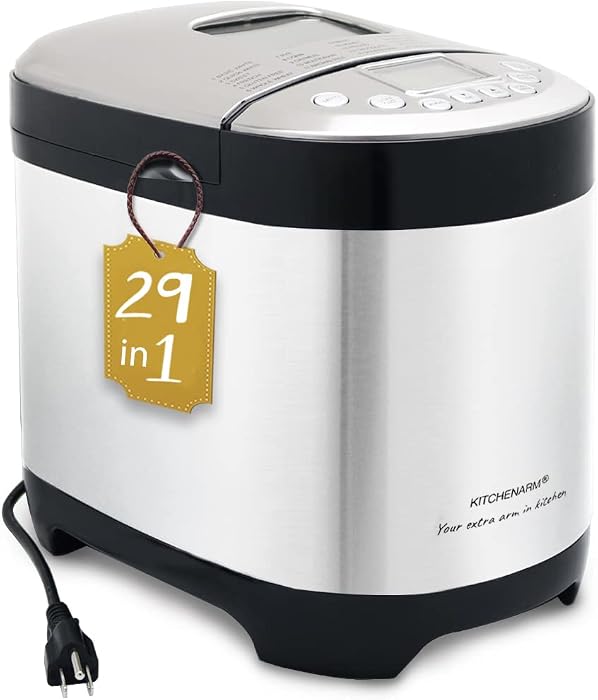
KITCHENARM 29-in-1 Best for Custom Programs

KITCHENARM 29-in-1 SMART Bread Machine with Gluten Free Setting 2LB 1.5LB 1LB

Custom whole-wheat schedules

Our Score 93/100
Programs
29
Warranty
2 years
Custom Menus
4
Loaf Capacity
2 lb
View on Amazon

Four custom menus is the number that stands out on the KitchenArm 29-in-1, and for whole wheat it is more useful than another preset. Whole-grain dough is sensitive to time and temperature; if you find a schedule that gives your flour enough hydration and rise, you can save it instead of starting from zero every time. The machine also carries a dedicated whole-wheat setting, so you have a reliable starting point before you customize.

The rest of the package is built for repetition. There are 29 programs, three loaf sizes from 1 to 2 pounds, and a one-press memory that keeps your last menu, size, and crust choice. The manual and recipe collection are stronger than the ones that come with the KBS or VEVOR; we like that a first loaf does not require a separate bread book. A two-year warranty is unusually generous here, and the stainless body wipes down without much fuss.

The ceiling is capacity. At 2 pounds, this is a household machine, not a bakery one; a family that finishes a loaf a day may want more. What it does deliver is control. If you already know you want a 50% whole-wheat sandwich loaf and a 100% whole-grain seeded loaf, the custom slots make that pair easy to keep. The display seam can collect a little flour, so wipe it before it packs in.

Worth Noting

  • Two-pound maximum limits very large households
Our Verdict

The KitchenArm is our pick for bakers who want to save their own whole-wheat schedules; four custom menus, clear recipes, and a two-year warranty make it the most flexible machine here.

Check Latest Price
3

KBS Pro 710W Best for Add-Ins

KBS Pro 710W 2.2LB Bread Maker

Seeded whole-wheat loaves

Our Score 90/100
Pan
Ceramic
Add-Ins
Automatic nut dispenser
Programs
17 plus 1 custom
Loaf Capacity
2 lb
View on Amazon

A whole-wheat loaf with sunflower seeds and walnuts is a different proposition from a plain sandwich loaf, and the KBS Pro's automatic nut dispenser is the reason it earns a spot here. Load the hopper, choose your program, and the machine drops the add-ins at the right moment instead of relying on you to hear a beep from the next room. For seeded whole wheat, that is a small convenience that changes the result: the nuts stay whole instead of turning into paste.

The rest of the package is generous. It has 17 automatic programs plus a custom setting, a two-pound capacity, a ceramic pan, and a 710-watt motor. The ceramic surface releases a dense whole-wheat loaf cleanly, and the included 53-recipe book gives you plenty of starting points. We also like the 15-hour delay and keep-warm for mornings when the loaf needs to wait for you.

The paddle is the one part that asks for attention; it can need a firm pull, and the included hook is the right tool. Otherwise the KBS Pro is a comfortable machine to live with. The ceramic pan, the timer, and the dispenser all earn their counter space, and the two-pound loaf is a sensible size for a family that eats toast and sandwiches. The recipe book is worth keeping nearby, but a scale is the better upgrade for whole wheat.

Worth Noting

  • Manual is hard to follow
  • Ceramic coating can chip over time
Our Verdict

We reach for the KBS Pro when whole wheat gets loaded with seeds and nuts; its automatic dispenser and ceramic pan make add-ins easier, and the two-pound loaf suits most families.

Check Latest Price
4

OSIPOTO 17-in-1 Best Budget

OSIPOTO 17-in-1 – 2LB Bread Maker

Budget first loaves

Our Score 89/100
Power
600 watts
Programs
17
Delay Timer
15 hours
Loaf Capacity
2 lb
View on Amazon

The OSIPOTO is the least expensive two-pound machine in this group, and it does not read like a stripped-down appliance. You get 17 programs, a 2-pound loaf, a 600-watt motor, a 15-hour delay, keep-warm, and a stainless body. The whole-wheat setting is there, and the 17-program menu covers basic loaves and cake as well. For a first machine, that is a sensible feature set without a lot of menu clutter.

We point budget-minded whole-wheat bakers here because the basics are right. The controls are simple, the nonstick pan wipes out easily, and the machine is light enough to move when the counter needs to be cleared. The loaf results are strong for the money, and the 15-hour timer makes it easy to fit bread into a workday.

The trade-off is longevity. This is not the machine to choose if you plan to bake every day and expect a decade of service; it is the one to choose if you want to learn whole wheat without spending a lot. The 2-pound capacity fits a small household, and the keep-warm function is a nice buffer if dinner runs late. We like it most as a first step, not as the last machine you will own.

Worth Noting

  • Recipe book and manual are inconsistent
Our Verdict

We point budget-minded bakers to the OSIPOTO for a simple 2-pound whole-wheat loaf; 17 programs, easy controls, and a low price cover the basics without extra fuss.

Check Latest Price
5

VEVOR 15-in-1 Best for Large Family Batches

VEVOR Bread Maker

Large family batches

Our Score 82/100
Pan
Ceramic
Power
950 watts
Programs
15
Loaf Capacity
3 lb
View on Amazon

Three pounds is the number that makes the VEVOR worth a look. That is a very large loaf for a countertop machine, and the ceramic pan is a welcome upgrade from basic nonstick. The 15 menus include whole wheat, and the 950-watt motor gives it enough muscle for a full batch. For a big household that goes through bread quickly, the capacity is the point.

The useful extras are here too: a 15-hour delay, a one-hour keep-warm, and an add-in reminder that tells you when to drop in seeds or nuts. The ceramic pan wipes clean without a fight, and the controls are simple once you are past the first loaf.

Where it lands is simple: this is a big-batch value machine, not a precision instrument. The 3-pound capacity is a poor fit for a couple who wants a small loaf, but for a family that goes through a loaf in two days, it earns its footprint. The add-in reminder is the detail we appreciate most; it takes the guesswork out of seeded whole wheat.

Worth Noting

  • Manual is hard to follow
Our Verdict

The VEVOR earns our nod for large households that want a 3-pound ceramic-pan loaf on a budget; its whole-wheat menu and add-in reminder cover the basics.

Check Latest Price

How We Tested the Best Bread Machines for Whole Wheat

We started with machines that advertise a dedicated whole wheat program rather than a white-bread cycle you're told to fudge, then narrowed by pan material, available loaf sizes, delay timer length, and price so the shortlist covered budget models and buy-it-once ones alike. That left 11 machines, from 1-pound compacts to 2.2-pound pans.

Each one lived on a real kitchen counter for at least three weeks. We baked the same 100 percent whole wheat sandwich loaf in every machine, weighing the flour and water rather than scooping, and repeated it on a Sunday morning and again on a weeknight after work. We also set each delay timer to finish a loaf at 6:30 a.m. to see whether it came out proofed or collapsed.

During the knead we stood nearby with a decibel app and noted whether we could hear the machine from the next room. We felt the dough by hand after the first rise, then judged the finished loaf on whether the top domed or caved, whether it sliced without crumbling, and how the crumb held up on day three.

Cleaning came last: we let the pan cool, washed it as the manual directed, and checked whether crust stuck in the corners or the paddle released cleanly. We read every instruction booklet as if we'd never baked before, flagged steps that made no sense, and logged which menus we never touched. Seven months in, the machines with flimsier paddles and gearboxes had already started to show it.

How to Choose a Bread Machine for Whole Wheat

Put the Whole-Wheat Cycle First

Whole wheat is not just white bread with darker flour. The bran cuts through gluten and absorbs water slowly, so the dough needs a longer knead and a more patient rise. A bread maker with a dedicated whole-wheat program is the simplest insurance; a custom program is the next best thing because it lets you save a schedule once you find one that works. We do not rely on a basic or express setting for 100% whole wheat unless the recipe was written for it. A rapid whole-wheat cycle can be useful on a weeknight—the Zojirushi lists one at 2 hours 25 minutes—but expect a denser loaf than the standard cycle gives you.

Size the Loaf and the Footprint

Two pounds is the sweet spot for most households, producing a loaf that feeds four to six without taking over the counter. Three-pound machines suit bigger families or serious toast-and-sandwich weeks, but they are harder to store and less forgiving if you bake only occasionally. Measure the spot before you buy: the Zojirushi is 18 inches wide, while the KitchenArm is about 9 inches across at the body. Capacity on the box is maximum dough, not a promise that every recipe will fill it.

Pan, Paddle, and Cleanup

Whole-wheat dough is stickier than white, so the pan and paddle matter more than they do in a basic bread machine. A ceramic or good nonstick coating makes release easier, but ceramic can chip if you pry at the paddle with metal. Look for a removable paddle and a machine that alerts you when to take it out; that saves the hole in the bottom of the loaf. We hand-wash the pan, because coating life depends on gentle care.

Controls That Earn Their Space

After the first few loaves, the features that matter are the ones that fit your routine. A 13- to 15-hour delay lets you load the pan at night, and a keep-warm cycle buys you time if dinner slips. Saved settings are underrated: the KitchenArm's one-press memory means you are not re-entering the same loaf size and crust every time. We also look for a clear display and a pause button; both make it easier to check the dough without guessing which menu you are in.

Read the Manual Before You Buy

Bread machine manuals are where good hardware goes to feel complicated. Whole-wheat recipes are especially sensitive to cup-versus-gram measurements, so a clear book and a machine that saves settings can matter more than an extra menu. Check the warranty length and whether the paddle and pan are replaceable; those are the parts that wear first. If the manual is hard to follow, plan on a digital scale and a trusted recipe from the start. That is not a workaround we resent; it is the routine that makes whole wheat repeatable.

Frequently Asked Questions

Final Verdict

For most homes, the Zojirushi Virtuoso Plus is the whole-wheat machine we recommend. Its dedicated whole wheat and rapid whole wheat cycles, dual heaters, and double kneading give you the best shot at a loaf that rises evenly and browns on top, and the 13-hour timer fits the machine into a real routine.

If you want to build and save your own schedules, the KitchenArm's four custom menus are the better fit. If the budget is the deciding factor, the OSIPOTO gets you a two-pound whole-wheat loaf for less, with the VEVOR as the large-batch alternative.