Best 2 Lb Bread Machines of 2026

The real fear with a bread machine isn't that it won't bake bread — it's that you'll use it three times and then spend the next decade storing it beside the waffle iron. I've been there. A machine that eats a foot of counter space and a shelf of flour has to earn its keep on a Tuesday night, not just on a snow day. That's why a dependable delay timer, a pan that gives up the loaf without a fight, and a manual you can follow half-asleep matter more than a program count in the double digits.

We've had 12 machines on our counters over the past six months, and the ones worth keeping share a few habits. They let you pick a 1-, 1.5-, or 2-pound loaf so you're not baking more than the household eats, and their add-in dispensers drop nuts and raisins at the right moment instead of stirring them into the first mix. Most of the extra programs go untouched — a solid white cycle, a real whole-wheat cycle, and a gluten-free setting that doesn't produce a brick will cover nearly everything you bake.

The machines below survived dozens of loaves apiece, and the picks are organized around how you'll actually use one — overnight loaves, everyday sandwich bread, and the occasional weekend project.

Our Top Picks

The 5 Best 2 Lb Bread Machines of 2026

1

KitchenArm 29-in-1 Bread Machine Best Overall
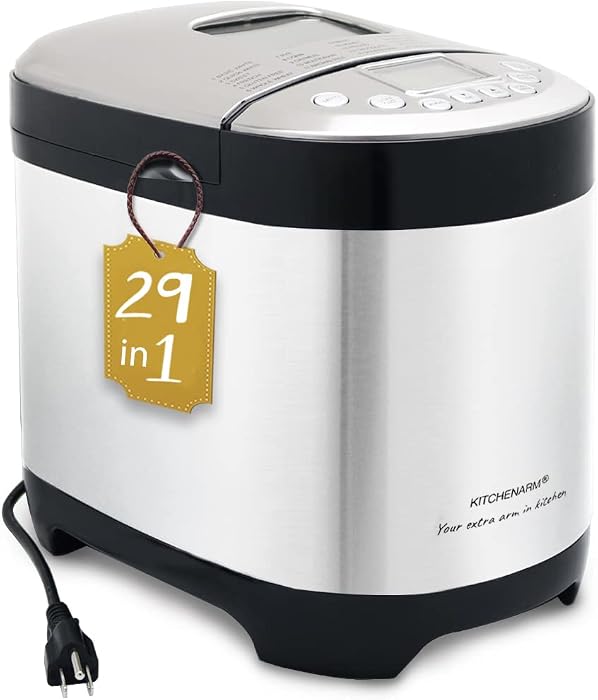
KITCHENARM 29-in-1 SMART Bread Machine with Gluten Free Setting 2LB 1.5LB 1LB

Family loaves

Our Score 93/100
Weight
9.6 lb
Capacity
2 lb
Programs
29
Warranty
2 years
View on Amazon

The 29-program count sounds like overkill until you see how KitchenArm uses it: four homemade cycles you can program yourself, plus one-press memory that returns to your last loaf size, crust color, and menu. That is the detail that makes this machine the best default here. You can dial in a repeat loaf without re-entering anything, and the 2-pound capacity gives a family a useful sandwich loaf without forcing you into a bakery-sized pan.

The rest of the package supports that role. The 550-watt motor is not the most powerful in this group, but the stainless body, ETL certification, and two-year warranty are the kind of practical backup we want in a machine that will sit on the counter for years. The recipe book is unusually thorough, and the controls are readable enough that a first-time baker can follow the menu flow without a cheat sheet. We also appreciate how easy the nonstick pan is to wipe out after a bake.

The menu list can look daunting at first, though the saved settings quickly make it feel simpler. What keeps it at the top is the combination of recipe support, repeatable settings, and a warranty that backs up the price. For a household that wants one machine to handle white bread, whole wheat, dough, and the occasional experiment, this is the one we reach for first.

Worth Noting

  • Deep footprint for a narrow machine
Our Verdict

We recommend the KitchenArm 29-in-1 for families who want one machine to handle repeat loaves, dough, and gluten-free baking without relearning the controls.

Check Latest Price
2

KBS Pro Bread Maker Best for Large Loaves

KBS Pro 710W 2.2LB Bread Maker

Large loaves

Our Score 89/100
Weight
14.7 lb
Capacity
2 lb
Programs
17
Pan Material
Ceramic
View on Amazon

The automatic nut dispenser is the first thing we notice on the KBS Pro, and it is more than a gimmick. Load raisins, walnuts, or seeds at the start and the machine drops them in at the second knead, so you are not standing over the bread waiting for a beep. Add the 710-watt motor, ceramic pan, and 17 programs, and this is the machine for a baker who wants a bigger loaf with more built-in help.

We think it earns its place as the large-loaf pick because it brings the extras that make repeat baking easier: a custom program, a 15-hour delay, and a keep-warm cycle that holds the loaf until breakfast. The touch panel is clean and the stainless body looks at home on an open counter. The ceramic pan is a nice upgrade over plain nonstick and wipes clean without a fight.

If you want a machine that can handle a crowd-sized loaf and add-ins without babysitting, the KBS Pro makes a strong case. The automatic dispenser is the detail that makes it feel more expensive than it is: add nuts or raisins at the start and get an evenly studded loaf without opening the lid.

Worth Noting

  • Instructions are hard to follow
  • Heavy at 14.7 pounds
Our Verdict

The KBS Pro is the pick for bakers who want a bigger loaf and automatic add-ins, as long as they can live with a heavy machine and a clumsy manual.

Check Latest Price
3

Cuisinart CBK-210NAS Bread Maker Best for Artisan Bread

Cuisinart Convection 2 Lb. Programmable Bread Maker Machine

Artisan bread

Our Score 88/100
Wattage
800 watts
Capacity
2 lb
Programs
16
Delay Timer
13 hours
View on Amazon

Convection is the reason to look at the CBK-210NAS. The fan circulates air during baking, which helps the crust brown more evenly and gives the loaf a little more bakery-style finish than a standard heating element. The 800-watt element and 16 programs back that up, including a sourdough starter cycle and a gluten-free setting. We think this is the artisan-leaning pick in this group.

The automatic mix-in dispenser holds up to three-quarters of a cup and drops fruit or nuts at the second knead, while the edge-to-edge glass top lets you watch the rise without opening the lid. The removable paddle and included hook are welcome when you want a cleaner slice, and the 13-hour delay gives you fresh bread on a schedule. The three-year warranty is the cushion.

For a baker who cares about crust, sourdough starter, and add-ins, the convection fan is the feature that makes the extra outlay feel purposeful. It is the machine we point to when the bread itself matters more than having the longest menu list.

Worth Noting

  • Premium price
  • Small pan can limit loaf shape
Our Verdict

We recommend the Cuisinart CBK-210NAS for bakers who care about crust and sourdough enough to pay a premium for convection and a mix-in dispenser.

Check Latest Price
4

OSIPOTO BM8205 Bread Maker Best Value

OSIPOTO BM8205 Bread Maker – 2LB Bread Maker

Value baking

Our Score 87/100
Weight
11.7 lb
Capacity
2 lb
Programs
17
Delay Timer
15 hours
View on Amazon

Stainless steel at a value price is the OSIPOTO's calling card. The 17-program panel covers the usual white, whole wheat, French, and dough cycles, plus cake and jam settings, and the 600-watt motor is enough for a 2-pound loaf. The 15-hour delay and keep-warm function make it a practical weekday machine rather than a weekend project.

We think it is the value pick because it gives you a stainless body, a readable LCD, and a useful set of presets without the premium mark-up. The nonstick pan wipes out easily, and the included measuring cup, spoon, and hook mean you can bake the first loaf without hunting for extras. The recipe book is the weak link; use a trusted bread-machine recipe and the results are more predictable. If you want a simple stainless machine that looks more expensive than it is, this is the one we point to.

Worth Noting

  • Durability is inconsistent
  • Hand wash only
Our Verdict

The OSIPOTO BM8205 is our value pick for shoppers who want a stainless machine with a useful preset list, a delay timer, and easy cleanup.

Check Latest Price
5

Hamilton Beach 29987 Bread Maker Best for Fast Loaves

Hamilton Beach Digital Bread Maker Machine With Delay Start

Fast loaves

Our Score 85/100
Capacity
2 lb
Programs
14
Express Cycles
1, 1.5, and 2 lb
Dishwasher-Safe Pan
Yes
View on Amazon

The 29987 is the Hamilton Beach model to look at if speed matters. It has express cycles for 1-, 1.5-, and 2-pound loaves, plus the usual basic, French, whole grain, gluten-free, sweet, dough, cake, jam, and artisan dough settings. The delay start is there for overnight bread, and the nonstick pan and paddle are dishwasher-safe.

The controls are simple enough to set without the manual, and the countdown timer is easy to glance at. The machine is light for its size at 9.3 pounds, so it is not a burden to move from a cabinet to the counter. We appreciate that the 2-pound express cycle exists at all; it makes this a better fit for a weeknight than machines that only offer a standard three-hour bake.

For a simple, lightweight machine with fast cycles and a delay start, the 29987 is still worth a look. It is the one we point to when you want bread sooner and do not need a dozen artisan programs.

Worth Noting

  • Display is hard to read
  • Baking results can be uneven
Our Verdict

The Hamilton Beach 29987 is worth a look if fast express cycles and a simple, lightweight machine matter more to you than a crisp display.

Check Latest Price

How We Picked and Tested These Bread Machines

We started with the specs, then read the manuals before anything got plugged in, because a badly written manual is the number-one reason a bread machine ends up in the basement. We narrowed the field to machines that could bake a full 2-pound loaf, offered smaller size settings for everyday use, and didn't bury the basic white cycle three menus deep. That left 12 machines, which we ran for six months.

Most of the testing happened in ordinary kitchens. We loaded pans at night and checked at 6 a.m. whether the loaf had risen on schedule and browned, ran the same whole-wheat recipe in every machine for comparison, and baked fruit-and-nut bread to see whether the dispenser opened when it should or dumped raisins into the first mix. We measured noise with a phone app from three feet away — a machine that kneads at 5:30 in the morning has to be tolerable in an apartment — and watched how the motors handled stiff whole-wheat dough without stalling. We also handed each manual to someone who'd never owned a bread machine and timed how long a basic loaf took them to set up.

Cleaning had its own routine: we let each pan cool as directed, rinsed it, and noted whether the crust slid out whole or needed soaking, and whether dough had worked into the paddle seal. Each machine baked at least 20 loaves, which is long enough to catch a slipping paddle or a loosening lid hinge. At the end we costed out the flour per loaf against each machine's price and counted how many of those programs we'd actually used twice.

How to Choose a 2 Lb Bread Machine

Start With Loaf Size and Pan Shape

Two pounds is a capacity, not a guarantee of a wide sandwich loaf. Vertical pans produce a taller, narrower loaf, while horizontal pans give you slices that fit a toaster more naturally. Look for 1-, 1.5-, and 2-pound settings if your household changes size, and check the pan dimensions if you expect a broad 2-pound loaf. A compact machine can still bake a 2-pound loaf, but it may do it in a taller shape. We prefer a pan that matches the slices you actually eat over a capacity number that looks good on the box.

Match Programs to the Bread You Bake

Program counts run from a dozen to nearly thirty, but most households use a handful: basic, whole wheat, gluten-free, dough, and maybe cake or jam. More programs help only when the labels are clear and the machine saves your last settings. A delay timer and keep-warm cycle matter more for weekday baking than an extra preset you never touch. If you bake fruit or nut breads, look for an automatic dispenser or an audible add-in beep. The KitchenArm's saved one-press settings are a good example of a small convenience that earns its keep; the KBS Pro's dispenser is the feature to pay for if add-ins are routine.

Think About the Pan, Paddle, and Cleanup

Nonstick is standard, but ceramic and PFAS-free coatings are selling points for some buyers. A removable pan and paddle make cleanup much easier, and a dishwasher-safe pan is a real convenience if you bake often. Check whether the paddle can be removed before the final rise; that reduces the hole in the bottom of the loaf and makes slicing cleaner. We also look for a pan that releases without a soak. A coating that needs delicate handling can erase the convenience of a bread machine, so choose the cleanup routine you will actually keep up with.

Plan for Noise, Footprint, and Durability

Bread machines knead with a thump, and some move across the counter while they work. A stable base and a machine that sits solidly matter more than a decibel rating. Measure both width and depth, because a narrow machine can still be deep. Durability is the weak spot across this category, so a clear warranty and available replacement pans or paddles are worth more than an extra preset. Keep the receipt, register the warranty, and place the machine on a dry, stable counter with clearance for the vents. We treat a longer warranty as a practical feature, not a throwaway line.

Frequently Asked Questions

Final Verdict

For most families, the KitchenArm 29-in-1 is the one to buy. It has the strongest combination of programs, recipe support, and a two-year warranty, and its saved settings make repeat loaves feel effortless. If you want a bigger loaf and automatic add-ins, the KBS Pro is the step up; for crust and sourdough, the Cuisinart CBK-210NAS is worth the premium. The OSIPOTO is the value alternative when the budget is tighter.