Best Bread Machines for Dough of 2026

Bread machines are sold on a smell: warm yeast drifting out of the kitchen on a Sunday morning while you do nothing. The catch is that the machine has to earn it — kneading a stiff whole wheat dough without stalling, holding temperature while it proofs, and baking a loaf you'd actually slice for a sandwich. What you're buying is a machine that takes the guesswork out of bread, not the bread itself.

I baked a lot of bad loaves to find the good ones. Over eight months, my team and I ran 12 bread machines through weekday sandwich loaves, whole wheat, a gluten-free run, and dough-only cycles for pizza and cinnamon rolls. We listened for motors that groan through heavy dough, measured the footprint on a counter that already holds a coffee maker, and read every manual to see whether the recipes matched the pan.

One thing first-time buyers get backwards: the preset count matters less than the delay-start timer, which is what lets you sleep through the whole process and wake up to bread. The picks below are the ones that got the basics right.

Our Top Picks

The 7 Best Bread Machines for Dough of 2026

1

KITCHENARM 29-in-1 Bread Machine Best Overall
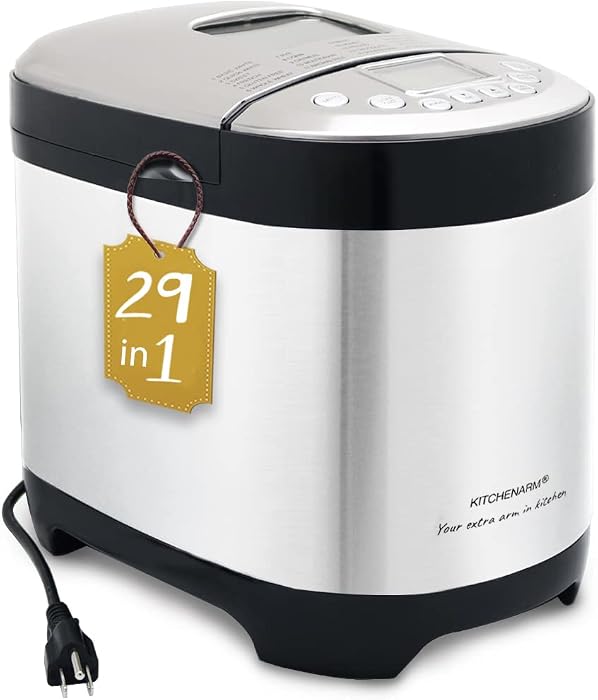
KITCHENARM 29-in-1 SMART Bread Machine with Gluten Free Setting 2LB 1.5LB 1LB

Dough-first bakers

Our Score 93/100
Programs
29
Warranty
2 years
Dimensions
14.2"D x 8.9"W x 12"H
Loaf Sizes
1, 1.5, 2 lb
View on Amazon

Twenty-nine programs is the number on the box, and it is the wrong thing to shop by. What earns this machine its place is the HOME MADE menu: four slots you program stage by stage, saving your own knead and rest times alongside loaf size and crust. That is the whole game with dough. A wet ciabatta and a stiff bagel dough do not want the same handling, and here you set the schedule instead of hunting for the closest preset and hoping.

That programmability is why we recommend it as the default for anyone whose machine will spend most of its life on dough, and why the 29 presets do not feel like clutter — the extras sit on top of a machine that will do what you tell it. Loaf sizes run 1, 1.5, and 2 pounds, and the settings you used last are still there when you come back, which matters when the same pizza dough happens every Friday.

It is a sensible shape for a counter, too: 8.9 inches wide, 12 tall, 9.6 pounds, narrow enough to slot beside the refrigerator. The manual is the best in this group — a real book, with recipes that read as if someone made them more than once and sourdough starter instructions for the people who want them — and it carries a two-year warranty and ETL certification. The pan and paddle are hand wash only, which is the one chore it adds to the routine.

Worth Noting

  • Display edges let flour dust in
Our Verdict

We recommend it without hesitation to anyone whose machine will mostly make dough: you can program the knead and rest times instead of settling for the nearest preset.

Check Latest Price
2

Cuisinart Compact Bread Maker Best for Small Kitchens

Cuisinart Compact 2 Lb. Automatic Programmable Bread Maker

Small kitchens

Our Score 90/100
Programs
12
Warranty
3 years
Dimensions
10.25"D x 13.25"W x 11.25"H
Loaf Sizes
1, 1.5, 2 lb
View on Amazon

Thirteen and a quarter inches wide and eleven and a quarter tall, at roughly eleven pounds: this is the compact one, and if your kitchen has exactly one clear stretch of counter, it is the machine we point you to. It tucks under a cabinet, comes out for a bake, and goes back without a wrestling match. Twelve programs cover white, French, whole wheat, sweet, gluten-free, jam, and cake, plus the two that matter here — a standard Dough and an Artisan Dough for a slower rise.

The paddle-removal alert is the detail we have come to appreciate most. It sounds before the final rise, so you can lift the paddle out and skip the hole in the bottom of the loaf, which changes how the bread slices and how it toasts. There is also a 13-hour delay, a 60-minute keep warm, three crust shades, a viewing window, and a three-year warranty — the longest stated coverage in this group.

Longevity is the open question. Failures inside the first year do turn up on this model, which is why that warranty earns its keep rather than sitting in the fine print, and why buying it somewhere with a generous return window is worth the trouble. In exchange you get the easiest machine here to live with in a small kitchen.

Worth Noting

  • Loud add-in beeps you cannot silence
Our Verdict

When counter space is the deciding constraint, this is the machine: a real artisan dough cycle, a three-year warranty, and a body you can put away in a cupboard.

Check Latest Price
3

Hamilton Beach Digital Bread Maker Best for Easy Cleanup

Hamilton Beach Digital Bread Maker Machine With Delay Start

Frequent dough batches

Our Score 89/100
Weight
9.3 lb
Programs
14
Loaf Sizes
1, 1.5, 2 lb
Pan And Paddle
Dishwasher-safe
View on Amazon

The pan and the paddle go in the dishwasher. That sounds like a line item until you have spent a Sunday digging dried dough out of a paddle's center hole, at which point it is the feature that decides the purchase. Of the machines here, only this one and the Elite Gourmet are rated for the dishwasher, and this is the one with dough settings worth using twice a week.

Fourteen settings, and the two that matter are Dough and Artisan Dough. The express cycles for 1-, 1.5-, and 2-pound loaves skip the long rise, so they will not help a pizza night, but they make the machine a reasonable one-appliance answer if you bake more than dough. Three loaf sizes, three crust shades, a gluten-free setting, jam, cake, and a delay start round it out.

The controls are the other quiet win: three steps, a clear walk through the settings, and no submenu to get lost in, which is more than we can say for a couple of the panels here. In a week of ordinary use it is the machine nobody has to think about, and the 1-pound setting is the one we reach for most — the 2-pound loaf is bigger than it sounds.

Worth Noting

  • Front panel has failed on some units
Our Verdict

Scrubbing is the part of bread making nobody budgets for, and this machine cuts it to a rinse: a dishwasher-safe pan and paddle, both dough settings, and a body light enough to lift with one hand.

Check Latest Price
4

OSIPOTO 17-in-1 Bread Maker Best Value

OSIPOTO 17-in-1 Bread Maker – 2LB Bread Maker

Value seekers

Our Score 88/100
Wattage
600 watts
Capacity
2 lb
Programs
17
Dimensions
13.78"D x 11.42"W x 10.04"H
View on Amazon

It sits between the budget machines and our top pick on price, and it gives up less than that gap suggests: 600 watts, a stainless body, 17 programs, and a nonstick pan that wipes out in a single pass. The 2-pound capacity matches most of this group, and the box includes a hook, measuring cup and spoon, stirring rod, and a recipe book.

Value, to us, is what a machine does per dollar rather than the lowest number in the row, and this is the one that made the case. Dough comes out cooperative and evenly kneaded — sandwich dough and a wet pizza dough both went in and came out ready to shape — and the pan releases cleanly enough that cleanup is a rinse rather than a soak. A 15-hour delay and a keep-warm function are there if you also bake loaves.

The weak spot is the paperwork. The recipes that ship with it are thin and the manual assumes you have made bread before, so plan on your own formulas or a bread-machine cookbook and give yourself a few bakes to dial in the hydration. Everything else about it behaves like a machine from a tier above.

Worth Noting

  • Pan and paddle are hand wash only
Our Verdict

The best balance of price and performance here: it kneads dough as well as machines that cost noticeably more, and the nonstick pan rinses clean in seconds.

Check Latest Price
5

Amazon Basics Programmable Bread Maker Best for First-Time Buyers

Amazon Basics Programmable Bread Maker

First-time buyers

Our Score 87/100
Weight
7.6 lb
Wattage
550 watts
Capacity
2 lb
Programs
14
View on Amazon

Set it on a smooth countertop and it travels. Kneading shakes this one across the surface, and it has gone off the edge; a rubber mat underneath or a few inches of clearance from the front fixes it, and it is the first thing we mention to anyone who buys one. At 7.6 pounds it is also the lightest machine here apart from the Elite Gourmet, easy to move and just as easy to knock.

Fourteen settings cover breads, doughs, gluten-free, and jam, with ExpressBake cutting a loaf to under 90 minutes and three crust shades to pick from. The dough setting is what most households will live in, and it does the job: it mixes and kneads, then hands the dough back for shaping and baking in your own oven. There is no dispenser and no programmable cycle, and at this price that is the right trade.

We rank it below the OSIPOTO because the two land in the same price neighborhood and the OSIPOTO is the better-built machine, but this is one of the two least expensive ways into a real dough cycle, and for a first machine or a second one for pizza night that is a fair trade. The manual is the other soft spot — thin on technique and thinner on recipes — so line up a cookbook and a scale before the first bake.

Worth Noting

  • Short working life on some units
Our Verdict

For a first machine or a pizza-night second, this does the core job for about as little money as anything here — put a mat under it and keep it off the counter edge.

Check Latest Price
6

Elite Gourmet 19-Preset Bread Maker Best for Occasional Bakers

Elite Gourmet 2 Lb Automatic Bread Maker

Occasional bakers

Our Score 86/100
Pan
Ceramic, dishwasher-safe
Weight
4.9 lb
Programs
19
Loaf Sizes
1, 1.5, 2 lb
View on Amazon

A ceramic pan and a 4.9-pound body are the two facts that make this one interesting. The CERALAST lining releases dough cleanly and is rated for the dishwasher, and the whole machine weighs less than half what the VEVOR does, so it comes out of a cabinet with one hand. Nineteen presets make it the most program-rich machine here short of the KITCHENARM, with pizza dough, gluten-free, rye, French, sweet, quick bread, cake, and jam on the list.

The 15-hour delay and 60-minute keep warm match what the others offer, and three loaf sizes and three crust shades cover the basics. Where it stumbles is the paperwork: the included recipes are inconsistent and the manual assumes more than a first-time baker brings to it, so budget for a scale and a bread-machine cookbook rather than judging the machine on its own pizza dough recipe.

The 1-pound setting is the one we kept coming back to for a two-person household, and the machine is compact enough — 9.45 inches deep — to live on the counter in a small kitchen. Go in knowing that the 2-pound setting is the ceiling rather than the norm, and that the interior finish discolors with steady use, so it will look older than it is long before anything goes wrong.

As a first machine, or a second one for pizza night, the case is easy: it is the least expensive way here to get a ceramic pan that goes in the dishwasher, and it weighs almost nothing. Buy it to learn on rather than to hand down.

Worth Noting

  • Some units quit inside the first few months
Our Verdict

The lightest, least expensive route to a ceramic pan with a pizza dough setting — a fine starter machine, provided you go in expecting to replace it sooner than the others.

Check Latest Price
7

VEVOR 15-Menu Bread Maker Best for Large Batches

VEVOR 15-Menu Bread Maker

Large batches

Our Score 82/100
Weight
12.6 lb
Wattage
950 watts
Capacity
3 lb
Programs
15
View on Amazon

Three pounds is the biggest loaf in this roundup, and it is the only reason you need to look here: a full pan of stiff dough for a household that goes through a loaf every other day, backed by the strongest motor in the group at 950 watts. At 12.6 pounds and 16.1 inches deep it is also the largest machine here, and that is the trade — the capacity comes with a footprint that wants a genuinely deep counter.

Fifteen menus, a food-grade ceramic pot, a delay that runs to 15 hours, a one-hour keep warm, and an add-in reminder that sounds when it is time for nuts or raisins. We were struck by how much difference the ceramic pot makes: dough releases cleanly and the pot wipes out with a sponge. The delay and keep-warm functions are aimed at baked loaves rather than dough, which is worth knowing if dough is all you make.

What holds it back is the documentation. The directions read as though they were translated twice, and beginners have a hard time getting a first loaf out of it without help, so a bread-machine cookbook and a scale are not optional here. Combine that with the depth of the thing and you have a machine for someone who already knows what they are doing and needs more capacity than anything else here offers.

Worth Noting

  • Manual is tough going for beginners
  • 16.1-inch depth needs a deep counter
Our Verdict

Buy it when capacity is the requirement: it is the only 3-pound machine here, the motor is the strongest, and the ceramic pot is the easiest to clean.

Check Latest Price

How We Tested the Best Bread Machines

To build the shortlist, we started with the specs that change how a machine bakes — loaf size options, pan material, crust shade settings, and whether it ran a dedicated gluten-free or dough-only cycle — then cut anything with a pan too small for a 2-pound loaf or controls that needed the manual to decode. That left 12 machines, which we ran for eight months in home kitchens rather than on a bench. Every one went through the same rotation so the comparisons would hold.

Weekday nights we loaded the delay-start timer before bed and checked whether we woke up to a properly risen, fully baked loaf or a collapsed one. Saturdays were sandwich loaves and whole wheat, where we judged the rise, the crumb, and whether the crust shade setting changed anything you could taste; we also ran a gluten-free loaf in every machine that claimed the cycle, since that is where thin pans and uneven heating show up. Fridays were dough-only cycles for pizza and cinnamon rolls, which is where a weak motor announces itself — the ball never comes together, or the machine walks toward the edge of the counter.

Between bakes we tracked durability: scratches in the nonstick after a dozen washes, a paddle that got harder to pull out, a lid latch that loosened. We measured footprint and the headroom the lid needs under a cabinet, stood in the next room during the knead to hear how much noise carried, and cooked from each machine's own recipe book to see whether the ratios produced dough or soup. Because these all sit in a similar price band, value came down to what's in the box — a usable recipe book, a measuring cup that matches the pan, a paddle you can remove without burning your fingers.

How to Choose a Bread Machine for Dough

Start With the Dough Cycle, Not the Menu Count

Twenty-nine presets do not make a machine better at dough; one programmable cycle does. Every machine here can knead, but they are not equivalent. A basic dough cycle works a fixed schedule, an artisan dough cycle stretches the rise for slower fermentation, and programmable cycles let you rewrite the stages yourself — the KITCHENARM's four custom menus are the only ones here that go that far.

If you make one dough and you like it, a fixed cycle is fine. If you are chasing a wet, open crumb or a long, cold fermentation, pay for the programming, because otherwise you will spend your time working around the preset instead of with it.

Match the Loaf Size and the Footprint to Your Kitchen

Loaf settings run 1, 1.5, and 2 pounds, and 2 pounds is a genuinely large loaf — more than two people finish before it stales, so a 1.5-pound default saves flour. Height is the measurement people forget: most of these stand 11 to 12 inches tall, and a machine whose lid will not open under your upper cabinets ends up in a closet or on the floor.

Weight decides whether it lives on the counter or comes out for a bake. The 4.9-pound Elite Gourmet moves with one hand; the 12.6-pound VEVOR does not.

Plan for Noise, and for a Machine That Moves

Kneading is loud, and it goes on longer than most people expect — a dough cycle is a long stretch of intermittent grinding rather than a hum. Vibration is the bigger surprise. On a smooth countertop the Amazon Basics works its way toward the edge, and heavier machines do the same thing more slowly.

Put a rubber mat or a folded towel underneath, leave a few inches of clearance on every side, and keep the machine out of the path between the refrigerator and the sink.

Weigh the Pan, the Paddle, and the Washing Up

You will clean this bread maker dozens of times a year, so the pan matters as much as the motor. Nonstick wipes out, ceramic releases dough more easily still, and either one turns into a chore once the coating starts to wear. Check two things before you buy: whether the pan and paddle are rated for the dishwasher — the Hamilton Beach and Elite Gourmet are, the rest say hand wash — and whether the paddle can come out before the final rise.

That last detail is the one people underrate. A removable paddle means no hole in the bottom of the loaf and no slicing around a metal stub.

Read the Recipe Book Before You Trust the Machine

The included manual decides how your first month goes, and it is where cheaper machines cut corners. The KITCHENARM's book has tested recipes and sourdough starter instructions; the VEVOR's directions defeat beginners. If the book that arrives is thin, buy a bread-machine-specific cookbook rather than adapting a hand-kneaded recipe, because pan size, hydration, and rise times all change.

Budget for a digital scale as well. Machine formulas assume weighed flour, and a cup of flour varies a lot depending on how you scoop it.

Frequently Asked Questions

Final Verdict

For dough, the KITCHENARM is the machine we point to first: it is the only one here that lets you set your own knead and rest times, and its manual is good enough to teach you why that matters. That combination is what a dough-first baker actually needs, and nothing else in this group offers it.

If the counter is the constraint, the Cuisinart Compact delivers a real artisan dough cycle in a body you can put away, and it carries the longest warranty here — which matters, because bread machines are appliances that fail. If you want to spend as little as possible on a machine that kneads properly, the Elite Gourmet will do it, as long as you treat it as a starter rather than a keeper.